Brands
Maruti Suzuki offers Electronic Stability Program+ as standard in Alto K10 and S-Presso
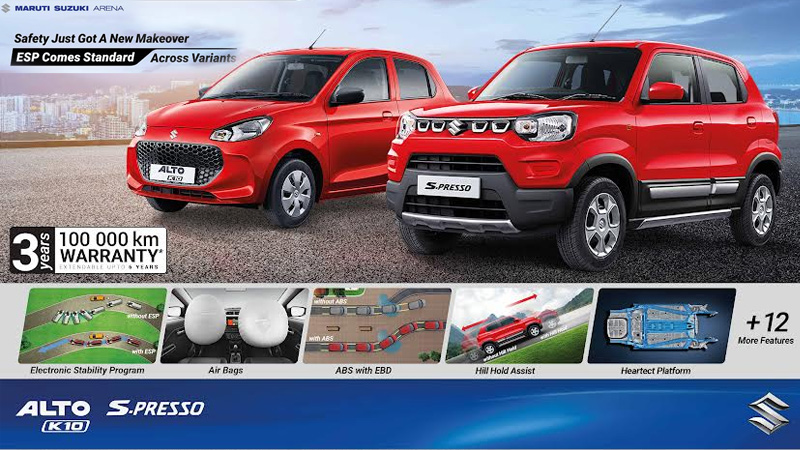
Mumbai: In its commitment towards passenger safety, Maruti Suzuki India Ltd (MSIL), today, announced that the Electronic Stability Program+ (ESP) will now be available across its entire passenger vehicle product portfolio*. The Alto K10 and S-Presso are the latest models to be equipped with ESP, making this crucial safety technology a standard feature across all Maruti Suzuki cars. Notably, the Company has added ESP on these models without a price increment, underscoring its attention to addressing the evolving needs of customers.
Equipping all its cars with ESP reflects Maruti Suzuki’s endeavour to democratize advanced features, delivering an exceptional value proposition to customers alongside a safer, more confident driving experience.
Commenting on this, Maruti Suzuki India Ltd, senior executive officer, of marketing & sales Partho Banerjee said, “The addition of Electronic Stability Program+ as a standard feature on Maruti Suzuki product portfolio* aligns with our endeavour to democratize advanced features and it significantly increases the value proposition of our vehicles. This is a step towards ensuring that our customers enjoy enhanced safety through improved driving confidence regardless of the model they choose. At Maruti Suzuki, we believe that advanced technology should be accessible to all, and this reinforces our commitment to delivering high-quality vehicles that cater to the diverse needs of Indian consumers.”
In addition to ESP, the standard safety suite on the Maruti Suzuki portfolio includes dual front airbags, ABS with EBD, reverse parking sensors, engine immobiliser, HEARTECT Platform, collapsible steering column, etc.
How does Electronic Stability Program+ work:
The Electronic Stability Program+ system counteracts a vehicle’s skidding movements, ensuring it remains in line with its natural path of motion. The ESP system, integrating the Anti-lock Braking System (ABS), Traction Control System (TCS), and Stability Control (SC), utilizes a range of sensors to measure the vehicle’s movement. This data is then processed by an electronic control unit to calculate and adjust the vehicle’s trajectory, enhancing stability and control.

Brands
Godrej clarifies ‘GI’ identifier after logo similarity debate
Says GI is not a logo, will not replace Godrej signature across products.
MUMBAI: In a branding storm where shapes did the talking, Godrej is now spelling things out. Godrej Industries Group (GIG) has issued a clarification on its newly introduced ‘GI’ identifier, addressing questions around its purpose and design following a wave of online criticism. At the centre of the debate were two concerns: whether the new mark replaces the long-standing Godrej logo, and whether its geometric design mirrors other corporate identities.
The company has drawn a clear line. The Godrej signature logo, it said, remains unchanged and continues to be the sole logo across all consumer-facing products and services. The ‘GI’ mark, by contrast, is not a logo but a corporate group identifier intended for use alongside the Godrej signature or company name, and aimed at stakeholders such as investors, media and talent rather than consumers.
The need for such a distinction stems from the 2024 restructuring of the broader Godrej Group into two separate business entities. With both continuing to operate under the same Godrej name and signature, the identifier is positioned as a way to differentiate the Godrej Industries Group at a corporate level.
The rollout, however, triggered a broader conversation on design originality. Critics pointed to similarities between the GI mark’s geometric composition and logos used by companies globally, raising questions about distinctiveness.
Responding to this, GIG said its intellectual property and legal review found that such overlaps are common in minimalist, geometry-led design systems. Basic forms such as circles and rectangles appear across dozens of brand identities worldwide, the company noted.
It added that the identifier emerged from an extensive design process and was chosen for its simplicity, allowing it to sit alongside the Godrej signature without competing visually. While acknowledging that elemental shapes may appear less distinctive in isolation, the group emphasised that the mark is part of a broader identity system that includes a custom typeface, sonic branding and other proprietary elements.
Following legal and ethical assessments, the company said it found no impediment to using the identifier, reiterating that the GI mark is a corporate tool not a consumer-facing symbol.
In short, the logo isn’t changing but the conversation around it certainly has.