Brands
Life insurance sector sees falling advocacy and rising passives: Hansa Research report
Axis Max Life, Kotak lead NPS as passive customers pose growth risk


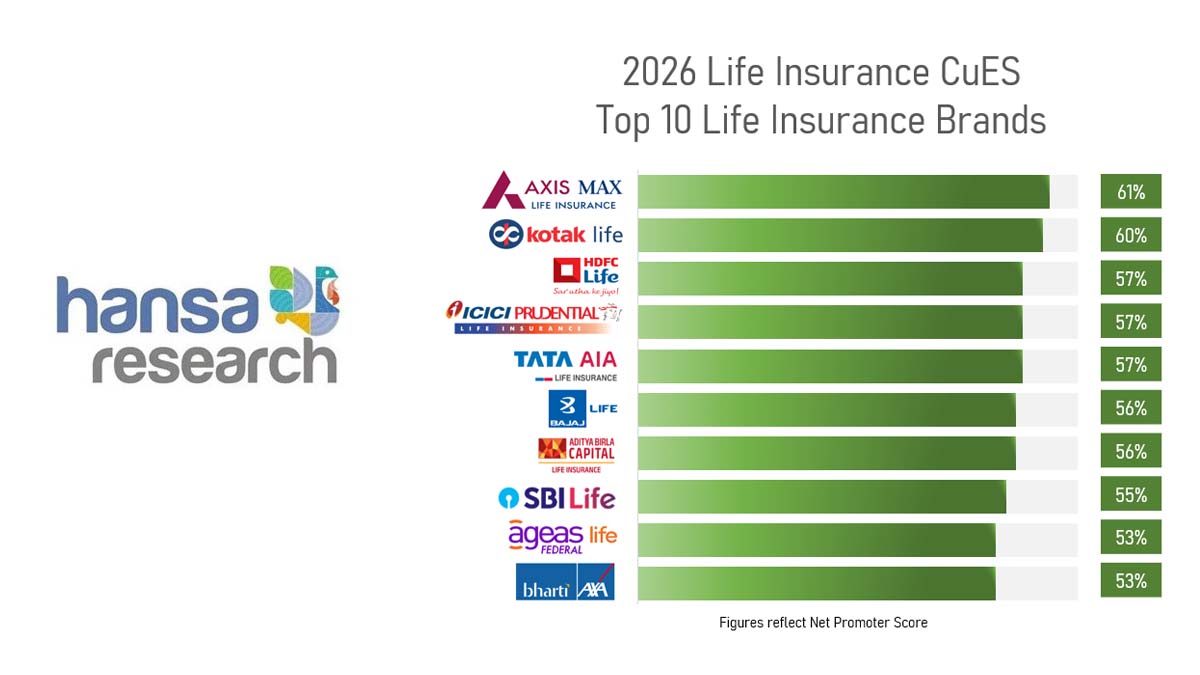
MUMBAI: Hansa Research’s latest Life Insurance CuES 2026 flags a growing challenge for India’s life insurers: delivering customer delight, not just satisfaction.
While overall experience scores have remained steady, the report points to what it calls a “delight dilution” trend, where insurers are struggling to convert consistent service into strong customer advocacy. Nearly 30 percent of customers now fall into the ‘passive’ category, signalling a potential engagement gap that could impact long-term loyalty.
Based on feedback from over 3,500 customers across 12 insurers, the study highlights how rising expectations, limited brand differentiation and a lack of standout experiences are flattening customer enthusiasm.
At the top of the rankings, Axis Max Life Insurance leads with a Net Promoter Score of 61, followed closely by Kotak Life Insurance at 60. HDFC Life, ICICI Prudential Life Insurance and Tata AIA Life Insurance share the third spot, while Life Insurance Corporation of India recorded the sharpest decline in advocacy, with its score dropping 10 points year-on-year.
Explaining the shift, Hansa Research CEO Praveen Nijhara said, “Most life insurance companies have improved operational performance, but experience delivery has now stabilised. Brands are blending, reducing their ability to stand out and limiting true customer delight.”
The report also underscores structural challenges, particularly in the agency channel, which continues to dominate distribution but is increasingly seen as an “engagement bottleneck”. Interactions often peak at purchase, with limited follow-up, weakening long-term brand connection.
Adding to this complexity is a shift in customer expectations, especially among younger segments. Hansa Research CX executive vice president Piyali Chatterjee said, “Gen Z is emerging as the most demanding segment, expecting seamless, transparent and self-directed experiences. One-size-fits-all strategies will no longer work.”
The findings also reveal that digital capabilities are no longer a differentiator but a baseline expectation, while premium customers are demanding more personalised and proactive engagement.
As insurers navigate this evolving landscape, the message is clear: consistency alone will not cut it. Turning satisfaction into advocacy will require sharper segmentation, deeper engagement and experiences that truly resonate.