Digital
Karnataka Bank’s 100-Year journey unraveled through the phygital experience center powered by DaveAI
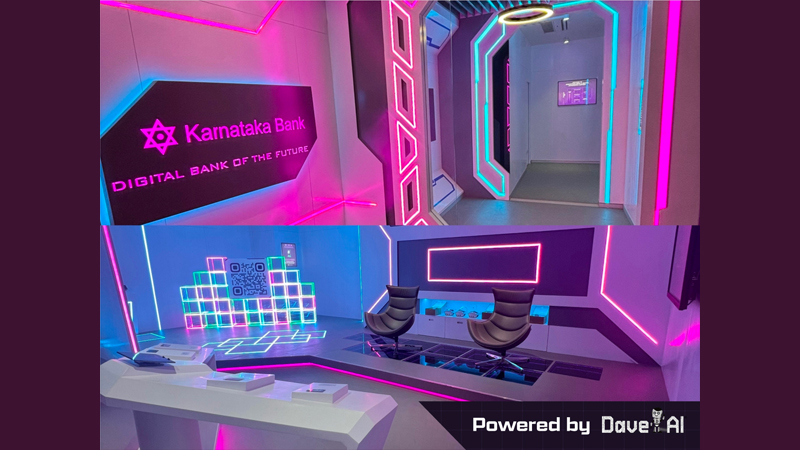
Mumbai: In celebration of Karnataka Bank’s remarkable century-long journey, a visionary Phygital Experience Center emerges as a beacon of innovation, inviting audiences to embark on an immersive exploration of the bank’s past, present, and future. Developed in collaboration with DaveAI, the leading AI-powered experience creators platform sets a new standard in customer engagement and showcases Karnataka Bank’s unwavering commitment to pioneering technologies.
The Phygital Experience Center, inaugurated by the Deputy Chief Minister of Karnataka – D. K. Shivakumar, promises a transformative encounter that seamlessly merges the physical and digital realms. By transcending conventional celebratory formats, Karnataka Bank aims to offer patrons a dynamic space where they can delve into the institution’s rich heritage while envisioning its trajectory in the digital age.
At the core of this innovative venture lies DaveAI’s proprietary visual synthesis pipeline, meticulously integrated into captivating narratives, gesture-controlled experiences, and immersive simulations. Visitors were greeted by virtual avatars, could take part in virtual reality tours, and engage with augmented reality experiences, all curated to provide an unparalleled glimpse into Karnataka Bank’s evolution over the past century and its vision for the future of banking.
“When Karnataka Bank celebrated their centenary year, one of their most important questions was, what do they need to do so that their legacy continues for another 100 years. They turned to us to ideate on what is possible in the future of banking. Together we came up with a very futuristic experience center with great ideas to showcase what they are already doing as well as what they would plan to do.
Concepts such as, Metaverse, Virtual Branches, Autonomous banking with the help of AI etc. were experienced by 100s of people from their staff and family as well as other dignitaries. Everyone was wowed by Karnataka Bank’s vision as well as their management’s commitment towards making it reality in the near future,” said Dr. Ananth, CTO & Co-Founder at DaveAI.
The highlights of this Digital Bank of the Future included:
1. Gesture-Controlled Experiences: A journey through the bank’s 100-year legacy, featuring a virtual avatar narrating key milestones and achievements, setting the stage for an enlightening exploration.
2. Virtual Reality Tour: Visitors could step into a VR pod for a 360-degree tour of the futuristic digital banking unit, experiencing firsthand the fusion of tradition and technology that defines Karnataka Bank’s future.
3. Innovation Showcase: A dynamic zone showcasing the bank’s innovative initiatives, featuring interactive kiosks and augmented reality-powered card discovery, designed to engage and educate visitors on Karnataka Bank’s diverse range of products and services.
Commenting on the launch, Karnataka Bank CDMO Pankaj Gupta expressed excitement saying, “It is a proud moment for Karnataka Bank as we seamlessly blend tradition with the boundless possibilities of the future. Our Digital Experience Center stands as a testament to this fusion, exuding beauty and innovation in every corner. Now, our mission extends beyond mere admiration within our experience center; it’s about bringing these immersive experiences to the doorsteps of all our customers, enriching their lives both within the confines of their homes and beyond.”

Digital
Google partners with Adani and Airtel to build India’s largest AI data centre
The three-campus complex, built with Adani and Airtel, is India’s largest-ever technology infrastructure investment
Visakhapatnam: Google has broken ground on what it is billing as India’s largest-ever technology infrastructure project: a gigawatt-scale artificial intelligence hub in Visakhapatnam, Andhra Pradesh, built in partnership with AdaniConneX and Nxtra by Airtel. The ceremony at Tarluvada on 28th April marked the start of construction on a three-campus data centre complex that sits at the heart of a $15 billion investment Google has committed to deploying across India between 2026 and 2030.
The numbers are staggering by any measure. Nearly 1 gigawatt of compute capacity at a single location, three data centre campuses, a fibre-optic expansion under the America-India Connect initiative, and a long-term clean energy strategy designed to feed new renewable supply into the national grid. Google says the project will help India hit its target of 500 gigawatts of non-fossil fuel capacity by 2030 while delivering the high-performance, low-latency infrastructure that businesses need to build and scale AI-powered services.
The groundbreaking drew a formidable gathering of political and corporate India. Union minister for information technology Ashwini Vaishnaw, Andhra Pradesh chief minister N. Chandrababu Naidu and state IT minister Nara Lokesh attended alongside Google Cloud chief executive Thomas Kurian, Adani Group directors Karan Adani and Jeet Adani, and Bharti Enterprises vice chairman Rakesh Mittal.
Vaishnaw framed the project in terms of national ambition. “The India AI hub and three subsea cables landing in Visakhapatnam will become very important infrastructure for the country’s journey forward,” he said, adding his thanks to Google for its “continued trust in India.” Naidu was equally bullish, describing Andhra Pradesh as “India’s premier investment destination” and the Vizag hub as a cornerstone of the state’s technology corridor. “Our vision goes beyond attracting investment,” he said. “We want local talent, startups, and enterprises to become active partners in this technology-driven growth story.”
Kurian called the groundbreaking “a powerful realization of our shared vision with the Indian government, and an inflection point for the country’s AI-native future.” Jeet Adani was characteristically direct: “When energy becomes more affordable and increasingly powered by clean sources, intelligence becomes more accessible, and that is how India will lead the next phase of digital growth.” Gopal Vittal, executive vice chairman of Bharti Airtel, said the full stack of data centres, green power, pan-India fibre and a next-generation cable landing station would enable “large-scale, world-class AI infrastructure in Vizag.”
The project was first announced in October 2025. AdaniConneX and Nxtra by Airtel will lead construction of the data centre buildings and connecting infrastructure, with Google deploying its AI capabilities on top.
Beyond the hardware, Google has announced a substantial package of community programmes. On water, it is partnering with Sponge Collaborative on a watershed management plan linking coastal ecosystem restoration with clean drinking water systems, including reverse osmosis plants and Water ATMs, for local residents. On livelihoods, a tie-up with the Sambhav Foundation will equip more than 1,000 fisherfolk with GPS navigation, weather-forecasting tools, cold-chain management training and UPI-based financial literacy. The Google Udaan India Fund, run through ChangeX, will provide direct grants to local schools and social enterprises for AI skilling labs and digital literacy programmes. The NARI Shakti programme, developed with the Learning Links Foundation, will support more than 10,000 women entrepreneurs from low-income backgrounds in building micro-enterprises. The Skills Trade and Readiness programme will prepare more than 1,000 local workers for construction, welding and facility operations roles, while a parallel tie-up with ICT Academy will train more than 1,200 students and educators in cloud computing and generative AI.
The groundbreaking was accompanied by the Bharat AI Shakti Conclave, a conference organised with the Andhra Pradesh government and Nara Lokesh, bringing together suppliers, industry partners and infrastructure firms to map how Google’s anchor investment can be turned into a broader economic value chain for the region. The conclave’s central theme was building an AI industrial corridor, with a local-first procurement approach and the integration of regional small and medium enterprises into Google’s global operational frameworks.
Every major technology company in the world has been courting India. What sets Vizag apart is the sheer scale of the commitment and the deliberate effort to build an industrial ecosystem around it rather than simply plant servers in a field. Google is not just betting on India’s digital future; it is trying to build the factory floor on which that future gets made. Whether the $15 billion translates into genuine local opportunity, or merely into an impressive data centre humming quietly on the Andhra Pradesh coast, will depend on whether those community programmes prove as durable as the hardware. The groundbreaking, as ever, is the easy part.