Brands
JioStar’s ‘jersey wahi toh jazba wahi’ breaks gender norms, champions ‘Women in Blue’

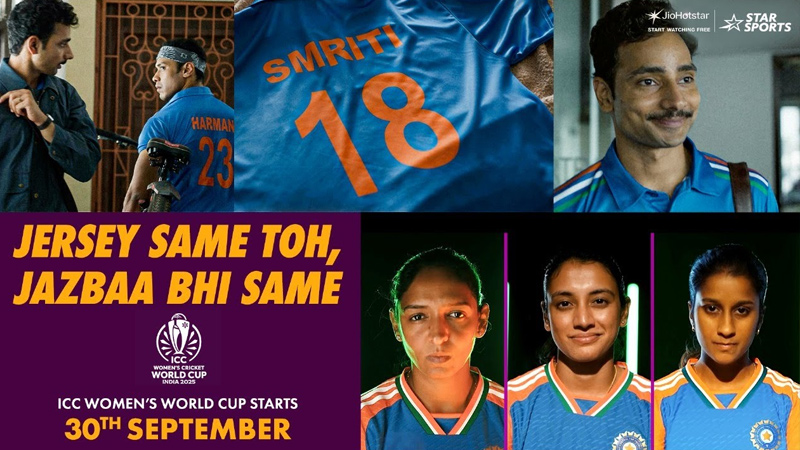
MUMBAI: JioStar’s new women’s WC ’25 campaign film opens with the protagonist asking his partner a slightly awkward question, “But is it necessary to wear the women’s jersey?” after she suggests he put one on for a match screening at a friend’s place. His partner, exasperated by the lingering stigma, looks on in dismay, pitying the shame that still surrounds supporting women in cricket. Undeterred, he steps out the door wearing the jersey, hiding it beneath a jacket.
On his way, he notices fellow Indians proudly donning women cricketers’ jerseys, from colleagues to even the office lift operator, who delivers the knockout line, “Virat khelein ya Smriti, jeetega toh India hi na” (whether it’s Virat or Smriti, India will win anyway). The moment sparks pride as the protagonist ditches the jacket and walks into the office with his Smriti Mandhana jersey proudly on display.

With the ICC women’s cricket world cup India 2025 just around the corner, JioStar’s “Jersey Wahi Toh Jazba Wahi” (conceptualised by Bubblewrap Films) celebrates the unifying power of the India jersey. It sends a clear message: no gender norms can diminish the pride of wearing blue, and the joy of support far outweighs the question, “Who watches women’s cricket anyway?”
JioStar, head of viewership and monetisation initiative – sports, Siddharth Sharma said, “This tournament is more than cricket. It is about rewriting history and inspiring a generation. Our endeavour is to channel this moment into a campaign that unites the country, reminding fans to take equal pride in every Indian jersey.”
The ICC women’s cricket world cup 2025, hosted across India and Sri Lanka, kicks off on 30 September in Guwahati with India facing co-host Sri Lanka. With matches lined up against Pakistan, Australia, England and others, the women in blue are chasing a trophy that has long eluded them.
With the roar of home crowds and the momentum of this campaign, JioStar aims to capture a cultural shift: cricket pride is not about gender, it is about the jersey and every fan who wears it.





Brands
Devyani International names Sandeep Anand, Robinder Singh in key roles
Pizza Hut and Costa Coffee businesses see leadership refresh from April

MUMBAI: Devyani International has strengthened its senior leadership bench with a fresh set of appointments across its key brands, Pizza Hut and Costa Coffee, signalling a sharper focus on growth and brand momentum.
The company has appointed Sandeep Anand as chief marketing officer and business head for Pizza Hut. His appointment, approved by the board via a circular resolution on April 3, follows a recommendation by the Nomination and Remuneration Committee, as reported by CNBC-TV18. Anand will officially step into the role on April 6, 2026.
He takes over from Vijay Gogate, who currently serves as chief executive officer for Pizza Hut within the company’s operations. The move marks a strategic transition as the brand looks to sharpen its marketing and business playbook in a competitive quick service restaurant market.
Anand brings over two decades of experience across the food and FMCG sectors, with a strong track record in brand building and innovation. His career spans roles at major consumer-facing companies including Domino’s, Zydus Wellness, Zomato, GSK Consumer Healthcare, Reckitt and Ranbaxy, giving him a well-rounded perspective on both scale and agility.
Alongside this, Robinder Singh has been appointed business head for Costa Coffee and the company’s airport operations. He too will assume his new role on April 6, bringing more than 18 years of experience in operations, business expansion and customer experience transformation.
The twin appointments come at a time when Devyani International is doubling down on leadership depth to steer its portfolio through evolving consumer preferences and heightened competition. With fresh faces at the helm of two key verticals, the company appears set to brew up its next phase of growth with renewed energy.






