Brands
India Brand Summit panel says AI must work with human intelligence
Marketers stress creativity, consumer insight and execution as AI reshapes brand building


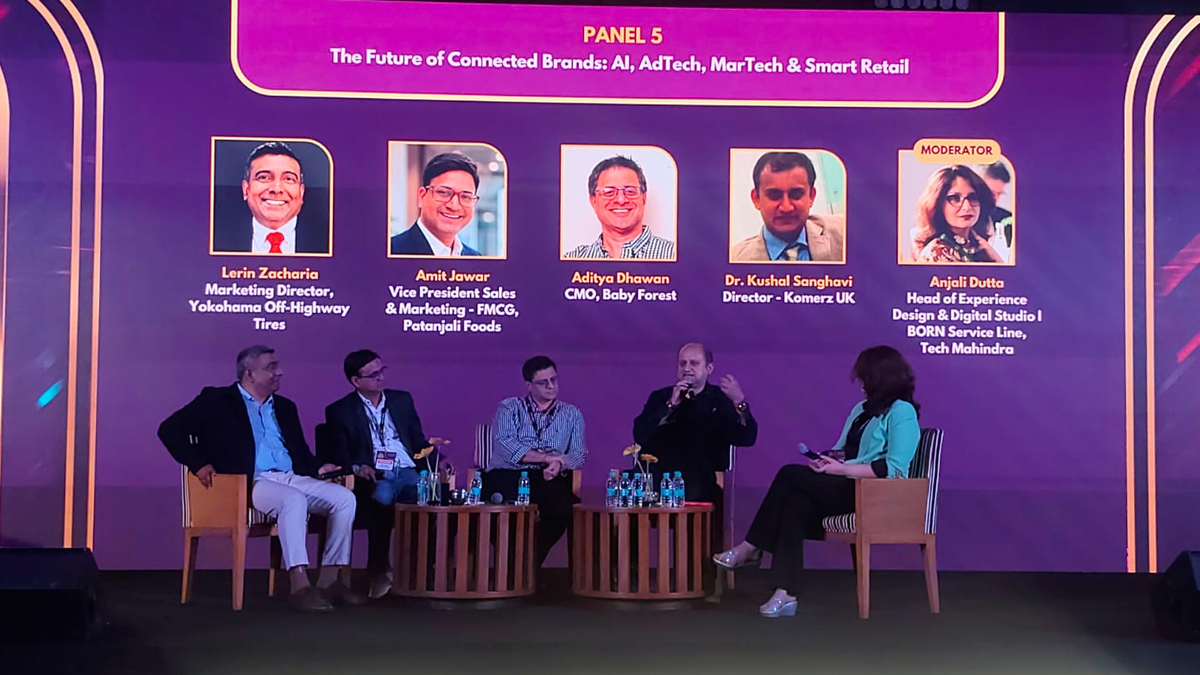
MUMBAI: Artificial intelligence may have the answers, but marketers still need to ask the right questions. At the India Brand Summit 2026, presented by IndianMedia.Biz, industry leaders argued that while AI, AdTech and MarTech are changing how brands understand and reach consumers, technology alone cannot decode the complexities of human behaviour. The real advantage, they suggested, will come from combining machine-led efficiency with human intelligence, creativity and an understanding of the world beyond the screen.
The session, titled ‘The Future of Connected Brands: AI, AdTech, MarTech & Smart Retail’, was moderated by Anjali Dutta, Head of Experience Design & Digital Studio, BORN Service Line, Tech Mahindra. The panel featured Lerin Zacharia, Marketing Director, Yokohama Off-Highway Tires; Amit Jawar, Vice President, Sales & Marketing – FMCG, Patanjali Foods; Aditya Dhawan, CMO, Baby Forest; and Dr. Kushal Sanghavi, Director, Komerz UK.
A recurring theme through the discussion was that data can help brands identify patterns, but understanding people requires something more than algorithms. Consumers may leave behind digital trails, but that does not mean they reveal everything about themselves.
Sanghavi, who has spent three decades working in digital technology, questioned whether AI could ever fully understand an individual. He pointed out that even people who have spent their entire lives together may not know everything about one another.
Drawing on the example of his parents, who had been married for nearly 55 years, he recalled how his mother had continued to discover new sides of his father. If people closest to us cannot know us completely, he argued, expecting a machine to understand every dimension of a consumer may be unrealistic.
“Even with AI permeating into our lives in multiple ways, no AI will completely know who I am or who a consumer is. Human beings are built in such a manner that there is always some part of ourselves that we keep to ourselves,” Sanghavi said.
For marketers, that makes understanding consumers a more complicated exercise than simply collecting information and building profiles. Sanghavi stressed that artificial intelligence would not displace human intelligence. Instead, the two would need to work together, with marketers using their judgement to decide what to do with the information generated by technology.
“Despite all AI, the thing which will prevail is HI, which is human intelligence. It will always sit above. Marketers will need the talent to figure out what to do with AI. You will have HI and AI, but they are going to work in combination,” he said.
Jawar brought the discussion back to the practical realities of marketing, explaining how data and technology help brands understand consumer groups rather than decode every individual. Marketers can identify broad preferences across geographies and categories, such as consumers looking for freshness or natural ingredients in toothpaste, and use those patterns to shape their positioning.
For a business with a wide distribution network, these insights can help identify opportunities to make everyday products more relevant. Jawar cited the example of atta, where brands could explore consumer interest in protein, health and awareness to create a stronger proposition.
However, he believes that access to data will not remain a differentiator for long. As more organisations gain access to similar information and AI capabilities, the advantage will shift towards how quickly and effectively they act on it.
“When data becomes democratised and AI becomes common, eventually it will boil down to execution excellence, speed and agility. When every organisation has access to the same set of data, the speed of execution will decide who wins the race,” Jawar said.
He also underlined the importance of retaining an element of surprise in brand building. If marketing becomes entirely technical and predictable, brands risk losing the human touch that makes them memorable.
“Without the element of surprise, I don’t think any brand will survive in the long run. If everything becomes technology-driven, the human angle, human intelligence and human empathy start getting lost. That is where marketing will eventually have to evolve,” he added.
The point was echoed by Dhawan, who argued that inspiration is central to building an emotional relationship with consumers. Brands that fail to create that connection risk becoming interchangeable products.
“Brands which don’t inspire will become commodities. The only way to connect with somebody is emotionally, but unless there is some inspiration or some element of wow, the customer will not be able to engage or align with that brand,” Dhawan said.
The conversation then moved to the role of human judgement in an environment where marketers increasingly have access to the same tools, datasets and technology.
Dhawan argued that the technology itself is no longer the differentiator. What matters is the problem a brand chooses to solve and the perspective it brings to the information available.
“It comes down to what objective you have, what problem you put forward and how you collect your data. That is where the human impact and human quotient come in. AI can take your thinking forward, but it cannot do your thinking for you,” he said.
The distinction becomes particularly important when brands are trying to build communication that goes beyond product features. Dutta brought up advertising examples, including a Clinic Plus campaign about a mother and daughter, to illustrate how a simple everyday interaction can carry a deeper emotional message.
The campaign’s central idea, as discussed during the session, was about a woman choosing herself and finding the courage to move on from a difficult marriage, with her daughter playing a pivotal role in her journey. It demonstrated how a brand can use an everyday moment to open up a larger conversation about identity, relationships and personal choices.
For the panellists, such communication cannot emerge from data alone. It needs an understanding of the emotions and experiences that shape people’s lives.
Zacharia also highlighted the importance of human intervention at the point of sale. Drawing on his experience across automotive brands, he said that while technology can provide demographic information and other customer data, the interaction between a salesperson and a prospective buyer can ultimately influence the purchase decision.
“Artificial intelligence gives you data sets and data points, but what you add through human intervention is emotional intelligence. At the shop-floor level, it is that human connection which ultimately decides whether the customer is going to make a purchase or not,” Zacharia said.
He advocated using AI as an enabler rather than allowing it to become the central driver of marketing strategy. In his view, the technology can improve efficiency and help brands scale, but it cannot supply the insight that makes one brand stand apart from another.
“AI is good for execution and good for scale. But if everything starts looking similar to the competition, you have lost the plot. What differentiates you is the insight you bring to the table and the nuances you understand from being on the ground,” he said.
Zacharia added that his team uses AI to support marketing across nearly 120 countries, particularly for scaling and localisation. However, insights gathered through on-ground interactions remain critical to understanding local markets and their nuances.
Beyond consumer insights, the panel also examined what happens to creativity when technology makes it easier to generate ideas, content and campaigns in a matter of minutes.
Dutta questioned whether AI was helping marketers overcome creative blocks or encouraging them to take shortcuts. The concern was that teams could become too dependent on prompts and ready-made suggestions, leaving little room for original thinking.
One panellist recalled how brainstorming sessions once stretched late into the night, with teams exchanging ideas over cups of coffee before arriving at a campaign concept. Today, much of that process can be completed in minutes with the help of AI. While that improves efficiency, the panellist cautioned that delegating too much of the thinking process to machines could weaken the creative spark that comes from human interaction.
The discussion also touched on how managers need to work differently with younger teams. Gen Z employees are often quick to identify the right tools for a task and use platforms such as Perplexity to speed up research and execution. The role of experienced leaders, therefore, is increasingly to provide direction, challenge assumptions and add the perspective that turns a technically sound output into something distinctive.
A panellist illustrated this through the example of Delhi’s street food. Even when several vendors use the same ingredients and follow the same broad recipe, each prepares the dish differently. The difference lies in the individual judgement and experience that goes into the process. The same, the panellist suggested, applies to creative work: the tools may be common, but the human contribution determines the outcome.
Jawar offered a practical example from Patanjali Foods to show how AI-generated insights could translate into business opportunities when combined with execution. A Gen Z team member had identified a gap in the company’s shampoo portfolio around milk protein, using AI to support the idea.
The suggestion eventually led to the development of a milk protein shampoo proposition. Jawar said the single SKU was currently generating business of around Rs 50 crore, with expectations that it would scale further in the next phase.
His takeaway was not that marketers should avoid borrowing ideas or using AI-generated suggestions, but that they must apply judgement before taking them forward.
“Even a copy-paste idea can succeed, but you have to do it smartly. You have to apply your brains, figure out how you want to execute it and then execute it ruthlessly. AI is there to give you ideas; you have to decide what to do with them,” Jawar said.
He also stressed that technology cannot replace the experience marketers gain by spending time in the field. Recalling his roots in Rajasthan’s Pratapgarh district, he said that people often reduce the state to familiar images of Jaipur, Jodhpur, forts and deserts, overlooking the diversity of its smaller districts.
For him, that is precisely where marketers can go wrong: relying on broad assumptions instead of understanding the people and places they are trying to reach. Real consumer insight comes from observing local behaviour, speaking to people and experiencing markets beyond the boardroom.
The panellists also emphasised the need to observe everyday consumer behaviour more closely. From noticing what people order at restaurants to watching what shoppers pick up at a supermarket such as DMart, seemingly ordinary interactions can reveal preferences that may not appear in formal datasets.
Another speaker stressed that AI works on historical information and patterns, making the context supplied by marketers essential. Teams must understand what consumers and salespeople experience on the ground before expecting technology to generate meaningful insights.
The session closed with a reminder that India’s diversity and cultural habits make it difficult for global technology platforms to understand consumers through standardised models.
Sanghavi argued that India has cultural nuances that cannot necessarily be understood through a single, standardised model. Household habits, family relationships and regional preferences can vary significantly, making it important for brands to understand the context in which consumers make choices.
“India is a world of its own. What happens in our house doesn’t necessarily happen in our neighbour’s house. India is a country that comes from its roots, culture and traditions. No matter what technology comes in, we are going to remain unique,” Sanghavi said.
The discussion also highlighted how Indian consumers may experiment with new products and trends, but their underlying preferences are often rooted in familiar habits. Jawar contrasted the appeal of Haldiram’s with Lay’s and described how consumers might try a premium or fancy soap once, share it on social media, but return to the familiar green soap they have used for years.
He also pointed to the similarities between generations, noting that Gen Z consumers continue to share everyday food habits with older Indians. Maggi, for instance, remains a familiar comfort food, even as younger consumers experiment with cheese and other additions.
The point brought the discussion back to the central question of the session: how can connected brands use technology without losing sight of the people they are trying to connect with?
For the panellists, the answer was not to choose between AI and human intelligence, but to understand where each works best. Technology can process information, identify patterns, accelerate execution and help brands scale across markets. But creativity, empathy, cultural understanding and the ability to recognise an unexpected consumer insight still depend on people.
As Dutta put it towards the close, there is no shortcut to clarity. Marketers need to step outside their workplaces, observe the world around them and engage with people to understand what makes them tick.
Her parting thought was simple: if brands want to be remembered, they must remain human first and use technology to turn their ideas into reality.