AD Agencies
GoaFest 2025: Future Tense Rishad Tobaccowla urges leaders to rewrite the rules before AI does

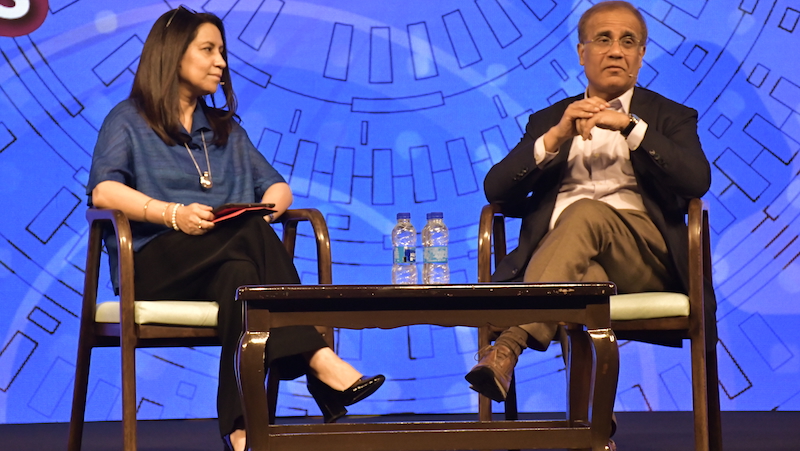
GOA: Change sucks, but irrelevance sucks harder. With that disarming one-liner, author and Publicis Groupe senior advisor Rishad Tobaccowala had the GoaFest 2025 crowd hooked. In a sharp and soul-searching fireside chat with Publicis Groupe CEO of South Asia Anupriya Acharya Tobaccowala offered a crash course in survival and soul in an era increasingly dominated by algorithms, automation and AI anxieties.
Tobaccowala’s core thesis was clear: AI won’t replace you, someone using AI better will. But the real danger isn’t the technology, it’s complacency. “Too many companies are trying to use AI to make their broken models slightly more efficient,” he warned. “You don’t just want faster printing presses you want a new way to communicate entirely.”
To prove the point, he spotlighted the New York Times, a legacy media brand that reinvented itself from a print-first paper to a digital-first platform with 12 online subscribers for every print one. Today, 35 per cent of its revenue comes not from news, but from games, recipes, and other lifestyle content. “They don’t call themselves a newspaper anymore, they’re an entertainment brand with a news vertical,” he quipped.
Referencing Andy Grove’s classic Only the Paranoid Survive, Tobaccowala argued that the age of paranoia has passed. In its place? Dual thinking. “Successful companies must run two business models at once, one for today, and one for tomorrow,” he said.
His advice: Spend five to 10 per cent of your money and 20–25 per cent of your best talent building the future. “Don’t assign tomorrow’s strategy to the person you don’t know what to do with,” he warned. “That’s like watering your grandfather’s grave instead of feeding your kids.”
“I worked 37 years in one company, lived 45 years in the same city, and met my wife 53 years ago,” he said. “So when I say I hate change, I mean it. But irrelevance? That’s worse.”
He dismantled the sugar-coated corporate approach to transformation. “Telling people change is good is a lie. It’s painful. It makes you look stupid. It scrapes your knees like learning to ride a bike.” What works instead? A three-part formula: incentives, training, and personal relevance. “Tell employees what’s in it for them, not just what’s in it for the company,” he urged.
Tobaccowala didn’t mince words about leadership either. “We’ve entered the age of de-bossi-fication. Nobody wants a boss. They want a leader.”
Monitoring, allocating, and measuring won’t cut it anymore. Today’s leaders must inspire, create, and mentor. If you’re not spending at least 50 per cent of your time leading instead of managing, he warned, “you’ll be retired by machines or Gen Z sooner than you think.”
Tobaccowala also had sharp advice for younger professionals: “You’re in a 50-year career. Stop thinking in 6-month cycles.” He urged them to chase growth over glam, pick the right boss, and resist jumping ship just because the grass looks greener. “The grass is greener because it’s fertilised with… well, you know what,” he joked.
Despite all the AI hype, Tobaccowala believes the machines may help us rediscover what makes us human. In 2023, the most popular AI tools weren’t just about productivity, they were about relationships, purpose, and self-growth.
“AI will amplify your creativity, but it can’t replace your conviction,” he said. “It’s not about resisting AI. It’s about partnering with it without outsourcing your soul.”
As he signed off, Tobaccowala reminded the audience of something many forget. “India is not the future. It is the present. Publicis gets 65 per cent of its workforce and a growing chunk of its global revenue from India, China, and the US,” he noted. “You’re not a footnote. You’re a headline.”
He ended with a final, cheeky mic-drop about his book’s global release: “My publisher didn’t want to launch in India first. Said it wouldn’t sell. Now India is the only place it’s sold out twice.”