Connect with us

MAM

Global e-commerce to make up 19% of retail sales in 2022, to grow upto 25% by 2027: GroupM report

Published

on

Mumbai: Today, e-commerce, after a surge of investment and adoption during the pandemic, is finding its place in a world where in-person activities are resuming. GroupM has released its e-commerce and retail media forecast that details the socioeconomic factors contributing to the state of this space. According to the study, the e-commerce industry will generate $101 billion in annual revenue this year, a 15 per cent increase over 2021. This, even as pandemic-related lockdowns in China and supply chain bottlenecks there and in war-torn Ukraine have contributed to a drag on growth in the first half of 2022.

The report has been penned down by GroupM’s global director of business intelligence Kate Scott-Dawkins. The study estimates global e-commerce to make up 19 per cent of global retail sales in 2022, growing to 25 per cent by 2027. Global retail media is likely to reach $101 billion in 2022 and will surpass $160 billion in annual revenue in five years’ time. In 2021, retail media ad revenue represented 18 per cent of global digital advertising revenue and 11 per cent of total global ad revenue.

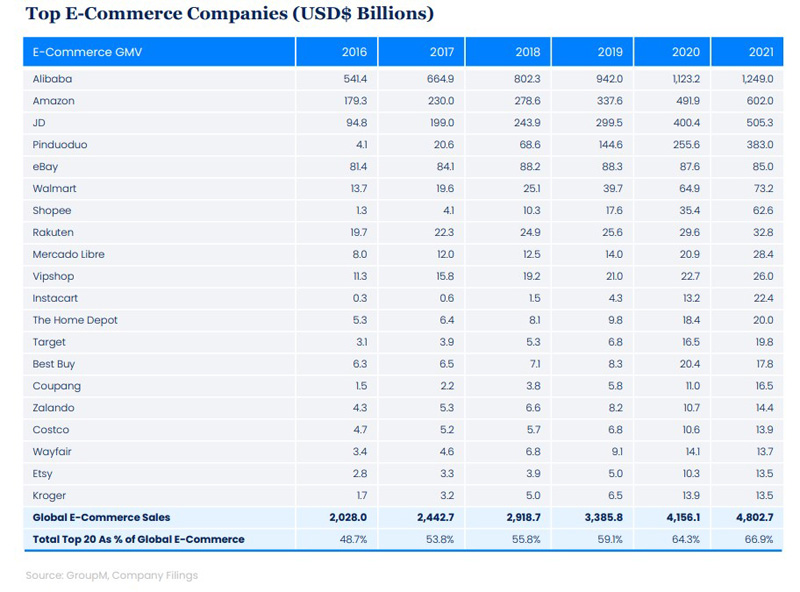
According to the report, 20 of the top global e-commerce companies accounted for 67 per cent of e-commerce sales in 2021. Global e-commerce sales of $5.4 trillion are estimated for this year. Of this figure, China and the US alone is expected to make up 52 per cent. Nearly 61 per cent of the total, $3.3 trillion, can be attributed to only seven markets: the US, China, Japan, Germany, the UK, Canada and Australia.

Advertisement

The top countries’ e-commerce figures are China – with an estimated e-commerce market growth in 2022 of 5.6 per cent, slower than last year’s growth of 10 per cent; and the US, with an estimated e-commerce market growth in 2022 of 25 per cent. Among the major global markets highlighted in this report, only three are forecast to see 10 per cent or lower e-commerce penetration in 2022: Australia, Japan, and Canada.

By 2027, the report estimates e-commerce sales will reach $9.1 trillion. This figure includes sales of autos and auto-parts, as well as gasoline, but excludes food services or catering sales to produce like-for-like comparisons across all tracked markets.

There is no doubt that the pandemic lifted the fortunes of any e-commerce retailer already established or ready to invest in becoming established during the first year of the pandemic. Unsurprisingly, Chinese retailers make up three of the top five retailers by global e-commerce gross merchandise value (GMV), with Amazon and eBay rounding out the other two spots (though Shopify would replace eBay at number five if included). Alibaba is the undisputed leader, with more than double the e-commerce GMV of Amazon. Alibaba has dominated the mobile commerce and payments ecosystem with Alipay (along with Tencent competitor WeChat), and certainly benefited from heavy adoption of mobile shopping during the COVID-19 outbreaks in China in 2020 and the spring of 2022.
Advertisement

Concurrently, global advertising revenue increased by 24 per cent in 2021, which is even more remarkable given that the figure in 2020 was only a two per cent decrease.

Read the full report here.

Advertisement
Click to comment

Leave a Reply

Your email address will not be published. Required fields are marked *

MAM

Barista partners Ginny Weds Sunny 2 with mango campaign

Cafe chain blends cinema buzz with summer menu and 20 per cent offer.

Published

on

Medha Shankr and Avinash Tiwary

MUMBAI: Love may brew slowly, but marketing clearly doesn’t especially when coffee meets cinema and mangoes steal the spotlight. Barista Coffee Company has partnered with the upcoming hindi film Ginny Weds Sunny 2 as its official beverage partner, in a move aimed at tapping into youth culture through entertainment-led engagement. The collaboration is not just a logo placement exercise. Instead, Barista is translating the film’s high-energy vibe into its cafés with a themed summer menu titled “Main Hoon Mango”, accompanied by a limited-period 20 per cent discount on combo offerings across outlets.

Actors Medha Shankr and Avinash Tiwary feature in the campaign, seen engaging with the mango-themed menu inside Barista cafés, a visual cue designed to blur the lines between reel and real-life consumption moments.

The strategy reflects a broader shift in how consumer brands are leveraging hindi film industry not just for visibility, but for immersive, on-ground engagement. By embedding the film’s narrative into its product experience, Barista is aiming to drive footfall, especially among younger audiences who increasingly seek experiential touchpoints over traditional advertising.

Advertisement

Barista Coffee Company CEO Rajat Agrawal described the partnership as both a branding and growth play, focused on expanding reach beyond the existing customer base and aligning with evolving consumer preferences.

The emphasis on a seasonal, flavour-led hook mango, one of India’s most culturally resonant ingredients adds a timely layer to the campaign, aligning with summer consumption trends while riding on the film’s promotional momentum.

For Barista, the move is part of a larger positioning shift. Rather than operating purely as a coffee retail chain, the brand is increasingly framing itself as a lifestyle destination, one that intersects with entertainment, conversation and shared experiences. By integrating cinema into its physical spaces, Barista is effectively turning cafés into micro-extensions of the film’s universe, where consumers do not just watch a story unfold but participate in it sip by sip.

Advertisement

The 20 per cent offer further nudges trial, lowering the barrier for consumers to engage with the themed menu while amplifying recall through a tangible incentive.

Brand-film collaborations are hardly new, but their execution is evolving. Where earlier partnerships relied on co-branded ads or product placements, the current playbook leans towards immersive storytelling and retail integration.

In that sense, Barista’s “Main Hoon Mango” push is less about promotion and more about participation inviting consumers to experience a slice of the film within a familiar, everyday setting. As the film industry continues to act as a cultural amplifier, such partnerships underline a growing truth, in today’s attention economy, it is not enough to be seen brands must be experienced.

Advertisement

And if that experience comes with a mango twist and a cinematic backdrop, all the better.

Continue Reading

Advertisement News18
Advertisement
Advertisement
Advertisement Whtasapp
Advertisement Year Enders

Indian Television Dot Com Pvt Ltd

Signup for news and special offers!

Copyright © 2026 Indian Television Dot Com PVT LTD

This will close in 10 seconds