Brands
FY-2015: Tepid box office, World Cup Cricket chop PVR profits


BENGALURU: Impacted by poor movie content and World Cup Cricket towards the end of FY-2015 (year ended 31 March, 2015, current year) Indian motion picture exhibition, production and distribution house PVR Limited reported just 23.1 per cent PAT at Rs 11.64 crore as compared the Rs 50.39 crore in FY-2014.
PVR, in its earnings release, says that there was a 12 per cent drop in the footfalls in Q4-2015 at 1.22 crore and that its entertained one per cent lesser patrons (5.92 crore) in FY-2015 and profit could have been lower but for strong performance of its Food and Beverages (F&B) revenues and Sponsorship income.

Note: 100,00,000 = 100 lakh = 10 million = 1 crore
All numbers are consolidated unless stated otherwise
The company’s Q4-2015 performance has been poor. PVR’s Movie Exhibition segment revenue dropped 4.3 per cent in Q4-2015 to Rs 271.40 crore as compared to the Rs 283.69 crore in Q4-2014 despite the company adding 50 more screens spread over nine properties in FY-2015. Also, Q4-2015 movie exhibition segment revenue was 30.9 per cent lower than the Rs 392.88 crore in the immediate trailing quarter. The movie exhibition segment has reported an operating loss of Rs 14.68 crore in Q4-2015 as compared to operating profits of Rs 18.99 crore of Rs 50.08 crore in Q4-2014 and Q3-2015 respectively. PVR’s movie exhibition revenue in FY-2015 at Rs 1370.31 crore was 9.1 per cent more than the Rs 1255.59 crore in FY-2014. The segment reported 28.2 per cent lower operating profit of Rs 88.23 crore in the current year as compared to the Rs 122.87 crore in FY-2014.
In Q4-2015, PVR’s net Total Income from Operations excluding other income (TIO) at Rs 299.55 crore was 4.5 per cent lower than the Rs 314.23 crore in the corresponding year ago quarter and 28.6 per cent lower than the Rs 419.71 crore in Q3-2015. TIO in FY-2015 at Rs 1481.34 crore was 9.6 per cent more than the Rs 1351.23 crore in FY-2014.
PVR reported a loss of Rs 35.56 crore in Q4-2015 as compared to PAT of Rs 0.74 crore in Q4-2014 and PAT of Rs 31.59 crore in the immediate trailing quarter.
PVR’s EBIDTA in FY-2015 also suffered on this account. EBIDTA including other income in the current year at Rs 209.67 crore (14.2 per cent margin) declined six per cent as compared to the Rs 222.99 (16.5 per cent margin) in FY-2014. EBIDTA including other income in Q4-2015 at Rs 12.71 crore (4.2 per cent margin) was almost a third (down 63.9 per cent) of the Rs 35.18 crore (11.2 per cent margin) and a little more than one seventh (15.3 per cent margin) of the EBIDTA including other expenses of Rs 82.23 crore (19.8 per cent margin) in the previous quarter.
Let us look at the other numbers reported by PVR
PVR’s Total Expenditure (TE) in FY-2015 at Rs 1393.11 crore (94 per cent of TIO) in FY-2015 was 13.2 per cent more than the Rs 1230.22 crore (91 per cent of TIO) in FY-2014. TE in Q4-2015 at Rs 314.12 crore (104.86 per cent of TIO) was 0.5 per cent lower than the Rs 315.58 crore (100.43 per cent of TIO) and 14.9 per cent lower than the Rs 369.33 crore (88 per cent of TIO) in Q3-2105.
The company’s Film Exhibition Cost in FY-2015 at Rs 342.18 crore (23.1 per cent of TIO) was 3.9 per cent more than the Rs 329.49 crore (24.4 per cent of TIO) in FY-2014. Film Exhibition Cost in Q4-2015 at Rs 62.96 crore (21 per cent of TIO) was 8.2 per cent lower than the Rs 68.6 crore (21.8 per cent of TIO) in Q4-2014 and 36.1 per cent lower than the Rs 98.49 crore (23.5 per cent of TIO) in the previous quarter.
PVR’s cost of Food and Beverages consumed (F&B cost) in FY-2015 at Rs 107.38 crore (7.2 per cent of TIO) was 16.3 per cent more than the Rs 92.31 crore (6.8 per cent of TIO) in FY-2015. F&B cost in Q4-2015 at Rs 21.05 crore (seven per cent of TIO) was 2.9 per cent lower than the Rs 21.67 crore (6.9 per cent of TIO) in Q4-2014 and 30 per cent less than the Rs 30.05 crore (7.2 per cent of TIO) in Q3-2015. PVR says that F&B revenues increased 17 per cent in FY-2015 as compared to FY-2014.
The company’s movie production segment (movie segment) in FY-2015 reported 35.9 per cent growth in revenue at Rs 51.23 crore as compared to the Rs 37.71 crore in FY-2014. Movie segment revenue in Q4-2015 at Rs 13.61 crore was 28.3 per cent lower than the Rs 18.99 crore in Q4-2014 and 14.9 per cent more than the Rs 11.85 crore in Q3-2015. The segment reported operating profit of Rs 2.74 crore as compared to an operating profit of Rs 0.90 crore in FY-2014. Operating profit of PVR’s movie production segment in Q4-2015 was Rs 1.54 crore as compared to an operating loss of Rs 0.56 crore in Q4-2014 and an operating profit of Rs 0.43 crore in Q3-2015.
PVR’s Others’ (including Bowling, gaming and restaurant services, etc) segment reported almost flat revenue (down 0.1 per cent) in FY-2015 at Rs 73.96 crore as compared to the Rs 74.02 crore in FY-2014. Revenue from ‘Others’ segment in Q4-2015 at Rs 17.27 crore was 9.9 per cent less than the Rs 19.16 crore in Q4-2014 and 9.1 per cent less than the Rs 19 crore in Q3-2015. The ‘Others’ segment reported slightly higher operating loss of Rs 2.80 crore in FY-2015 as compared to the Rs 2.63 crore in FY-2014. Operating loss of the segment in Q4-2015 at Rs 1.46 crore was higher than the operating loss of Rs 0.96 crore in Q4-2014 and the operating loss of Rs 0.13 crore in Q3-2015.
Assuring stakeholders of a better FY-2016, PVR chairman and managing director Ajay Bijli said, “While Q4-2015 performance stood tepid, with the consumer sentiment coming back Q1-2016 box office have been very strong with movies like Fast & Furious 7, Avengers, Gabbar, Piku and Tanu Weds Manu leading the pack. Going forward we have Dil Dhadakne Do, Jurassic World and ABCD-2 releasing in June followed by Bajrangi Bhaijaan, a Salman Khan starrer and Drishyam in July. The content pipeline looks pretty promising and hopefully the worst in terms of content should be behind us and we expect a blockbuster 2015-16.”







Brands
Samsung certifies 1,000 Maharashtra students in AI and coding
The South Korean electronics giant marks its first large-scale skilling push in the state, with women making up nearly half the national programme’s enrolment
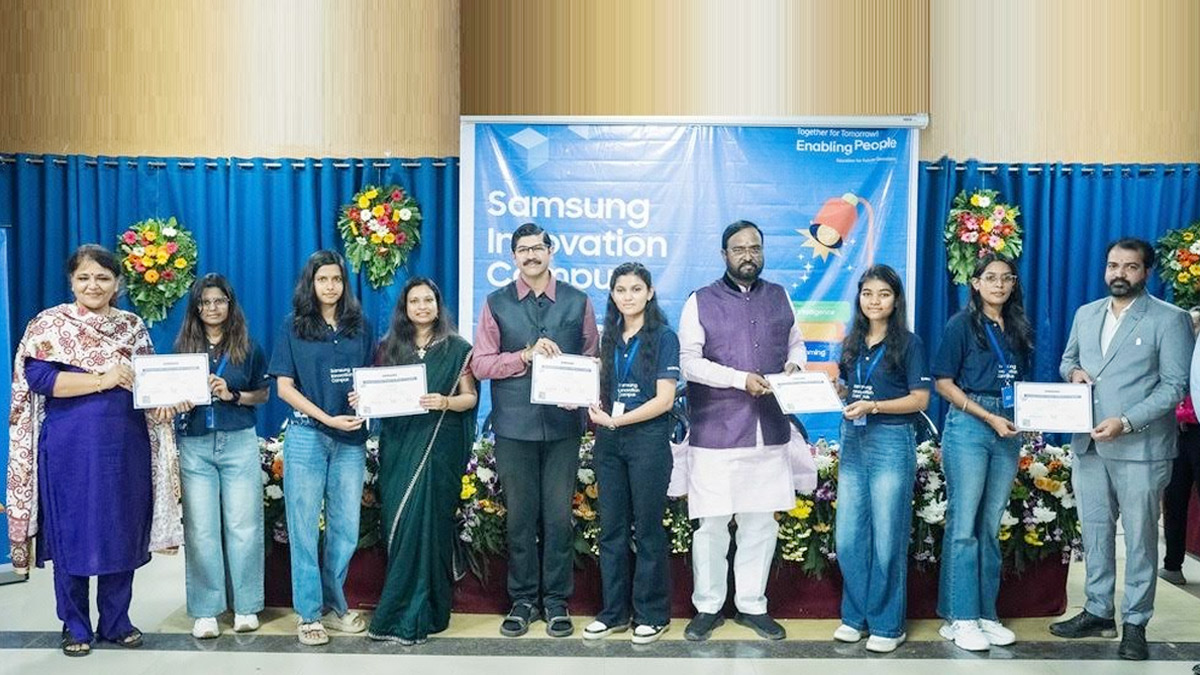
PUNE: Samsung has put 1,000 students in Maharashtra through a certified training programme in artificial intelligence and coding, the largest such drive the South Korean electronics company has run in the state and a signal that corporate India’s skilling ambitions are moving well beyond the boardroom brochure.
The certifications were awarded under Samsung Innovation Campus (SIC), the company’s flagship corporate social responsibility programme, which launched in India in 2022 with the stated aim of democratising access to future-technology education. The 1,000 graduates were drawn from four institutions: 127 from Savitribai Phule Pune University, 373 from Pimpri Chinchwad University, 250 from D.Y. Patil University’s Ramrao Adik Institute of Technology and 250 from Anjuman-I-Islam’s Kalsekar Technical Campus. All completed training in either AI or coding and programming, the two disciplines Samsung has identified as the critical pillars of the digital economy.
The programme does not stop at technical training. Soft-skills development and career-readiness modules are baked into the curriculum, a deliberate attempt to close the gap between what universities teach and what employers actually want.
“India’s digital growth story will ultimately be shaped by the quality of its talent pipeline,” said Shubham Mukherjee, head of CSR and corporate communications at Samsung Southwest Asia. “As technologies like AI move from the periphery to the core of industries, skilling must evolve from basic training to building real-world capability. This milestone in Maharashtra reflects how industry and academia can come together to create a future-ready workforce that is both globally competitive and locally relevant.”
The Maharashtra drive sits within a rapidly scaling national effort. Samsung Innovation Campus trained 20,000 young people across India in 2025, hitting its stated target for the year. Women account for 48 per cent of national enrolments, a figure the company cites as evidence of its push for an inclusive technology ecosystem. The programme is implemented in partnership with the Electronics Sector Skills Council of India and the Telecom Sector Skill Council.
Samsung, which is marking 30 years in India this year, runs SIC alongside two other initiatives, Samsung Solve for Tomorrow and Samsung DOST, as part of a broader effort to build what it calls a generation of innovators with both the technical depth and the problem-solving mindset to thrive in a fast-moving digital world.
A thousand certified students is a tidy headline. Whether they find jobs that match their new skills is the harder question, and the one that will ultimately determine whether corporate skilling programmes like this one are genuine pipelines or well-photographed gestures.






