Connect with us

Brands

Farmley goes 100 per cent palm oil-free across its product range

Published

on

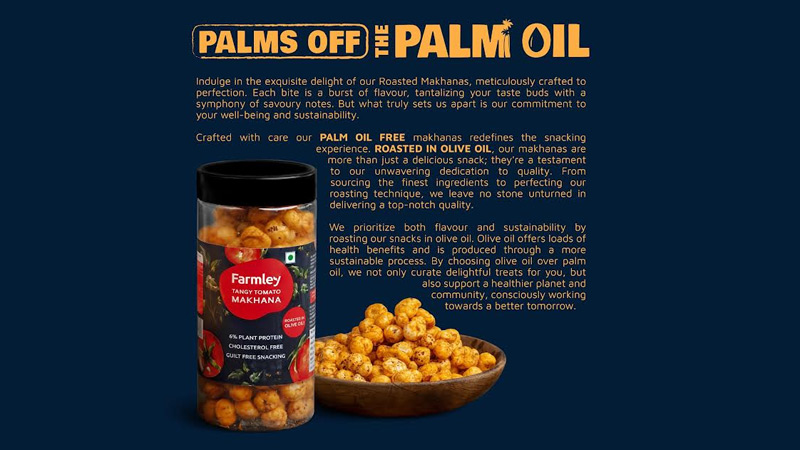
Mumbai: Marking a significant step towards healthier and more sustainable snacking options for consumers, Farmley, a wholesome snacking specialist, has announced its transition to becoming completely palm oil-free.

Backed by extensive research and development, Farmley, with a yearlong mission of phasing out palm oil with healthier alternatives like olive oil, ghee or zero-oil across its entire range of products, has further solidified its commitment to redefining healthy snacking for its consumers. Palm oil, a commonly used vegetable oil, has raised environmental and health concerns due to its high saturated fat content. In an industry where the development and sale of blended palm oil is the norm – which includes 80-90 per cent of palm oil and only 10-20 per cent olive oil – Farmley is one of the first brands that is 100 per cent palm oil-free.

While creating a completely palm oil-free product range, Farmley has launched  the “Palms Off Palm Oil” campaign, to raise awareness among consumers about the harmful effects of palm oil on health. It also aims to educate consumers about the negative impacts of palm oil production on the ecology, as it contributes to deforestation, destruction of wildlife habitats and climate change.

Advertisement


A post shared by Farmley (@farmleyin)


A post shared by Farmley (@farmleyin)

Expressing his delight in steering the transition to 100 per cent Palm oil-free products, Farmley co-founder Akash Sharma said, “At Farmley, prioritising the well-being and satisfaction of our consumers stands at the forefront of our mission. We began our journey 6 months ago to go completely palm oil free when a few of our  customers expressed resentment towards our products being made in palm oil during our regular customer feedback surveys. Customer feedback is not just a suggestion box for us; it’s a guiding light that impacts our business decisions. We are happy to be among the first to transition our entire range of products to being completely palm oil free by replacing it with zero-oil, olive oil, or ghee. While this move will cater to the health of the nation, from a business perspective, it will provide us a first-mover advantage into an emerging F&B segment, which focuses on food quality and health. As we continue to innovate and improve, we remain committed to providing snacks that are not only delicious but also mindful of our planet and its inhabitants.”

Advertisement

A study published in the National Library of Medicine reveals that palm oil is used in almost half of the most commonly consumed food and consumer items, including popular snacks. Composed of 50 per  saturated fatty acid, it increases LDL or ‘bad’ cholesterol levels in the bloodstream, increasing the unhealthy fat content in the human body while elevating the risk of cardiovascular diseases in people.

Farmley’s range of wholesome snacks is available on online commerce platforms including Amazon, Flipkart, Blinkit, Zepto and Instamart, along with retail stores near you.


Advertisement
Click to comment

Leave a Reply

Your email address will not be published. Required fields are marked *

Brands

Estée Lauder to shed 10,000 jobs as new boss bets on digital shift

The cosmetics giant raises its profit outlook but stays silent on a possible merger with Spain’s Puig, as job cuts deepen and a three-year sales slump weighs on the turnaround

Published

on

NEW YORK: Stéphane de La Faverie is not done cutting. Estée Lauder announced on Friday that it plans to eliminate as many as 3,000 additional jobs, taking its total redundancy programme to as many as 10,000 roles, up from a previous target of 7,000 announced a year ago. The company, which owns La Mer, The Ordinary, Tom Ford, and Aveda, employs roughly 57,000 people worldwide. The mathematics of what is now being contemplated is stark.

The fresh round of cuts is expected to generate a further $200 million in savings, bringing the total annual savings from the programme to as much as $1.2 billion before taxes. That money, De La Faverie has made clear, will be ploughed back into the turnaround.

A CEO in a hurry

Advertisement

De La Faverie, who took the helm in January 2025, inherited a company that had endured three consecutive years of annual sales declines. His response has been to move fast and cut deep. A significant portion of the latest redundancies reflects his push to reduce headcount at US department stores, long a cornerstone of Estée Lauder’s distribution model but now a channel in structural decline. In their place, he is accelerating the shift toward faster-growing online platforms, including Amazon.com and TikTok Shop, a pivot that is reshaping not just where Estée Lauder sells but how it thinks about its customers.

The numbers are moving in the right direction

Despite the pain, there are signs the medicine is working. Estée Lauder raised its profit outlook for the remainder of the fiscal year, guiding for adjusted earnings per share in the range of $2.35 to $2.45, above analyst estimates and a notable step up from the $2.05 to $2.25 range it had guided for in February. Organic net sales growth is expected to come in at 3 per cent, the company said, at the high end of the range it set out in February.

Advertisement

The share price tells a mixed story. After De La Faverie took charge, the stock surged nearly 60 per cent, buoyed by investor optimism that a longtime company insider could finally arrest the decline. But 2026 has been rougher: the shares have fallen 27 per cent this year, weighed down by disappointing February results and the overhang of unresolved merger talks with Spanish beauty giant Puig Brands SA. The company gave no additional details about those discussions on Friday, leaving the market to guess.

Silence on Puig

The proposed tie-up with Puig remains the most consequential unknown hanging over Estée Lauder. A deal with the Barcelona-based group, which owns brands including Carolina Herrera and Rabanne, would reshape the global luxury beauty landscape. But with nothing new to say and a turnaround still very much in progress, De La Faverie is asking investors to trust the process.

Advertisement

Three years of sales declines, 10,000 job cuts, and a merger that may or may not happen. At Estée Lauder, the overhaul has barely started.

Continue Reading

Advertisement News18
Advertisement
Advertisement
Advertisement
Advertisement Whtasapp
Advertisement Year Enders

Indian Television Dot Com Pvt Ltd

Signup for news and special offers!

Copyright © 2026 Indian Television Dot Com PVT LTD