MAM
“Facebook Live will be the future of advertising”: Fergus O’ Hare


MUMBAI: Facebook’s recently launched live streaming service ‘Facebook Live’ is yet another tool that digital marketers can add to their kitty. There is no denying the fact that 2016 will be the year of video streaming in India, with bandwidth easing out thanks to Reliance Jio and other 4G players, as well as broadband expanding and strengthening to tier II and tier III cities.
For India that means more disruption in the video space, especially for those dealing with the news media and live events space. Because Facebook Live allows live video streaming on not just from smartphones but other devices like drones as well!
Citing the multiple uses the new service will have for brands, Facebook Creative Shop APAC Fergus O’ Hare revealed, “We just launched it a couple of weeks ago. It’s still at an infant stage now. It’s a great way to tell people what is happening at the moment, share real-time updates and emotions. From an advertiser’s standpoint, there is so much one can do. Currently we are making certain tweaks to make it easier and more convenient for the advertisers to reach consumers. This could be the future of advertising on Facebook.”

Explaining why he added, “The dying breed of salesmen will find a renewed motivation with Facebook Live as they can make calls to consumers at specific relevant times of the day when they are most likely to buy the product. Brands can call you any time of the day when it matters the most.”
When asked if that would make the service ad intrusive, O’Hare argued, “In Facebook we have to always make sure that things are not intrusive. If people ‘X’ the ads, then advertisers will have to spend more money to put up their ads again. If we become intrusive with our ads, people will stop using Facebook. So we do anything and everything to make sure we are not intrusive. Interest and relevance plays a huge role in curating ads for each person so that users don’t see the ads they don’t want to.”
Brands can also build their credibility by taking consumers to their factories and beaming the production live from there, O’ Hare shared. As per the ESP Sportzpower report 2016, most of the internet users in a stadium or at a sporting event use their devices to share content rather than getting news. This would mean a ready demand for Facebook Live among sports fanatics. For publishers, digital media and digital creators like YouTube stars, this could mean live beaming of their content from anywhere they want. The service allows one to go on short commercial breaks and put the advertisements they want to and make revenue from there.
On the revenue model of Facebook Live, O’ Hare commented, “We haven’t figured it out for sure yet, as we have just launched. We want to play it out and see how users interact with it before setting specifications. First people need to live and put content for us to monetize it. For now we know that it will be a sort of commercial break that you get on television, only it will be on demand and completely as per the choice of the user, and viewers can also filter the type of ads they want to see in their live feed.”
O’Hare concludes by asking not to confuse the Live feed and commercial breaks with TV ads, as the advertisements on Facebook Live will still be targeted and personalised. “TV follows the prime time formula where 9 ads are force fed to viewers even if they are not interested in them. On Facebook we go by relevance and then the right time,” O’ Hare added in parting.





MAM
Lego brings Messi, Ronaldo, Mbappé, Vinicius together
Campaign clocks 314 million views ahead of FIFA World Cup 2026 buzz.
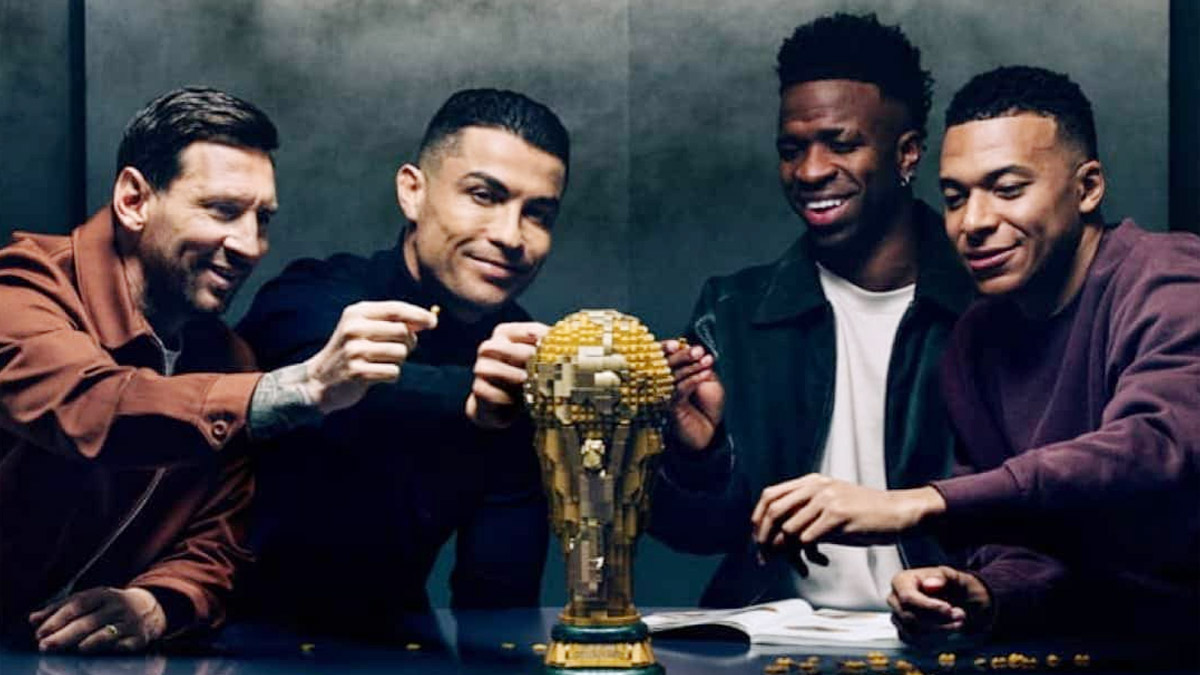
MUMBAI: Four legends, one frame and not a single tackle in sight. Lego has pulled off a crossover few thought possible, uniting Lionel Messi, Cristiano Ronaldo, Kylian Mbappé and Vinícius Júnior in a single campaign ahead of the FIFA World Cup 2026 only this time, they’re building dreams brick by brick.
Titled “Everyone wants a piece”, the campaign features the quartet assembling a Lego version of the World Cup trophy, before placing miniature versions of themselves atop it, a playful nod to football’s ultimate prize. Shared widely across social media, the ad carries a pointed disclaimer: it is not AI-generated, a subtle but telling signal in an era where even reality is often questioned.
The numbers tell their own story. The campaign has already crossed 314 million views on Instagram across the players’ accounts, with fans hailing it as a rare, almost nostalgic moment particularly for the reunion of Messi and Ronaldo, whose last shared campaign ahead of the 2022 World Cup became one of the platform’s most-liked posts.
Beyond the film, Lego is extending the play with exclusive, player-themed sets tied to each of the four stars, part of a broader football-led programme designed to ride the global momentum building towards 2026. The idea, as echoed by the players themselves, leans into the parallels between football and play experimentation, creativity, failure, and triumph.
Messi described the sets as a way to bring on-pitch moments into an imaginative, hands-on world, while Ronaldo called the transformation into a Lego figure a rare honour, blending sport with storytelling. Vinícius, meanwhile, struck a more personal note, recalling childhood moments of building with Lego and framing creativity as a universal language that transcends borders.
The timing is no accident. With the 2026 World Cup set to run from June 11 to July 19 across the United States, Canada and Mexico, and featuring an expanded 48-team format, global anticipation is already building. Argentina, led by Messi, will enter as defending champions, adding another layer of intrigue.
For Lego, the campaign does more than celebrate football, it taps into its mythology. Because when icons become figurines and rivalries turn into play, the beautiful game finds a new kind of pitch. one built, quite literally, by hand.






