Brands
Eyes on the billboards again, as OOH business rebounds

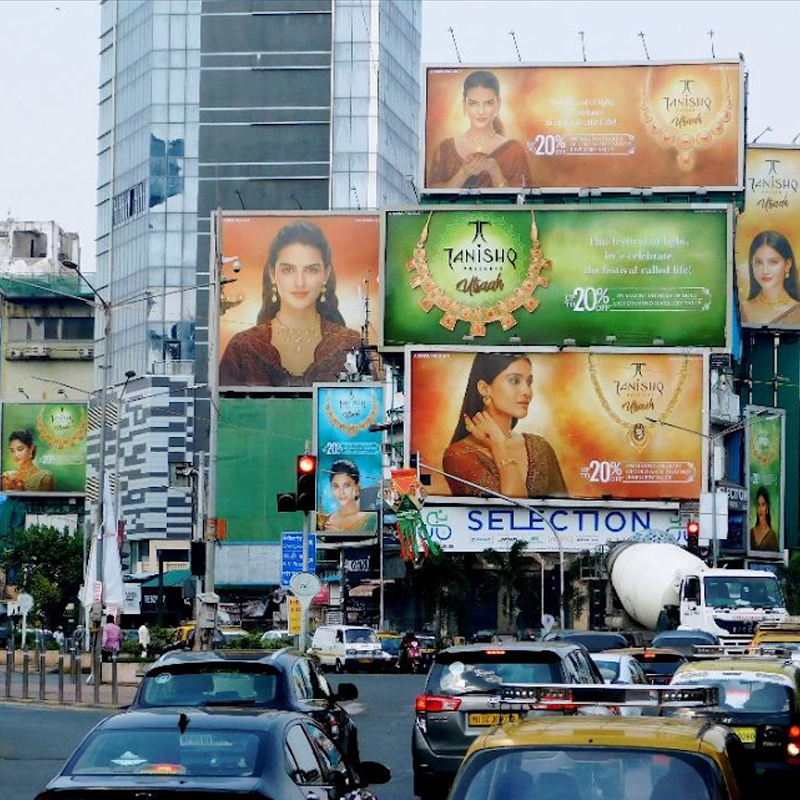
Mumbai: As the markets and public spaces open up and consumers’ mobility return back to normal, the OOH (Out-Of-Home) industry is rebounding from a long phase of shutdowns. The festive season in India this year witnessed a resurgence in OOH campaigns as the industry shifted gears and advertisers adjusted their game plan to take advantage of the evolving OOH landscape.
“Though the internet gained momentum in the last few years, people are always going to be spending time outdoors, including a significant amount of time commuting. That means there will always be opportunities for companies to make an impact and grow their brand using attention-capturing, visually appealing billboard advertising,” said Posterscope OOH country head Imtiyaz Vilatra.
OOH has always been a critical part of the media mix for most marketers, and it was also the one which was hardest hit by the lockdown. But, it is slowly reviving as vaccination drives gain pace, offices open up and economic activity revives. The festive period also saw a flurry of campaign launches from across categories such as OTT, Retail, Education, Automobile & BFSI.

“We witnessed more than fifty campaigns in a span of forty days- campaigns where OOH has been an integral part- Parle, Airtel, Viacom18, Tata Sky, Bike Bazaar, to name a few,” said Vilatra, adding, “We have been able to drive measurability data and deliver better ROI through our Location specialist capabilities for our clients and the response has been great.”
As India lifted lockdown restrictions, major brands such as Tanishq, Tissot, Titan, Croma, Kotak Mahindra Bank, Raymond unveiled festive campaigns, and so did new age brands like Rapido, Tendercuts and Bumble. The women-first social networking & dating app launched exclusive out of home campaigns across major cities like Mumbai, Delhi and Chennai that grabbed eyeballs, leveraging the medium featuring taglines with humorous, localised takes at dating culture.
Laqshya Media Group also executed a multi-city high decibel OOH campaign for Hero Lectro E-cycles. The campaign encompassed a mix of large format media units, cluster brandings and other unconventional mediums across all cities.
“A host of brands are choosing OOH – not only as a medium, but as one of the lead mediums. Across the country, the biggest spenders straddle industry verticals from Real Estate to Automobiles, from insurance to OTT, and from Jewellery to electronics (D2C as well as Legacy,” said Laqshya Media Group chief strategy officer Sai Nagesh. “During the month of October, we executed several prominent campaigns for clients like Tanishq, Maruti Suzuki etc, amongst others.”
He cites two recent innovations executed by the agency- cluster advertising used by Titan to dominate a geography across its brands, Titan watches and Tanishq and 3-dimensional billboards used by Maruti Suzuki for its brand Celerio- to highlight his point.
[[{“fid”:”1050499″,”view_mode”:”default”,”fields”:{“format”:”default”,”alignment”:””,”field_file_image_alt_text[und][0][value]”:false,”field_file_image_title_text[und][0][value]”:false},”link_text”:null,”type”:”media”,”field_deltas”:{“2”:{“format”:”default”,”alignment”:””,”field_file_image_alt_text[und][0][value]”:false,”field_file_image_title_text[und][0][value]”:false}},”attributes”:{“height”:394,”width”:700,”class”:”media-element file-default”,”data-delta”:”2″}}]]
Agencies also highlight how brands today are becoming highly data-centric and using advanced algorithms to measure the impact of various media available to them. “On our part, we have been sharing advanced OOH metrics off our proprietary platform SHARP that is able to generate the measure of quantum and quality of traffic across 32 cities in India along with metrics like Nett Reach & OTS. This has also aided the clients in re-allocating significant funds for OOH,” added Nagesh.
The best measure of whether OOH campaigns are truly ready for a comeback after the pandemic-induced hit it took is the traffic on the roads. And the traffic back on streets is a positive sign for both businesses and media partners. Some of the agencies also tracked the mobility trends during the course of the pandemic and updated their clients. With people moving out after the pandemic-induced lockdowns, the traffic has also resumed across all roads.
[[{“fid”:”1050509″,”view_mode”:”default”,”fields”:{“format”:”default”,”alignment”:””,”field_file_image_alt_text[und][0][value]”:false,”field_file_image_title_text[und][0][value]”:false},”link_text”:null,”type”:”media”,”field_deltas”:{“3”:{“format”:”default”,”alignment”:””,”field_file_image_alt_text[und][0][value]”:false,”field_file_image_title_text[und][0][value]”:false}},”attributes”:{“height”:367,”width”:615,”class”:”media-element file-default”,”data-delta”:”3″}}]]
Out of Home advertising as a fast-growing industry is only set to develop further with advanced AI-powered tools that aid in accessing appropriate locations in each city to reach out to the core TG of the campaign and new technology trends over the year. A medium that was once static images with simple captions now also features interactive and electronic billboards with DOOH (Digital OOH). Brands can be much more creative with how they reach customers in all demographics using these latest innovations.
Across the world, the OOH and mobile media are fast moving towards convergence. There is even data to show that OOH + Mobile advertising produces better recall than any other medium, according to a PJ Solomon study conducted in the US. “Unlike digital advertising, people can’t skip, quickly scroll past, use ad-blocks or avoid billboards using premium subscriptions. I think in a smartphone world, the biggest screens still matter,” summed up Vilatra.






Brands
Trump announces $300bn Texas oil refinery with Reliance, calls it the biggest in US history
First new US refinery in 50 years planned at Brownsville port with Reliance

WASHINGTON: The United States may soon see the first brand-new oil refinery built on its soil in half a century.
Donald Trump announced a proposed $300 billion refinery project in Texas, calling it a landmark moment for American energy production and jobs.
Posting on Truth Social on 10 March, Trump said the facility would be built at the Port of Brownsville and developed by a company called America First Refining, with major investment from India’s Reliance Industries.
The announcement frames the project as a centrepiece of the administration’s push for “energy dominance”, with Trump claiming it would deliver thousands of jobs and billions of dollars in economic activity to South Texas.
If realised, the plant would mark the first all-new major refinery constructed in the United States since the 1970s. In recent decades, oil companies have largely chosen to expand existing facilities rather than build new ones, citing high costs, regulatory hurdles and environmental scrutiny.
Trump described the proposed investment as the “biggest in US history”, positioning it as proof that policy changes such as streamlined permits and lower taxes are drawing large-scale energy investments back into the country.
The refinery is planned for the Port of Brownsville, a strategic Gulf Coast location that provides easy access to shipping routes and export markets.
A key partner in the project is Reliance Industries, controlled by billionaire industrialist Mukesh Ambani. The company already runs the world’s largest refining complex in Jamnagar, India, making it one of the most experienced operators in large-scale petroleum processing.
The Texas venture would mark a significant step for the group into America’s domestic refining sector, potentially strengthening industrial ties between the US and India.
The proposed refinery is being promoted as a next-generation facility capable of processing American shale oil while maintaining high environmental standards. Trump said it would be “the cleanest refinery in the world”, although the specific technologies behind that claim have not yet been detailed.
Industry observers also note that the $300 billion figure is unusually large for a refinery project, and analysts are waiting for more clarity on whether the number reflects total construction costs, long-term infrastructure investment, or broader economic impact estimates.
As of 11 March, Reliance Industries had not publicly confirmed the investment size or the structure of its involvement.
For now, the announcement has sparked equal parts excitement and curiosity in energy markets. If the plan moves from promise to pouring concrete, the refinery could reshape the Gulf Coast energy landscape, and reopen a chapter in American refining that has been quiet for nearly fifty years.