MAM
Election tracker: Battling it, out-of-home

MUMBAI: This general election may be the first among many, where media has been so extensively (and blatantly) used by political parties and their prime ministerial hopefuls.
Far from fighting shy of marketing themselves, the main players – Congress and BJP – have spent nearly Rs 400 to Rs 500 crore each on publicity campaigns. An additional Rs 500 to Rs 1,000 crore will be spent on related activities such as banners, hoardings, organization of public meetings and transportation of key campaigners, among others. Not surprisingly, media agencies estimate around 2 to 2.5 per cent of overall advertisement spends this year to come from elections.

One can switch a channel, turn a page or surf away, but hoardings are hard to ignore or even miss. And this is the reason why of the whole advertising budget, parties are spending approximately 10-15 per cent of the total budget i.e. close to Rs300-400 crore on OOH, if not less, as per industry sources.
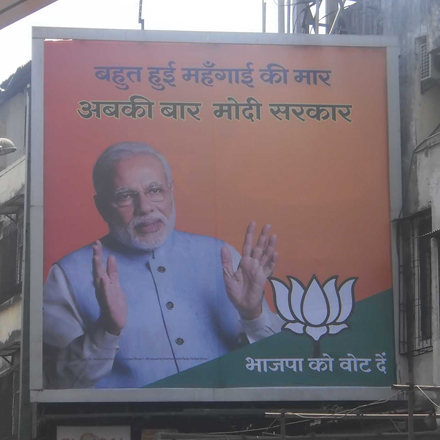
Possibly, with advertising rates on general entertainment channels (GECs) on television being prohibitive and posters having been banned in several cities of the country, outdoor remains the only viable option for election propaganda as it is cost-effective and has high reach as well. So you have hoardings of calling for a ‘Modi Sarkar’ or boating of ‘Bharat Nirman’ with NamO and RaGa staring down at you from the most non-descript locations in the country. What’s more, they have illumination for better visibility at night.
With elections just round the corner, outdoor advertising has picked up significantly, mostly fuelled by political parties, which is quite unlike the usual scenario where outdoor advertising is more prominent during the second half of the year.
Speaking of the growing appeal of OOH, Madison OOH Media Group CEO Arminio Ribeiro, says: “Given the flexibility of this medium in terms of narrow- and broad- casting and its localization and rapid awareness build-up benefits, outdoor has appealed to political parties to get their message across to the electorate through its multiple formats.”
In order to get the best quality hoarding, tapping the most crowded route through buses or railway has certainly increased the competition. Everyone is trying to avail the benefit of this golden opportunity and those who have the diverse range of inventories are the main gainers.
Sanjeev Gupta, managing director of Global Advertisers, which has been roped in for outdoor by both Congress and BJP, says, “With changing trends, political parties have also changed their approach and have become more professional. Therefore, our media plan included a mix of outdoor inventories to expand the reach of these campaigns and we expect to see more demand for outdoor in the coming months.”
While Postercope Asia Pacific regional director, Haresh Nayak, says: “Tier II and Tier III markets have been the focus for the last year, continuing to grow this year as well, showing deep penetration in rural areas to create brand awareness.”
Indeed, the FICCI-KPMG 2014 report finds that the OOH industry has grown by 5.5 per cent from CAGR (2007 to 2013), what with clients from real estate, telecom, media, auto, and now politics, driving it forward.







Brands
Creative Intelligence: Using AI to Predict Which Ads Will Actually Convert
Priyanka Aeron, Director & Co-founder of Thrive Global AI

MUMBAI: In a heavily populated digital landscape, simply being creative with your advertising will not guarantee that your ad will be successful. In fact, brands today are producing more content than ever. However, very little of that results in actual engagement or sales. However, Creative Intelligence, powered by AI, is fundamentally transforming the advertising industry.
Creative Intelligence utilizes data, machine learning, and statistical behavioral insights to analyze and predict how well a creative asset will perform prior to it being published. Therefore, marketers no longer have to rely on either their gut instincts or post-campaign analytics for making informed decisions before production. That said, AI-powered creative intelligence greatly improves results and decreases wasted dollars spent.
Moving Beyond Guesswork
In the past, making ads was a mix of gut feeling, experience, and A/B testing. These methods were useful, but reactive by nature. People have already spent their budgets by the time the results are looked at. AI models can find patterns that are linked to higher engagement and conversion rates by looking at huge datasets. These datasets can include things like past campaign performance, audience behavior, and visual elements like color, composition, and facial expressions. This helps marketers guess which ads will do well even before they go live.
Decoding What Truly Drives Conversions
AI-powered creative intelligence allows for an evaluation of advertisements that is not limited to the basic data but also explores the elements of an effective advertisement through subtle reactions; clarity and directness of the ad message and how well the ad captures audience’s attention in the first three seconds. AI can also provide insights into the successful use of advertisements directed to human faces, which connect through eye contact based on media channels, and how advertisements that utilize shorter but clear calls to action may produce more clicks from certain populations. The insights, provided through AI, provide marketers with the ability to think beyond creating more advertising material and additionally create more effective ad campaigns that actually convert.
Personalization at Scale
Consumers expect relevance more than ever. Irrelevant mass messaging is not going to work in a society inundated with information. Hyper-personalization, using AI, allows companies to create content that suits individual segments within their target markets based on their demographics, interests, and behaviors. Rather than having one single message that aims to reach everyone, brands can have many versions of their messages tailored to each segment within the market. Such flexibility is what makes campaigns successful nowadays.
Faster Iteration, Better Results
Another advantage to using AI in creative decision-making is speed. Companies must improvise because their campaign cycles are shorter than ever before, and having the ability to iterate rapidly is more important than it has ever been. There is no greater way to do this work than through AI, as new technologies give brands the ability to test multiple creative avenues and figure out which ones are working well. This reduces a lot of the testing that companies would otherwise have to do and makes the process faster.
With AI, brands can also make creative changes in real-time during a campaign, allowing the, to make vital decisions and adjust their creatives, rather than waiting out. This allows for faster adaptability, well-tested campaigns and reduced lost ad spend.
The Human-AI Collaboration
Even though AI is capable of performing certain tasks, its purpose is not to eliminate human creativity. Successful campaigns require human collaboration with computer intellect since both complement each other. While computers are capable of dealing with massive amounts of information, discovering patterns, and providing predictions, humans are the one to inject stories and emotions into campaigns.
The Future of Advertising
As the complexity of advertising becomes harder with the passage of time, Creative Intelligence will play a significant role in helping marketers formulate a strategic approach. The yardstick that will set standards for determining whether a marketing firm has fulfilled its responsibilities will be the forecasting of future outcomes, as well as personalized content and optimization of creative elements in real-time. In contrast to the existing scenario where the campaigns remain fixed, these campaigns will be capable of adjusting themselves according to the customer interacting with the brand, as well as other trends on social media channels. This will enable brands to offer customers an engaging experience that will exceed expectations. The biggest hurdle marketers will face will be finding ways to utilize these capabilities without compromising branding and enhancing the creativity of the team involved.