MAM
E-commerce in India sees uptick of 77% between 2020 and 2021: Report
Mumbai: E-commerce in India has witnessed an uptick of 77 per cent between 2020 and 2021 with tier-2, tier-3 cities leading maximum transactions according to a report by conversation media platform Bobble AI.
While the tier-1 cities dominate the fashion festival figures, transactions in tier-2 cities like Jaipur, Guwahati, Lucknow, Kochi, Mysore, and Bhubaneswar are at an all-time high – up 82 per cent over the previous year, found the report based on over 50 million smartphone users’ (in 640+ Indian cities) data.
The findings also show that majority of consumers are between the ages of 26 and 35 accounting for 37 per cent, and between the ages of 18 and 25, accounting for 26 per cent with 72 per cent males and 28 per cent females.
Beauty and fashion lead e-ecom in India
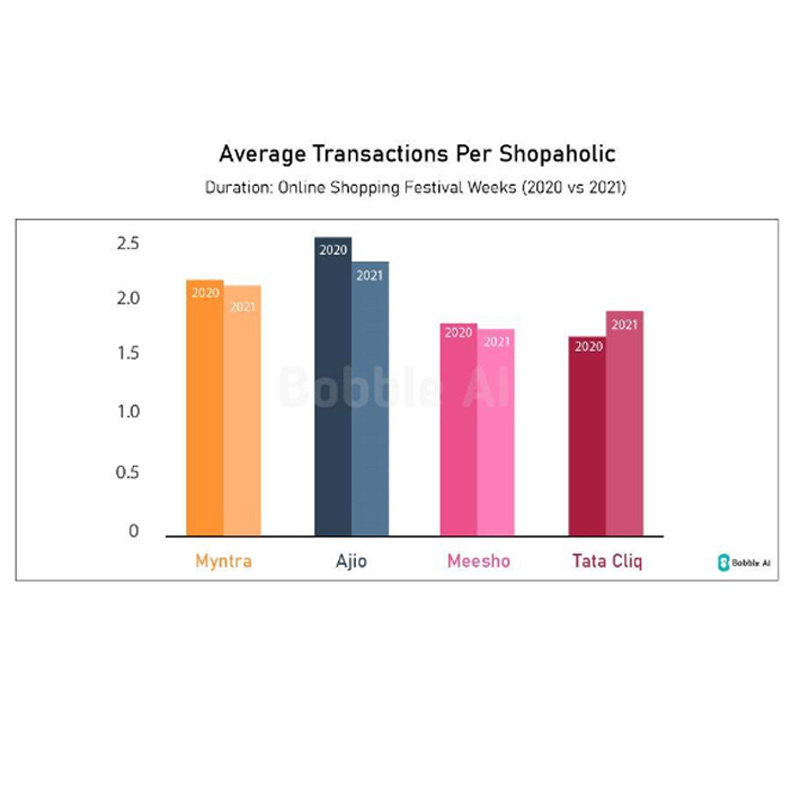
Beauty e-commerce apps usage grew by 64 per cent, whereas fashion e-commerce grew by 368 per cent over the past year. The festive period has only led the two e-commerce domains to skyrocket, with at least two transactions completed by shopaholics during the fashion festivals.
Competition heating up with new players
As per the report, India’s fashion e-commerce industry has transformed from ‘Monopoly’ to ‘Ludo.’ Fashion giant Myntra faced tough competition from its competitive counterparts, Meesho, Ajio, and TataCliq. While almost 46 per cent of all transactions belonged to Myntra during the 2020 festive period, Ajio bagged around 69 per cent of all transactions in 2021. The share of Myntra’s active users, also using Meesho, Ajio, and TataCliq has also increased significantly, indicating how users are exploring multiple options this year.
The battle of the e-commerce legends, Amazon, and Flipkart is also worth noting, with Flipkart’s active user base rising 83 per cent in 2021 online shopping festival compared to Amazon’s 72 per cent. Despite the fact that Flipkart is dominating in terms of engagement metrics like search frequency and active sessions, Amazon is winning in terms of transactions, significantly less average session times.
Apart from fashion e-commerce, interesting insights have also emerged from the beauty e-commerce segment.
Leading players Nykaa and Purplle locked horns this festive season – and Purplle took a piece from Nykaa’s pie. In light of Nykaa’s IPO, let’s look at their market share against Purplle, Nykaa’s pure-play fashion e-commerce competitor. Purplle had a 70 per cent growth in active users in the 2021 shopping festival, compared to a 50 per cent increase for Nykaa. With 15 per cent common user base in 2020, Purplle is now standing at 17 per cent in 2021, as per the report.
Hypergrowth on the horizon
The festive season trends point towards healthy and fast-evolving competition in the e-commerce market, which bodes well for customers who are looking for high-quality products at affordable prices.
With the festive season coming to a close, it is exciting to anticipate how the competition will pan out in 2022. With India’s e-commerce market set to reach $120 billion by 2025, the future seems promising. Hypergrowth is definitely on the horizon for the segment, and according to Bobble AI’s findings, brands are poised to capture growth opportunities.

MAM
Worldwide Travel Insurance for Indian Travellers: How to Find a Plan Without Geographic Gaps in Your Protection
Travelling to more than one country can make insurance selection more complex, because a policy that looks broad at first may still leave certain destinations, transit points, or regions outside its scope. For Indian travellers, this can lead to gaps in cover during a medical emergency or travel disruption abroad.
Here’s a guide to understanding how worldwide coverage works, which plan types to review, and how to check for geographic exclusions before choosing a policy.
Why Geographic Coverage Matters in Travel Insurance
When travellers look for the best travel insurance, medical cover and premium often get early attention, but geographic scope matters just as much. A policy may appear broad while still limiting cover in certain countries, regions, or travel routes.
This can affect hospital access, emergency support, evacuation terms, and non-medical benefits. For Indian travellers visiting more than one destination, checking where the policy applies is an important way to avoid gaps in protection.
Types of Worldwide Travel Insurance Plans Available to Indians
Worldwide travel insurance may be available in different formats, and each one should be reviewed based on the route, trip pattern, and list of destinations.
Single-Trip Travel Insurance
This type of policy is generally chosen for one overseas journey with fixed departure and return dates. It may suit travellers visiting one country or more than one destination during the same trip. The policy still needs to be checked carefully to confirm whether every destination on the itinerary is covered during the full travel period.
Multi-Trip Annual Insurance
This type of plan may be suitable for travellers who visit different countries several times a year. It can be useful only when the policy’s covered regions match the countries included across those trips. Before choosing it, travellers should check trip duration limits, region-wise exclusions, and whether all intended destinations are covered under the annual plan.
Region-Specific Plans
Some policies are built for selected regions rather than for the whole world. These plans may be arranged by destination groups such as Asia, Europe, or broader international zones. They may be suitable in some cases, but they should be reviewed carefully if the journey includes stopovers, connecting countries, or travel beyond the listed region.
Comprehensive Worldwide Plans
These plans are usually reviewed by travellers who want broader international cover across multiple destinations. However, a plan described as worldwide may still have country-wise limits, separate terms for certain regions, or limits on healthcare access and emergency services. The wording should therefore be checked in detail before relying on the description alone.
Key Coverage Areas That Ensure Global Protection
A worldwide policy should be reviewed for the coverage points that matter when travel includes more than one country or a wider international route. These areas help show whether the plan is suitable for broader overseas travel and not limited to only a few listed destinations.
● Cover that applies to all countries listed in the itinerary, not only the main destination.
● Cover for transit stops and connecting countries that are part of the planned journey.
● Clear mention of excluded countries, restricted regions, or destinations not covered under the policy.
● Emergency medical and assistance support that remains available while travelling across different countries.
● Evacuation and repatriation terms that continue to apply during multi-country travel.
How to Check for Geographic Exclusions Before Buying
Geographic exclusions are often found in the detailed wording rather than in the headline promise of the plan. A careful review before purchase can help travellers understand whether the policy matches their travel route.
● Check the destination list in the policy schedule.
● Read whether excluded countries, sanctioned regions, or restricted zones are mentioned in the wording.
● Review whether transit stops and connecting destinations are mentioned as covered travel locations.
● Check if medical network access differs across countries even when the policy appears globally valid.
● Read whether adventure activities, cruises, or remote locations have separate geographic conditions.
● Review assistance and claim support terms to see if they apply equally across all covered destinations.
Conclusion
A travel insurance plan cannot be judged only by premium, destination label, or the word worldwide term alone. For Indian travellers, geographic scope needs close attention because exclusions and regional limits may affect how the policy works during the journey. A careful review of plan type, covered locations, medical support, and destination-specific terms may help reduce avoidable gaps.