Brands
Dream11, Tata Group, Jio, My11 Circle, RuPay, CEAT top performers at IPL 2024

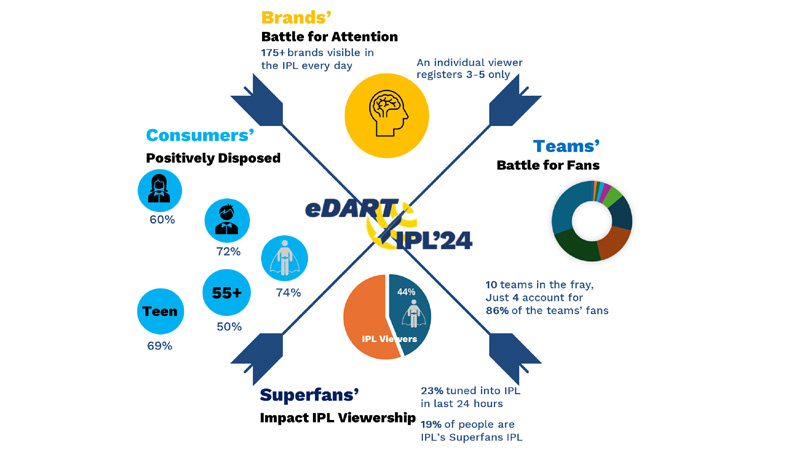
Mumbai: A day-after recall survey being conducted jointly by Kadence International and Crisp Insights shows that amidst the multitude of brands vying for attention during an IPL game, an individual viewer recalls only three-five brands, underscoring the battle for attention brand face in the IPL. Viewer engagement positively correlates with brand recall, with more engaged viewers more likely to remember brands. Surprisingly, mobile screen viewers exhibit better brand recall compared to those watching on larger screens, indicating evolving media consumption habits of the involved viewers of the IPL.
The survey covers key cities in the catchments of the 10 IPL teams, with male and female respondents aged 15-65. Assessing day-after recall via telephonic interviews, the survey measures the impact seeing a brand as part of the IPL viewing experience has on the audience. Kadence International, a global market research agency specialising in CATI and CAPI-based surveys, is conducting 1500 odd interviews every week for the duration of the IPL.
Highlights:
23 per cent of people are tuning into IPL games within the past 24 hours, reaffirming the IPL’s enduring popularity. While IPL is far more popular with men, with as high as 30 per cent of them tuning in to the games, 12 per cent of women are tuning in, too, with as many as 30 per cent actively following the progress of the IPL. The IPL enjoys widespread popularity across age groups, with young adults and seniors equally likely to join and actively follow the tournament.
The survey identifies the IPL Superfans as devoted enthusiasts who exhibit exceptional dedication to the tournament and have a propensity to watch every game. One in five of the respondents surveyed demonstrated the characteristics of a Superfan. They are twice as likely to have watched a game within the past 24 hours compared to other viewers and express strong emotional attachment to the IPL.
Superfans constitute the core target for brands interested in the IPL. They make up a fifth of the audience but because they try and follow every game, they make of 44 per cent of the viewers of an individual IPL game. They are more likely to notice brands and more likely to rewards brands for sharing their passion with 74 per cent responding positively to at least one brand’s communication.
Almost half of IPL viewers do not have a favourite team; of the rest, 86 per cent are CSK, RCB, KKR, or MI fans. While CSK has the largest fan base, with, for instance, more fans among Delhiites than Delhi Capitals, RCB has the strongest in-catchment following, with 84 per cent of the fans in Bangalore naming it as their favourite team.
The report assesses the visibility and performance of brands present as tournament or team sponsors and advertisers during IPL matches; highlighting brands recalled by viewers. To date Dream11, Tata Group, Jio, My11 Circle, RuPay and CEAT are the most recalled brands.
Commenting on the report, Crisp Insights’ Ritesh Ghosal said that with over 175 brands getting associated with the teams, the broadcast, or the event, getting noticed is a growing challenge for brands. Further, with each mode of association coming at a very different price, assessing return-on-investment for the brand of these modes of association becomes a key input to decision-making. Our survey provides actionable insights to navigate the competitive landscape and capture audience attention effectively and efficiently.
Commenting on the report, Kadence International’s Aman Makkar said that IPL is not just the biggest sporting event but the most critical window in the marketing calendar for the year. Marketers either buy into the IPL or wonder how to compete for attention while staying out. E-DART IPL’24 aims to provide useful data on how audiences interact with the IPL for all marketers.
Crisp Insight and Kadence International’s latest report serves as a beacon for brands navigating the competitive landscape of IPL sponsorships, offering actionable insights into audience engagement, brand recall, and the evolving dynamics of fan loyalty. As brands vie for attention amidst the IPL frenzy, strategic alignment with the tournament’s pulse emerges as paramount for sustained visibility and impact.