MAM
‘Digital marketers need to be more confident:’ Digital Marketer Awards
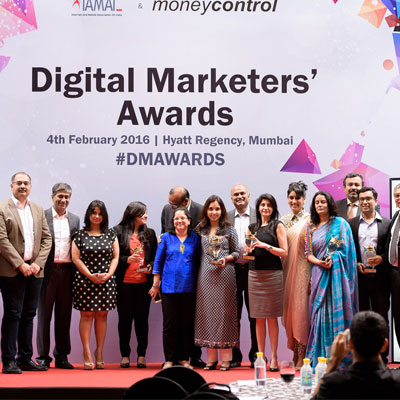
MUMBAI: For the first time, India’s top digital marketers came under one roof to appreciate and uphold the brilliant work that their peers are doing exclusively on the digital front. Put together by Moneycontrol and IAMAI, the maiden Digital Marketing Awards saw a healthy turnover of CMOs, executives and creatives from various sectors in the industry.
Dentsu Aegis Network chairman & CEO South Asia Ashish Bhasin set the tone of the awards function with his address to the audience. “Digital marketers should get confident,” he said, adding, “We must move on from convincing others and ourselves about the imminent digital future with quotes, studies and results. If someone isn’t convinced already, leave them be. They will soon follow after.”
Staying true to the medium that the show was vouching for, attendees were requested to tweet about the event with #DMAwards, with a live Twitter feed visible to all on the monitor.
Network18 group board of director Rohit Bansal was the Keynote Speaker at the award ceremony and shared his views on the future of digital marketing where new trends were being introduced every day.
On the difficulty in categorising the entries, jury and Mahindra Holidays & Resort India CMO Deepali Nair shared that the first edition of the awards was definitely a learning experience and based on the results and feedback the jury is considering to club or separate a few categories. “When deciding on how many categories to have it is always a debate as to what to club and what not to. After we got the entries, there was a bit of learning on how to categorise the digital campaigns. You may see one or two more categories next year because in clubbing some categories, we saw some entries losing out. Some brands are restricted by virtue of their categories and hence we are thinking of separating them. A category like Travel and Hospitality is vast and there is a lot of good work, so each deserve their own category for the awards,” Nair said.
Conversely, she added, “In several awards we have seen bank, insurance and mutual funds as separate categories. But when you think of financial services and what they are doing on the digital front in their digital brand communication, I feel that is a category we can club together.”
Speaking on the occasion, Moneycontrol COO Rubeena Singh said, “Brands have started investing a lot of money in digital marketing, which is significantly growing every single day. We at Moneycontrol have also taken path breaking initiatives to reach out to the youth through this medium. Being the face of India’s digital growth story, we feel there couldn’t have been a better opportunity for us to recognise the leaders in the digital marketing industry today.”
The awards come at a crucial juncture when the industry upgrades itself to the changing times and not only churn out serious digital work but have yardsticks and standards to compare and appreciate the trends setters.
The winners, who took away the Digital Marketing Awards are as follows:
• Karthi Marshan, Kotak- Digital Marketer of the Year, Banking/ Insurance
• Gaurav Suri, UTI mutual fund – Digital Marketer of the Year, Mutual Fund / Broking
• Naveen Kukreja, Policy Bazar – Digital Marketer of the Year, ECommerce / Online Classified
• Manmeet Vohra, Starbucks – Digital Marketer of the Year, Travel /Hospitality
• Bedraj Tripathy, Godrej Interio- Digital Marketer of the Year, FMCG / Consumer Durable
• Aparna Lal, Microsoft – Digital Marketer of the Year, IT / ITES
• Karan Sarin, One Plus – Digital Marketer of the Year, Mobile Service/Hardware
• Reema Kundnani, Oberoi Realty – Digital Marketer of the Year, Real Estate
• Amit Tiwari, Philips – Digital Marketer of the Year, Healthcare
• Virat Khullar, Renault – Digital Marketer of the Year, Automobile

AD Agencies
Omnicom posts $6.2 bn Q1 revenue, EBITDA margin rises to 14.8 per cent
AI push and cost synergies lift margins in first full quarter post-merger
NEW YORK: Omnicom has reported a robust first quarter following its acquisition of Interpublic Group, signalling early gains from integration, cost efficiencies and a sharper focus on AI-led services.
The results mark the first full quarter with Interpublic’s operations included, offering a clearer view of how the combined entity is shaping up. Revenue from core operations stood at $5.6 billion, up $345 million year on year on a combined basis, while organic growth came in at 3.9 per cent. Adjusted EBITDA margin rose sharply by 240 basis points to 14.8 per cent, reflecting early synergy benefits.
“We’ve seen momentum and cohesive growth across the organisation,” said Omnicom chief executive officer John Wren. “Our results demonstrate the benefits of realigning our portfolio and moving decisively on integration.”
A key part of that realignment involves shedding underperforming assets. Omnicom has identified businesses worth roughly $3.2 billion in annual revenue for disposal, with about $1 billion already exited in the first quarter. The company expects to complete most of the remaining divestments over the coming quarters, sharpening its focus on higher-growth, higher-margin operations.
On the bottom line, adjusted earnings per share rose 11.8 per cent to $1.90, underlining the financial impact of cost discipline and integration. The company is targeting $900 million in cost synergies by 2026, rising to $1.5 billion by mid-2028.
“We are realising significant cost reduction synergies while continuing to invest for growth,” said Omnicom chief financial officer Philip Angelastro.
Beyond the numbers, the strategic pivot is becoming clearer. Omnicom has restructured its business around “core operations”, stripping out assets earmarked for sale to highlight the segments driving future growth. More than half of its revenue now comes from integrated media, which includes data, commerce, CRM and content automation, areas that are growing faster than traditional advertising.
Indeed, integrated media led growth in the quarter with high single-digit gains, while PR and experiential businesses delivered mid-single-digit growth. Healthcare posted modest gains, while traditional advertising lagged, reflecting a broader industry shift towards performance-driven and tech-enabled marketing.
Central to this transformation is Omni, the company’s AI-powered marketing and sales platform. Rolled out across the organisation during the quarter, the system connects data, talent and services while enabling AI-driven workflows.
The platform is already delivering tangible results, improving media performance, speeding up campaign execution and enhancing measurement capabilities. Integration with partners such as Adobe and Amazon is further expanding its reach.
“We’ve put the latest agentic AI tools in the hands of all our employees,” said Wren, highlighting the company’s push towards automation and data-led decision-making.
The shift is also reshaping client relationships. Omnicom reported new business wins with major brands including IBM, GSK and John Deere, while expanding engagements with existing clients such as Unilever and Exxon. Increasingly, clients are opting for consolidated partnerships, relying on a single provider for end-to-end marketing and sales services.
“There’s a clear trend of clients choosing one partner to manage most of their needs,” said John Wren. “Our integrated model makes that easier.”
Geographically, the US remains the largest market, contributing 61 per cent of revenue, followed by Europe and the UK at 21 per cent. Growth was strongest in the US, with other regions posting modest gains.
The balance sheet remains solid despite increased debt following the acquisition. Long-term debt stood at $10.2 billion at the end of the quarter, while liquidity was supported by $4.3 billion in cash and a $3.5 billion revolving credit facility. The company is also returning capital to shareholders, repurchasing $2.8 billion worth of shares in Q1 as part of a planned $5 billion buyback programme.
Looking ahead, Omnicom remains optimistic but cautious. While the company expects double-digit EPS growth for the year, it acknowledged ongoing geopolitical uncertainties, particularly in the Middle East, though the region accounts for less than 2.5 per cent of revenue.
The integration of Interpublic is still in its early stages, but the initial signs point to a business that is not just bigger, but structurally different. With AI at its core, a streamlined portfolio and a growing tilt towards integrated services, Omnicom is betting that scale, simplicity and smart technology will keep it ahead in an increasingly complex marketing landscape.
If the first quarter is anything to go by, that bet is already starting to pay off.