Brands
DDB Mudra Group creates a new rally cry for team KKR


MUMBAI: The Kolkata Knight Riders (KKR) is a franchise cricket team representing the city of Kolkata (West Bengal) in the Indian Premier League (IPL). The team, defined by its ‘Korbo, lorbo, jeetbo’ (Play, Fight, Win) spirit has won the championship trophy twice. At the IPL 2018, the team has already drawn first blood in its match against Royal Challenger Bangalore (RCB) and then against Delhi Daredevils (DD).
Created by the DDB Mudra Group, KKR’s latest anthem #KKRHaiTaiyaar (KKR is ready) shows the city and its die-hard fans gearing up for the 2018 IPL season. Featuring Bollywood celebrity and team owner Shahrukh Khan, the anthem has been crafted to give KKR and its fan-base a distinct, symbolic action in the form of a fist pump, which has the potential to become a ritual during every KKR match. The lyrics give the team’s decade-long war cry – ‘Karbo, lorbo, jeetbo’ a new spin, resulting in an anthem that fans – both old and new, can connect with.
Kolkata Knight Riders MD and CEO Venky Mysore says, “Every year our marketing embarks on a research and insight-backed exercise that aims to find the pulse of our fans to arrive at a tagline that rings most true to KKR. This year, along with the creative team at the DDB Mudra Group, the team has come up with #KKRHaiTaiyaar; which truly signifies the mood at our camp.”

The anthem boldly challenges KKR’s opponents to watch out as the team sets out to destroy every challenge in its path to becoming champions again. The visual representation and the music composition of the anthem captures the pride and passion that drives everyone associated with KKR – right from the players, to the coaching staff, the groundskeeper, the bat-maker , etc., along with the millions of supporters that live and breathe for the team.
DDB Mudra Group national creative director Rahul Mathew adds, “KKR has always prided itself on being more than just a team. KKR is an attitude. And you see this attitude in every aspect of their game; be it the auction, the training, the selection, the strategy, the execution of it, their victories and even their losses. Which is why, the KKR fan base spills far and wide outside of Kolkata. Because while Kolkata maybe in the name, the spirit of the Knight Riders is something everyone relates to. It’s this very spirit and attitude that we’ve captured in the work and in our call to arms #KKRHaiTaiyaar.”
Backed by a strong media strategy, the campaign is being showcased across television channels, radio, digital and print. In the print campaign, the players are shown coming out of moulds, to emphasise their readiness. On the digital medium, the anthem has more than 1.9 million views and 21K shares on the brand’s Facebook page alone, since its launch on 6 April 2018.







Brands
Samsung certifies 1,000 Maharashtra students in AI and coding
The South Korean electronics giant marks its first large-scale skilling push in the state, with women making up nearly half the national programme’s enrolment
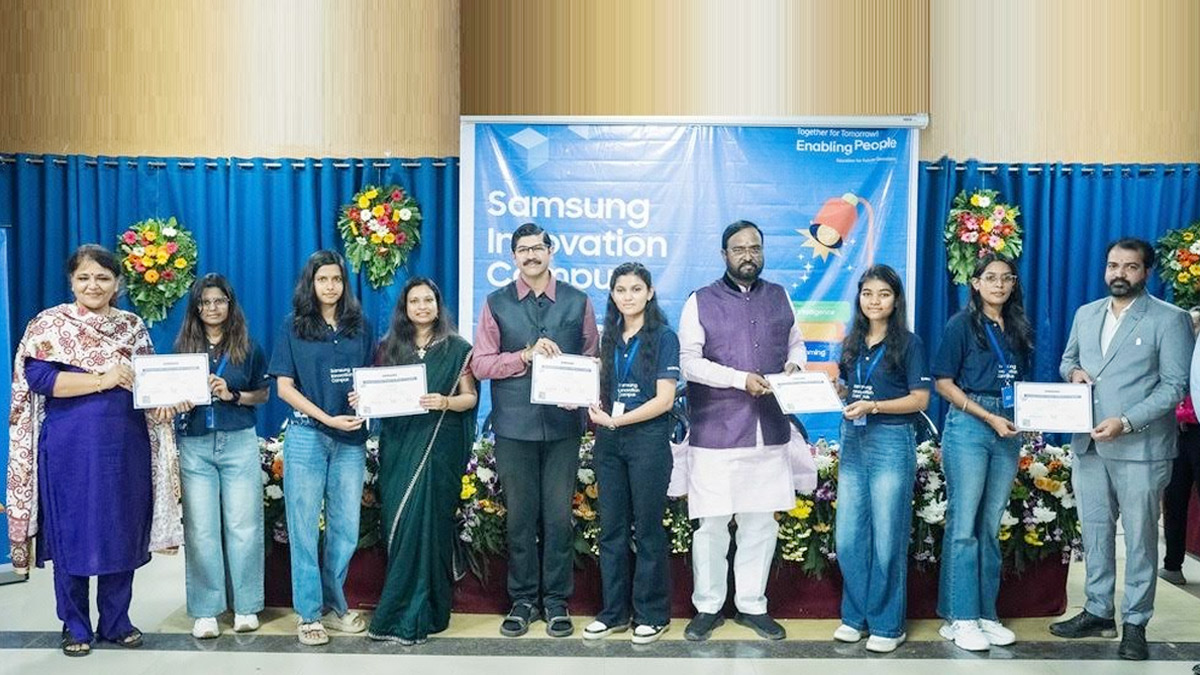
PUNE: Samsung has put 1,000 students in Maharashtra through a certified training programme in artificial intelligence and coding, the largest such drive the South Korean electronics company has run in the state and a signal that corporate India’s skilling ambitions are moving well beyond the boardroom brochure.
The certifications were awarded under Samsung Innovation Campus (SIC), the company’s flagship corporate social responsibility programme, which launched in India in 2022 with the stated aim of democratising access to future-technology education. The 1,000 graduates were drawn from four institutions: 127 from Savitribai Phule Pune University, 373 from Pimpri Chinchwad University, 250 from D.Y. Patil University’s Ramrao Adik Institute of Technology and 250 from Anjuman-I-Islam’s Kalsekar Technical Campus. All completed training in either AI or coding and programming, the two disciplines Samsung has identified as the critical pillars of the digital economy.
The programme does not stop at technical training. Soft-skills development and career-readiness modules are baked into the curriculum, a deliberate attempt to close the gap between what universities teach and what employers actually want.
“India’s digital growth story will ultimately be shaped by the quality of its talent pipeline,” said Shubham Mukherjee, head of CSR and corporate communications at Samsung Southwest Asia. “As technologies like AI move from the periphery to the core of industries, skilling must evolve from basic training to building real-world capability. This milestone in Maharashtra reflects how industry and academia can come together to create a future-ready workforce that is both globally competitive and locally relevant.”
The Maharashtra drive sits within a rapidly scaling national effort. Samsung Innovation Campus trained 20,000 young people across India in 2025, hitting its stated target for the year. Women account for 48 per cent of national enrolments, a figure the company cites as evidence of its push for an inclusive technology ecosystem. The programme is implemented in partnership with the Electronics Sector Skills Council of India and the Telecom Sector Skill Council.
Samsung, which is marking 30 years in India this year, runs SIC alongside two other initiatives, Samsung Solve for Tomorrow and Samsung DOST, as part of a broader effort to build what it calls a generation of innovators with both the technical depth and the problem-solving mindset to thrive in a fast-moving digital world.
A thousand certified students is a tidy headline. Whether they find jobs that match their new skills is the harder question, and the one that will ultimately determine whether corporate skilling programmes like this one are genuine pipelines or well-photographed gestures.






