Brands
Colour me record L’oréal inks Guinness title with 422 stylists in action

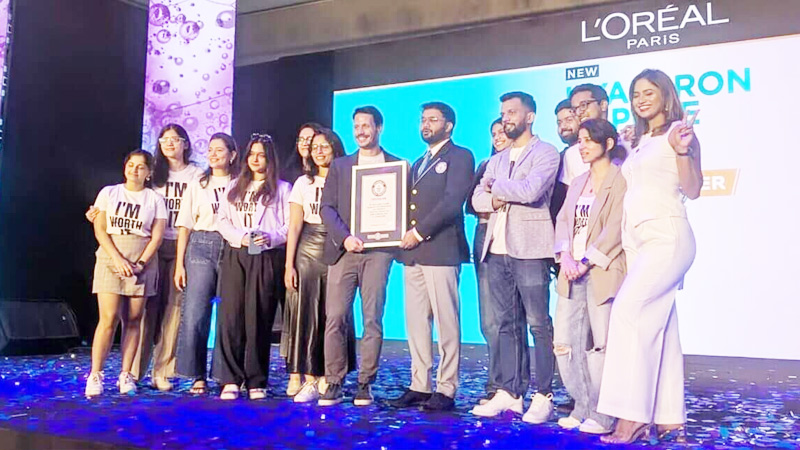
MUMBAI: When 422 hairdressers pick up their brushes in unison, history gets a new shade. On 17 September 2025, L’Oréal Professionnel turned Mumbai’s NESCO into the nation’s largest ever salon, setting a Guinness World Records title for ‘Most people colouring hair’ in one go.
The grand spectacle, dubbed Hair Color Coders 2025, saw 422 hairstylists and 422 models take over a 1 lakh sq ft space, powered by 60 backwashes and more than 5,000 tubes of colour. The palette of the day? Iconic Browns, the brand’s colour trend of the year versatile tones designed to capture India’s evolving love affair with understated glamour.
But this was more than just a numbers game. With L’Oréal Professionnel Artistic Ambassadors and Indian Hairdressing Award winners leading the charge, the event spotlighted the rise of the hairdresser-as-creator. Stylists weren’t just colouring hair they were shaping digital stories, creating over 1,000 social mentions in a single day, and claiming their place as influencers in India’s booming beauty ecosystem.
“What we achieved today showcases our ability to set global benchmarks,” said Zeenia Bastani, Director, Professional Products Division, L’Oréal India. “From Min Kim’s mega masterclass to 422 Iconic Brown makeovers under one roof, it was a celebration of artistry, entrepreneurship, and an overwhelming love for hairdressing.”
The day was anchored by Min Kim, L’Oréal Professionnel’s Global Color Ambassador, who demonstrated cutting-edge techniques like face-framing and tonal layering. To prove the power of browns, she delivered a live makeover for actress Kritika Kamra, transforming her locks into a glossy, dimensional brunette showstopper that set Instagram buzzing.
Mathilde Barthélemy-Vigier, General Manager, L’Oréal Professionnel India, called the event a “pivotal step for the professional hairdressing industry”. She underlined how premium salon services like hair colour are now driving unprecedented growth, with salons morphing into destinations for personalised, elevated experiences.
The record-breaking showcase was the culmination of four intensive pre-event masterclasses where hairdressers were trained in not just cut, colour and style but also social savviness ensuring their artistry resonates both in salons and online feeds. “Education has been the backbone of our brand,” said Priya Kasthuri Rangan, Head of Education, L’Oréal Professionnel India. “Hair Color Coders wasn’t only about setting a record, it was about equipping stylists with the skills and confidence to shine as creators.”
For the hairstylists, the event was both a celebration and a career-defining stage. Glossing, balayage, and gloss-layering techniques were redefined at scale, proving that Indian hairdressing can match and even set global trends.
As Min Kim summed it up: “This moment reflects the power of sharing knowledge and elevating hair artistry internationally. Browns are being reimagined globally and India just coloured itself onto that map in a record-setting way.”
From 5,000 tubes of Inoa, Majirel and Dia Color to 422 synchronised transformations, Hair Color Coders 2025 wasn’t just about dyeing hair, it was about dyeing history.