MAM
Celebrating Piyush: Mumbai’s ad world gathers to remember the maestro who made advertising human

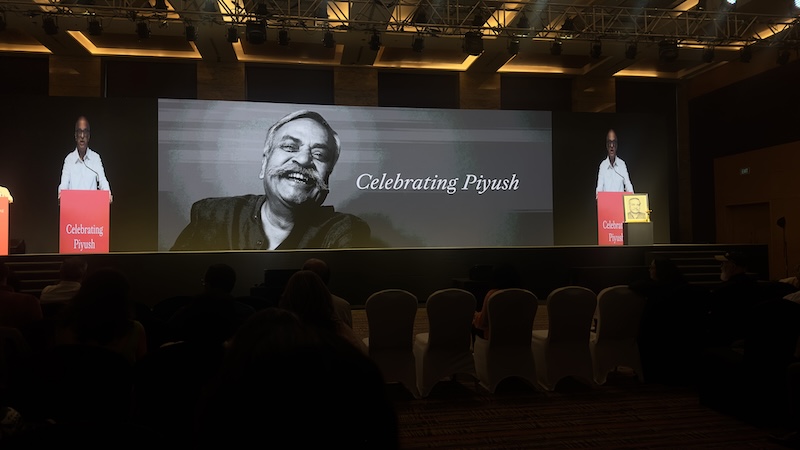
MUMBAI: At 10am on a Sunday morning, 1,500 of India’s advertising elite crammed into Mumbai’s Grand Hyatt to do what the industry does best: tell stories. This time, though, the subject was one of their own. Piyush Pandey, the creative titan who died last week, got the send-off befitting a man who transformed Indian advertising from borrowed jingles and forced sophistication into raw, real-life observation. The numbers would have swelled far higher had Ogilvy thrown open the doors, but this was an invitation-only affair—a gathering of those who’d worked alongside, been mentored by, or simply marvelled at the man who made “front foot pe khelo” the rallying cry of an entire generation.
The two-hour tribute played out like a masterclass in the man himself—equal parts emotion, irreverence and creative brilliance. Hepzibah Pathak, Ogilvy India’s executive chairperson, took the stage visibly shaken, setting the tone for what would become an outpouring of stories that captured Pandey’s essence better than any obituary could. She was followed by a caravan of speakers: WPP’s chief operating officer Devika Bulchandani, Ogilvy India group chief executive Rajesh VR, chief strategy officer Prem Narayan, chief creative officers Kainaz Karmakar and Harshad Rajadhyaksha, vice-chairman and director client relations Madhukar Sabnavis, the legendary R Balki, McCann Erickson’s Prasoon Joshi, Pidilite director Madhukar Parekh, marketing guru Suhel Seth, his nephew and agency boss Abhijit Avasthi, and Asian Paints chief executive and managing director Amit Syngle. Even commerce minister Piyush Goyal made time to pay tribute, underscoring the breadth of Pandey’s influence beyond advertising’s narrow confines.
 The 6:30am phone calls became the event’s leitmotif. Most speakers wore them as badges of honour—those dawn raids when Pandey would ring, sometimes to share a creative idea that had struck him in the shower, other times to help them excavate their own. His Ogilvy team recalled in granular detail how he mentored them: kind words when they delivered good work, sharp rebukes when they didn’t push hard enough. “Front foot pe khelo,” he’d say, deploying his favourite cricket analogy to urge aggression over timidity. Karmakar captured the bittersweet mood: “Who will make those 6:30am calls now?” she asked, confessing she’d hated being woken but lived for those conversations. Others complained they’d been left out of the dawn club, wondering aloud why Pandey’s Rolodex of early-morning confidants hadn’t included them.
His creative team peeled back the curtain on his teaching methods. At a Cannes Lions masterclass, he’d begun not with case studies or charts but with meditative breathing. Inhale deeply and slowly, he’d instructed global participants. That’s observation—riding trains, chatting with taxi drivers, watching life unfold in its messy, unscripted glory. Exhale. That’s the creative work that connects with real audiences, not the manufactured personas of focus groups. It was vintage Pandey: grounding the lofty business of advertising in the quotidian rituals of simply paying attention.
Syngle, who worked with Pandey for 37 years across Cadbury, Pidilite and Asian Paints, painted a portrait of a man allergic to pretence. He recalled being dragged from formal dinners during overseas trips—the kind with white tablecloths and wine lists—to eat dal chawal and bhindi at hole-in-the-wall Nepalese joints. “That was Piyush,” Syngle said. “Authentic. You got what you saw.” When invited to join the Pidilite board, Pandey made clear he wouldn’t wear formal clothes to meetings. Not as rebellion, but as declaration: this is who I am. Take it or leave it.
Friends and cricketers Amit Mathur and Arun Lal delivered the comic relief Pandey would have demanded. They shared his joke about why actress Sridevi wouldn’t marry Lal: “Because she wouldn’t want to be called Sridevi Lal”—a reference to politician Chaudhary Devi Lal that sent Pandey into his trademark loud guffaws. The joke was terrible. The memory was priceless.
 Goyal’s recollection offered a window into Pandey’s principles. In 2014, the minister spent six hours at Pandey’s Shivaji Park home trying to convince him to handle BJP’s election advertising. “Despite years of friendship, he was stubborn every time I approached him for days,” Goyal explained. “I thought I’d failed. Next morning, relief: he called saying he’d do it.” The result was “Ab ki baar, Modi Sarkar”—a slogan that became the soundtrack of that election. What persuaded him remains unclear, but the episode revealed a man who wouldn’t be rushed or arm-twisted, even by friends in high places.
Balki and Joshi traded admiration for Pandey’s work, but Balki’s anecdote cut deeper. They’d once decided to quit smoking together after visiting a hypnotherapist. Pandey called daily to compare notes—until he didn’t. When Balki rang, Pandey admitted he’d started smoking again. Balki lasted longer, then folded too. But Balki struck a defiant, almost evangelical note: at a time when advertising has become dreary—all performance metrics and programmatic buying and jargon-stuffed decks—Pandey’s death has ironically handed the industry its biggest campaign. “To bring advertising back into focus,” he said. “No amount of jargon, no amount of people trying to distract us from the fact that we have to do great stuff will work now. People are looking and saying: this is advertising. We’ve got the best opportunity for great work.” It was a call to arms wrapped in a eulogy.
Prasoon Pandey, Piyush’s younger brother and an accomplished film-maker, delivered perhaps the most wrenching tribute. After seeing the industry’s outpouring, he wondered if his own love had been enough. “He was my elder brother, my father, my hero,” he said. “We’d speak six or seven times a day—not about work, but jokes, vicious pranks he wanted to pull on family or friends.” On work, the dynamic was pure Piyush: he’d hand Prasoon the soul of an idea in three or four words and expect execution. “We were drinking beer on our balcony when he asked: how strong would eggs be from a hen that feeds from a Fevicol container?” Prasoon recalled. “I thought it brilliant. He told me to go do it.” The result was one of Indian advertising’s most memorable campaigns—born not in a conference room but over beers and brotherly banter.
The event was interspersed with screenings of Pandey’s greatest ads—the Fevicol campaigns, the Cadbury work that made Indians fall in love with chocolate again, the Asian Paints spots that turned home décor into emotion. The audience responded with applause, oohs, ahs, and more than a few tears.
Lunch followed the stories: a spread of his favourite Indian dishes, the kind he’d have sought out in that Nepalese eatery instead of rubber chicken at a five-star buffet. Attendees left smiling, bellies and hearts full, having spent two hours remembering a man who’d taught them that the best advertising doesn’t sell products—it celebrates life.
Piyush would have approved: tears, laughter, great work on screen, and damn good food to finish. Front foot pe khelo, indeed.