
MAM
ASCI Vision 2032 targets faster self regulation in the AI era
Panel highlights trust, AI, creators and technology as advertising enters a new phase


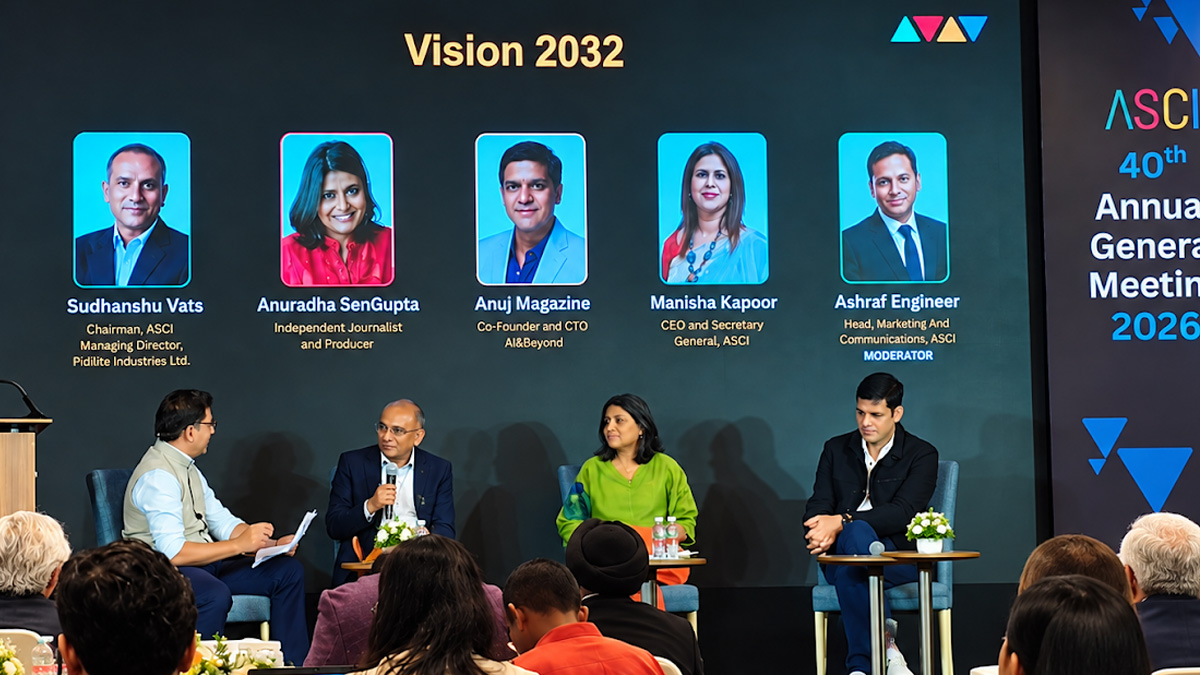
MUMBAI: Advertising is moving at breakneck speed, and ASCI wants its guardrails to move before the brakes are needed.
That was the underlying message at the Vision 2032 panel at the Advertising Standards Council of India’s Annual General Meeting 2026, where industry voices examined how self-regulation needs to change as artificial intelligence, creators, digital media and shifting consumer expectations reshape advertising.
The panel brought together ASCI head of marketing and communication Ashraf Engineer, AI&Beyond CTO Anuj Magazine, ASCI CEO and secretary general Manisha Kapoor, ASCI chairman Sudhanshu Vats and independent journalist and producer Anuradha Sengupta. The discussion focused on a question at the heart of ASCI’s new vision: how can advertising keep evolving without leaving consumer trust behind?
The answer, according to the discussion, lies in moving self-regulation beyond a model that primarily reacts to complaints. ASCI’s Vision 2032 proposes three Centres of Excellence covering legal and regulatory affairs, AI and responsible innovation, and the creator ecosystem. The aim is to prepare the advertising industry for issues that are emerging faster than conventional regulatory processes can handle.
The legal and regulatory pillar becomes particularly relevant as India’s policy landscape develops around AI and data protection. At the same time, the creator economy is making the boundaries of advertising increasingly fuzzy, with influencers and individual content creators becoming important voices for brands. The panel noted that both developments ultimately return to the same currency: trust.
That trust is becoming harder to earn in a digital-first world. The panel discussion highlighted how consumers are no longer passive recipients of brand messages. Social platforms, search engines and AI tools give them the ability to question claims, compare information and investigate brands almost instantly.
This also changes the role of self-regulation. Instead of simply identifying an advertisement after something goes wrong, the emphasis is shifting towards educating advertisers, creators and consumers so that fewer problems emerge in the first place. The Vision 2032 approach therefore puts prevention alongside enforcement, rather than treating the two as competing priorities.
Scale, however, remains the elephant in the ad room.
As content volumes rise, ASCI cannot realistically rely only on human teams to monitor every piece of advertising. The panel discussed the possibility of using education to get 60 to 70 per cent of the process right before problems reach the regulator, while technology handles more of the remaining workload.
AI could become an important part of that equation, but it comes with its own fine print. Magazine pointed out that generative and agentic AI systems are probabilistic and non-deterministic, meaning identical inputs can potentially produce different outputs. For advertising, where consistency and accuracy of claims matter, that creates an obvious regulatory challenge.
Yet AI’s ability to recognise patterns at a scale humans cannot match could also prove useful. The panel cited an accuracy rate of around 98 to 99 per cent for existing ad-version detection work, while identifying throughput as the bigger challenge. The broader ambition is to explore whether technology can eventually help scan the entire advertising universe rather than waiting for individual issues to surface.
There is also room to use AI in the less glamorous parts of regulatory work. The panel discussed opportunities around processes such as drafting and operational tasks, where automation could reduce the time spent on repetitive work while leaving judgement-heavy decisions to people.
ASCI’s experience with its Academy offers another indication of how the organisation is attempting to scale. Over the past three years, the Academy has moved from developing its initial learning programmes over several months to creating subsequent programmes much faster. Its school education work has also expanded significantly between the first and sixth months of implementation, while partnerships and alliances have widened its ability to deliver consumer education, industry training and thought leadership.
The wider ASCI roadmap already includes 11 thought leadership reports, more than 1 million students reached through its education efforts and over 8,000 professionals trained. The organisation has also indicated that the student programme could potentially scale tenfold through state partnerships and train-the-trainer models. With roughly 100 million children in India, however, the current reach of 1 million students also underlines the size of the road ahead.
The panel also placed self-regulation in the context of ASCI’s four-decade evolution. Its role has expanded alongside changes in television, cable and now digital advertising, with the underlying argument that self-regulation can bring context and pragmatism to advertising decisions while also responding faster to changing formats.
And then there is the creator economy, where the traditional definition of an advertiser is becoming increasingly difficult to pin down. The growth of influencers and user-generated content means brands can enter conversations without having complete control over how those conversations develop.
That becomes particularly complicated when advertising intersects with public-interest issues such as healthcare, food, children’s safety and other social concerns. The panel noted that brands increasingly want to participate in wider societal conversations, but doing so can also expose them to regulatory and reputational risks. Proactive understanding of the rules and stronger self-regulation could therefore become a form of risk management for marketers.
AI adds another layer to that challenge through deepfakes and synthetic endorsements. The panel discussed the growing possibility of public figures being digitally represented as endorsing products or services they never backed, while AI-generated imagery can also create misleading impressions about products.
Technology alone may not provide the answer. Existing tools designed to identify synthetic content or attach digital markers can help, but they are not foolproof. Even basic actions such as taking a screenshot can undermine some watermarking systems, making industry-wide standards and practical guardrails increasingly important.
The urgency is reflected in where complaints are now coming from. Digital media accounts for 95 per cent of ASCI’s complaints, according to the panel discussion, highlighting how dramatically the advertising landscape has shifted from the traditional media environment.
The broader Vision 2032 framework also looks beyond the immediate advertising cycle. ASCI’s roadmap includes work around legal and policy developments, responsible AI, synthetic-content disclosures, agentic AI guardrails and creator education. Its Academy, thought leadership initiatives and proposed Centres of Excellence are intended to build capabilities before new problems become mainstream.
The message from the panel was therefore less about predicting exactly what advertising will look like in 2032 and more about preparing for a landscape where the next disruption could arrive well before the rulebook catches up. For ASCI, the task is to make self-regulation faster, more preventive and more technology-enabled without allowing speed to outrun trust.






