MAM
Ariel’s #ShareTheLoad campaign focuses on women’s sleep deprivation issues due to household work


MUMBAI: While most ads propagated the notion that women bear all the brunt of housework, Ariel India was the first to break that stereotype a few years ago. The successful #ShareTheLoad campaign revolved around the unequal division of domestic chores, urging men to take up more responsibility. Continuing its mission, the fourth edition of the campaign, #EqualSleep, addresses the issue of sleep deprivation due to excessive household work which affects 71 per cent of women.
Let’s rewind. In 2015, Ariel India raised a triggering question ‘Is laundry only a woman’s job?’ followed by ‘Dads Share the Load’ in 2016. This helped locate the root cause and the stigma of prejudice passed down from one generation to the next. In 2019, it started to drive action with sons urging parents to raise them like they have been raising their daughters, so that the future generation is more equal.
P&G India CMO and fabric care head for the Indian subcontinent Sharat Verma says that the aim of #EqualSleep is to highlight how women compromise their sleep, downtime, rest and personal time to provide her very best to the family and her career.

“Even within progressive households, where men have started to increase their involvement in domestic chores, the woman still takes the onus of getting everything done; the mental load is still only hers. When men don’t share the load, what ends up getting impacted is something as basic as sleep. Lack of sleep is, thus, almost an indicator of the inequality within the household. Hence, with this chapter, Ariel seeks to drive action, urging men to take the first step to #ShareTheLaundry and eventually, #ShareTheLoad for #EqualSleep,” he says.
An Ariel India survey found that from 79 per cent men in 2014 who thought laundry was only a woman’s job, the number has steadily declined to 41 per cent in 2019. However, even today, only 35 per cent of men contribute daily to household chores. In a survey, most men agree that washing clothes in a machine are the easiest chore for them to start taking over.
Verma went on to add that the campaign shifted from showing that men weren’t sharing the load to showing how this decision impacts women. Uneven division of household chores like laundry is coming in the way of women getting enough sleep and rest with at least one hour of sleep that these women give up every day, over seven days that accounts to almost an entire night’s sleep that is lost every week, due to the uneven distribution of domestic responsibility
The film, conceptualised by BBDO, is depicted from the eyes of a little girl devoid of any conditioning; she notices her mom is missing at night while she is asleep and continues to notice her running around doing multiple things, tired and sleepy. The father’s moment of realisation is also in a way driven by the daughter missing her mom at night.
BBDO India chairman Josy Paul said, “We started with ‘the condition' in 2015 – Is laundry only a woman’s job? In 2019 we focused on the younger generation, who if raised in a balanced manner, will grow up to be a generation of equals. This year, we make men realise the severe impact on their partners/ wives when they don’t share the load at home i.e., unequal sleep.”
With every passing year, both BBDO and Airel have the challenge of coming up with the next round of an impactful #ShareTheLoad campaign. How do they manage it? “When thinking of the next leg, we realign ourselves with the evolved cultural context of current times. Society today is not the same as it was two years ago. Similarly, family and couple dynamics are not the same. So, we have to root ourselves in the reality of today. As a creative team, when we observe society, we see laundry as one of those daily chores where the distribution of load is uneven. Laundry, here, is the face of the movement,” Paul concludes.







MAM
Lego brings Messi, Ronaldo, Mbappé, Vinicius together
Campaign clocks 314 million views ahead of FIFA World Cup 2026 buzz.
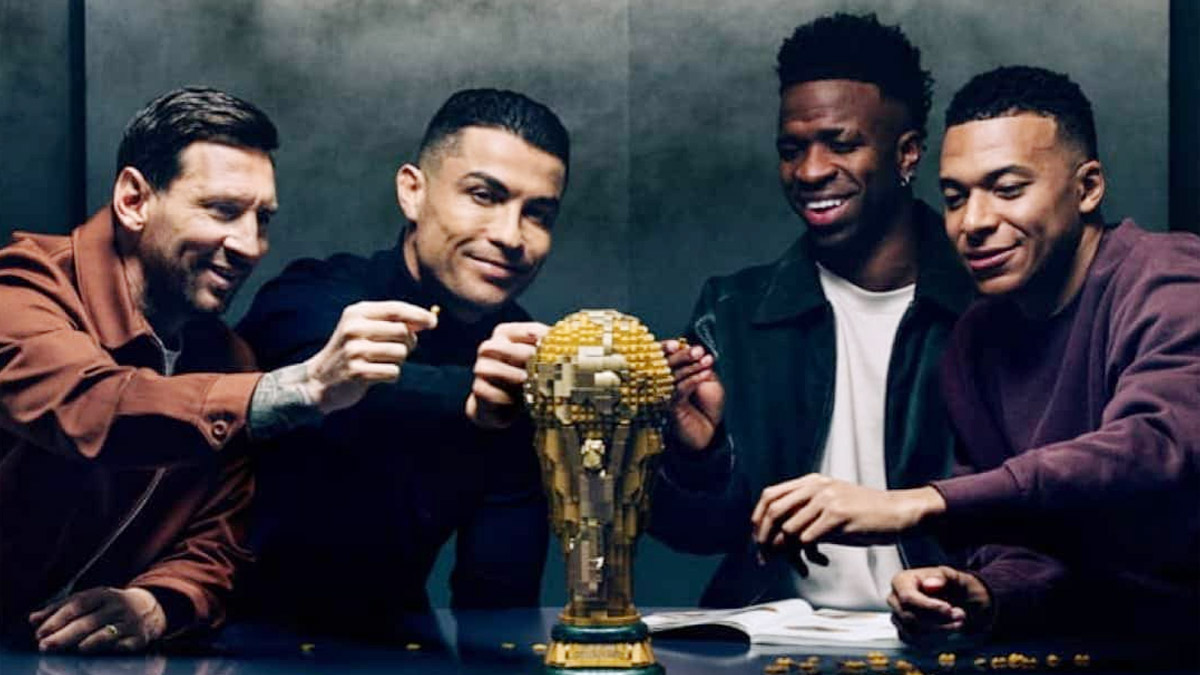
MUMBAI: Four legends, one frame and not a single tackle in sight. Lego has pulled off a crossover few thought possible, uniting Lionel Messi, Cristiano Ronaldo, Kylian Mbappé and Vinícius Júnior in a single campaign ahead of the FIFA World Cup 2026 only this time, they’re building dreams brick by brick.
Titled “Everyone wants a piece”, the campaign features the quartet assembling a Lego version of the World Cup trophy, before placing miniature versions of themselves atop it, a playful nod to football’s ultimate prize. Shared widely across social media, the ad carries a pointed disclaimer: it is not AI-generated, a subtle but telling signal in an era where even reality is often questioned.
The numbers tell their own story. The campaign has already crossed 314 million views on Instagram across the players’ accounts, with fans hailing it as a rare, almost nostalgic moment particularly for the reunion of Messi and Ronaldo, whose last shared campaign ahead of the 2022 World Cup became one of the platform’s most-liked posts.
Beyond the film, Lego is extending the play with exclusive, player-themed sets tied to each of the four stars, part of a broader football-led programme designed to ride the global momentum building towards 2026. The idea, as echoed by the players themselves, leans into the parallels between football and play experimentation, creativity, failure, and triumph.
Messi described the sets as a way to bring on-pitch moments into an imaginative, hands-on world, while Ronaldo called the transformation into a Lego figure a rare honour, blending sport with storytelling. Vinícius, meanwhile, struck a more personal note, recalling childhood moments of building with Lego and framing creativity as a universal language that transcends borders.
The timing is no accident. With the 2026 World Cup set to run from June 11 to July 19 across the United States, Canada and Mexico, and featuring an expanded 48-team format, global anticipation is already building. Argentina, led by Messi, will enter as defending champions, adding another layer of intrigue.
For Lego, the campaign does more than celebrate football, it taps into its mythology. Because when icons become figurines and rivalries turn into play, the beautiful game finds a new kind of pitch. one built, quite literally, by hand.






