
Brands
AI-driven memory crunch pushes India smartphone shipments down 10 per cent
Counterpoint says higher handset prices hit demand as Samsung bucks trend with growth


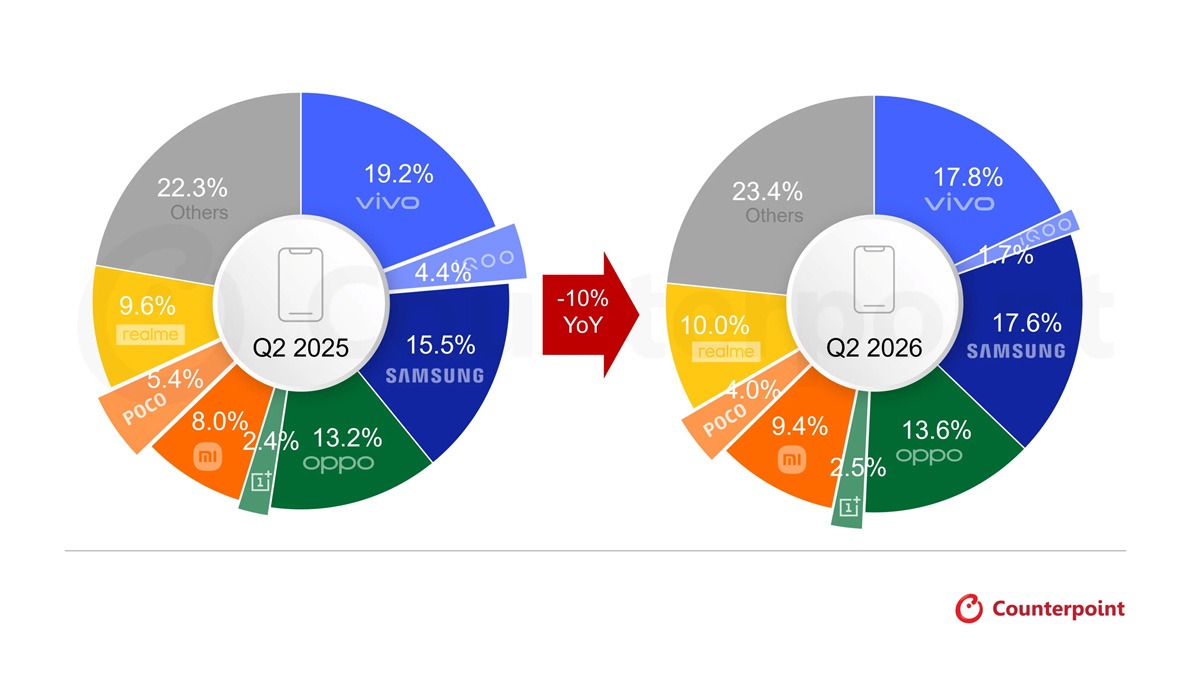
NEW DELHI: India’s smartphone market hit a speed bump in the second quarter of 2026, recording its steepest June quarter decline in six years as soaring component costs pushed handset prices sharply higher and persuaded consumers to hold on to their devices for longer.
According to Counterpoint Research’s Monthly India Smartphone Tracker, smartphone shipments fell 10 per cent year-on-year during the April to June quarter. The slowdown was driven by a sharp rise in memory and component prices, which forced almost every major smartphone brand to raise prices across multiple product categories, dampening consumer demand despite promotional offers and financing schemes.
Senior analyst Prachir Singh said the Indian smartphone market remained under pressure as both demand and supply weakened during the quarter.
He noted that record-high memory prices and rising component costs prompted manufacturers to implement multiple rounds of price hikes, resulting in an average smartphone price increase of around 15 per cent by the end of the quarter. At the same time, inflationary pressures, macroeconomic headwinds and weak discretionary spending extended replacement cycles.
The impact was most severe in the entry-level market.
Shipments in the sub-Rs 15,000 segment plunged 45 per cent year-on-year, making it the hardest-hit price band. Since Chinese smartphone makers have a strong presence in the entry and mid-range categories, their combined market share fell to its lowest level for a second calendar quarter since 2020.
To counter slowing demand, several manufacturers expanded their 4G portfolios in the affordable segment, recognising that while 5G remains the industry’s long-term growth engine, 4G devices continue to appeal to value-conscious buyers until component costs ease.
In contrast, the ultra-premium segment above Rs 45,000 remained resilient, supported by the growing popularity of financing options that lowered the upfront cost of flagship smartphones.
Research director Tarun Pathak said the market is expected to remain under pressure for the rest of 2026, with memory prices continuing to weigh on affordability.
He noted that smartphone memory prices have increased nearly fourfold since September 2025 and could rise to almost five times previous levels in the coming months. Counterpoint expects India’s smartphone market to decline 13 per cent year-on-year for the full year.
Since the second half traditionally accounts for most annual smartphone sales, manufacturers are expected to focus on portfolio optimisation, financing-led affordability and premium devices to sustain demand.
vivo, excluding iQOO, remained India’s largest smartphone brand with an 18 per cent market share.
The company benefited from strong demand in the premium segment following the launch of the V70 series. However, repeated price increases across its budget-focused Y and T series resulted in a double-digit decline in shipments compared with a year earlier.
Samsung was the only brand among the top five manufacturers to post year-on-year growth.
The South Korean company grew 2 per cent, narrowing the gap with vivo while retaining second place.
Growth was driven by healthy demand for the Galaxy A series and flagship Galaxy S smartphones. Samsung also launched aggressive summer promotions across devices including the A07 5G, A17 5G, A37 5G, A57 5G, and the Galaxy S25 and Galaxy S26 series.
Its strongest performance came from the Rs 15,000 to Rs 20,000 segment through the Galaxy A, M and F series.
OPPO retained third place with a 14 per cent market share.
The brand’s performance was supported by double-digit growth in smartphones priced above Rs 20,000, led by the A6 and K14 series.
Xiaomi, including POCO, ranked fourth with a 13 per cent share, while realme remained fifth.
Both brands recorded shipment declines after repeated price hikes reduced demand across their entry and mid-range portfolios.
For Xiaomi, higher prices affected models such as the Redmi A7, POCO C71 and POCO C75, while realme experienced weaker sales for the P4 and C85 series.
Apple’s shipments declined 3 per cent year-on-year, giving it a 7 per cent market share.
While demand for the iPhone 17 series remained strong, supply constraints and inventory shortages across online and offline retail channels limited shipment growth during the quarter.
Nothing emerged as India’s fastest-growing smartphone brand with 105 per cent year-on-year growth.
The company benefited from strong demand for the Phone (4a) and Phone (4a) Pro, alongside increased brand visibility through its title sponsorship of the Royal Challengers Bengaluru (RCB) during the Indian Premier League.
Google recorded the fastest growth in the ultra-premium segment, with Google Pixel shipments rising 68 per cent year-on-year.
Counterpoint attributed the performance to aggressive marketing, rapid expansion of offline retail presence and the absence of price increases.
MediaTek retained leadership in India’s smartphone chipset market with a 49 per cent shipment share.
More than 50 per cent of smartphones sold through organised retail channels during the quarter were financed using NBFCs or credit and debit card EMI schemes, underlining the growing role of financing in supporting premium purchases.
Meanwhile, AI+ posted strong demand in the entry-level segment with its AI+ Nova 2 and Pulse 2 smartphones.
Counterpoint also highlighted the unprecedented rise in memory costs. DRAM and NAND prices have pushed memory’s share of smartphone bill of materials from below 20 per cent to more than 45 per cent in the sub-Rs 15,000 segment. In some cases, cumulative price increases during 2026 exceeded 100 per cent of a handset’s original launch price, underscoring the pressure facing both manufacturers and consumers as the market navigates one of its toughest pricing environments in recent years.






