iWorld
Times Network hosts Digital India Summit and Awards 4.0

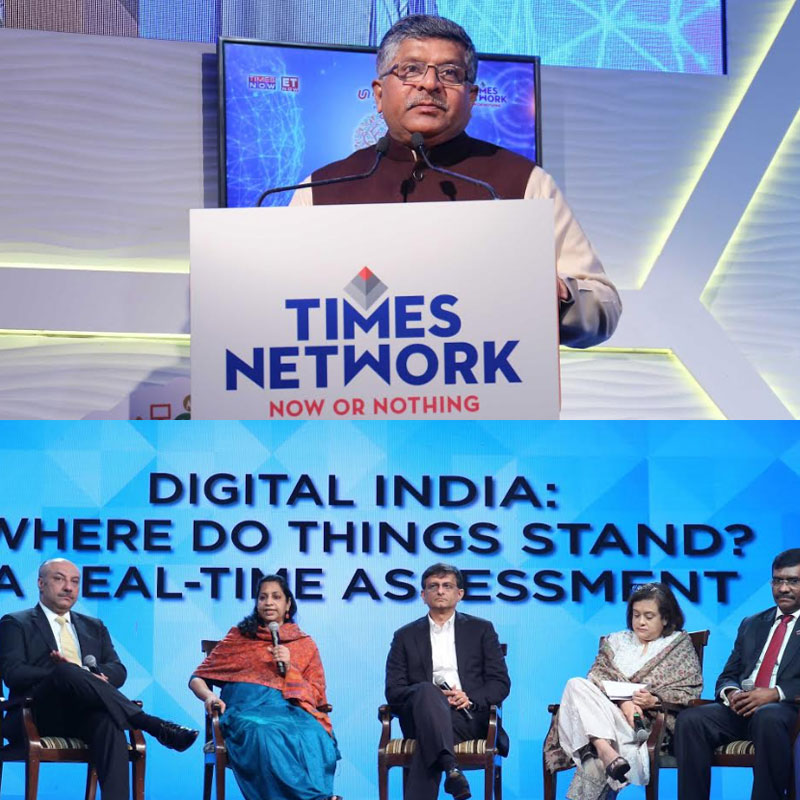
MUMBAI: Times Network, a part of The Times Group, launched the fourth edition of its ‘Times Network Digital India Summit and Awards 4.0. Attended by some of the most valued dignitaries in India, the summit aimed at deliberating on key challenges and laid out key imperatives and framework for turning the vision of ‘Digital India’ into a reality, through a series of panel discussions and deliberations.
The summit kicked off with the keynote address by the Chief Guest, Honorable Union Minister for Law & Justice and Electronics & Information Technology, Ravi Shankar Prasad. The participants at the first session of the panel discussion themed “Digital India- Where Do Things Stand? A Real Time Assessment” were DoT Secretary Aruna Sundararajan; Nasscom President Designate Debjani Ghosh; Union Bank of India MD & CEO Rajkiran Rai; Bain & Co India Chairman Sri Rajan and IBM India MD Karan Bajwa.
Talking extensively about the growth, opportunities and possibilities of the digital connectivity in India, Honorable Union Minister for Law & Justice and Electronics & Information Technology, Ravi Shankar Prasad stated, “Digital India which is a flagship initiative the government is designed to empower and to help the poor and the underprivileged. We are focusing on providing the affordable and inclusive digital media to the masses. Today we have well over 1 billion mobile phones in the country with 350 million being smartphones which defines the digital identity of the nation. Low cost technology for inclusive growth is crucial.”The Honorable Minister also touched upon the benefits of digital India in the wake of enrolling Aadhaar. He added “With enrollment of 1.18 billion Aadhaar cards, we were able to save 49,000 crore of the exchequer which was previously looted by the middlemen in the public distribution system.” Further talking about the inclusion of the digital resources, he highlighted that India has digital aspiration, appetite and customer. We are heading towards a revolution of digital media in this country.”

“Technology is an enabler in bringing women to work and this will add 60 per cent to GDP by 2025,” says
NASSCOM President Designate Debjani Ghosh.
Commenting on Times Network Digital India Summit 4.0, Times Network MD & CEO MK Anand said, “Over the last 3 years, Digital India Summit & Awards, has enjoyed tremendous response from both delegates and particpants alike. With unwavering focus on building a digitally empowered India, the 4th edition of Digital India Summit is another step towards bridging the ‘digital divide’ and finding solutions and opportunities to create a robust security architecture.”
Union Bank of India MD and CEO Rajkiran Rai said, “Digital India is one of the biggest government programs in the world to bring about sustainable and inclusive societal transformation using digital technologies. The process of making India into a trillion-dollar digital economy has begun and Digital India is making this dream a reality. We at Union Bank are committed to help India achieve its digital vision. We are proud to partner Times Network for the last 3 years in this impact initiative.”
In the intriguing session on ‘Digital India- Where Do Things Stand? A Real Time Assessment’, DoT Secretary Aruna Sundararajan, said, “Digital India is an aspiration. We are focused to enable digital opportunities to reach to the masses and leverage them”. She additionally highlighted the issue of data protection in the discussion as she stated, “We are planning a robust data protection framework to empower the digital mandate. Data protection is beyond Aadhaar; issue of privacy is a global threat.”
Stating the issue of data protection in the digital domain, Nasscom President Designate Debjani Ghosh said, “Critical end to end data policy is a must. The emerging technology needs solid building blocks of data privacy which will enhance the dependency on the digital media. Digital solutions can enhance the employment in the rural areas if we cater it to the most underprivileged parts of India.”
COAI Director General Rajan S Mathews speaking on the vision of 5G in India emphasized on the periphery of competitive landscape of the telecom industry. He said, “We need to position ourselves in the telecom industry with the spectrum auctions pricing methodology. We need more spectrum in the upcoming time to leverage the last customer of a telecom company.”
Ministry of Skill Development & Entrepreneurship Secretary TP Krishnan addressed a panel discussion on the theme of ‘Developing A Digital Workforce- The Ground Realities’. He said “Skills acquisition needs to be more aspirational. Our jobs are not aspirational. Soft skill developments programs including life skills and ITI which are the game changers under the Skill India campaign of the government can play pivotal role in shaping the skill development sector in this country.”
The summit had discussions on the relevance of 5G in India, how Fintech has helped in the growth of Digital India and discussed the importance of data security in India.
The ‘Digital India’ Awardees are:

The session extensively talked about the opportunities and challenges in the digital world when the country is looking for economic independence.






iWorld
Micro-Dramas Surge in India, Redefining Mobile Content Habits
Meta-Ormax study maps rapid rise of short-form storytelling among 18–44 audiences.
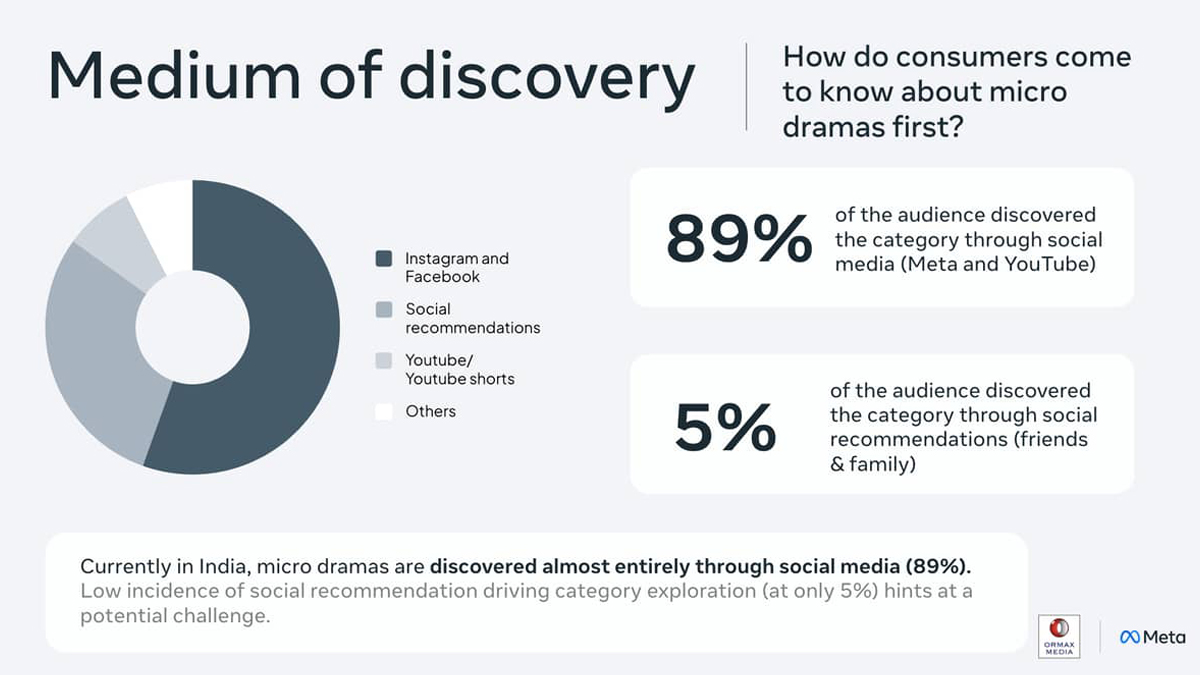
MUMBAI: Micro-dramas aren’t just short, they’re the snack that ate Indian entertainment, and now everyone’s bingeing between the sofa cushions. Meta, in partnership with Ormax Media, has released ‘Micro Dramas: The India Story’, a comprehensive study unveiled at the inaugural Meta Marketing Summit: Micro-Drama Edition. The report maps how the vertical, bite-sized format is reshaping content consumption for mobile-first audiences aged 18–44 across 14 states.
Conducted between November 2025 and January 2026 through 50 in-depth interviews and 2,000 personal surveys, the research reveals that 65 per cent of viewers discovered micro-dramas within the last year proof of explosive adoption. Nearly 89 per cent encounter the format through social feeds and recommendations, making algorithm-driven discovery the primary engine rather than active search.
Key viewing patterns show a median of 3.5 hours per week (about 30 minutes daily) spread across 7–8 short sessions. Consumption peaks between 8 pm and midnight, with additional spikes during commutes and work breaks classic “in-between moments” that the format fills perfectly. Around 57 per cent of viewing happens in ambient mode (while doing something else), and 90 per cent is solo, enabling more intimate, personal storytelling.
Romance, family drama and comedy lead genre preferences. Audiences show growing openness to AI-generated content, 47 per cent find it unique and creative, while only 6 per cent say they would avoid it entirely. Regional languages are surging after Hindi and English, Tamil, Telugu and Kannada dominate consumption.
Meta, director, media & entertainment (India) Shweta Bajpai said, “Micro-drama isn’t a passing trend, it’s rewriting the rules of Indian entertainment. In under a year, an entirely new category of platforms has emerged, built audience habits from scratch, and created a business vertical that is scaling fast.”
Ormax Media founder-CEO Shailesh Kapoor added, “Micro-dramas are beginning to show the early signs of becoming a distinct content category in India’s digital entertainment landscape. When a format aligns closely with how audiences naturally engage with their devices, it has the potential to scale very quickly.”
The study proposes ecosystem-wide responsibility, universal signposting of commercial intent, shared accountability among advertisers, platforms, creators, schools and parents, built-in safeguards, and formal media literacy in schools.
In a feed that never sleeps and a day that never stops, micro-dramas have slipped into the cracks of every spare minute turning 30-second stories into the new national pastime, one vertical swipe at a time.







