
iWorld
Story TV bets big on the south
Eloelo Group’s microdrama arm bets on Telugu, Tamil, Kannada and Malayalam originals to win South India


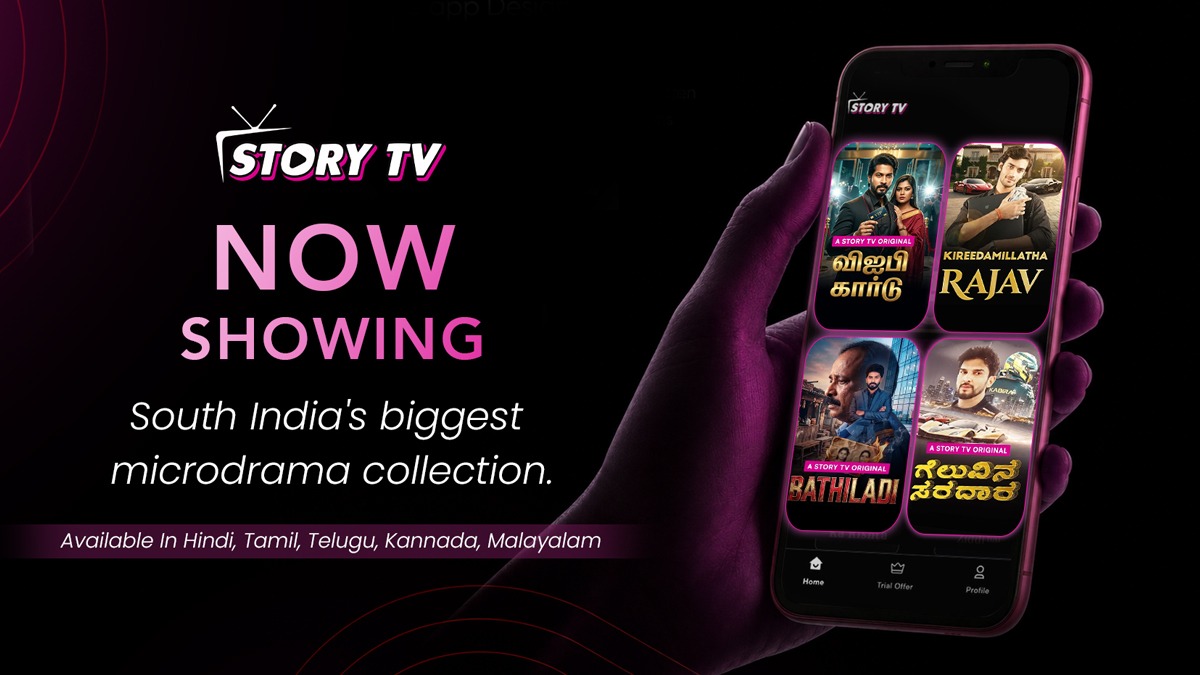
BENGALURU: Microdrama, the bite-sized, vertical-video soap opera that Chinese apps popularised and Indian ones are now devouring, has found its next frontier: the south. Story TV, the microdrama arm of the Eloelo Group, has just placed its biggest regional bet yet, promising more than 1,000 original shows in Telugu, Tamil, Kannada and Malayalam by March 2027. For an industry that until recently treated “regional” as an afterthought, this is a statement of intent dressed up as a press release.
The logic is sound, even if the delivery is breathless. India’s four southern film industries are not junior partners to Bollywood; on many measures of scale and audience devotion they outrank it. Telugu and Tamil cinema alone produce stars with fan followings that would make a Mumbai producer weep with envy. Story TV’s bet is that this appetite for language-specific, culturally specific storytelling translates neatly onto phone screens in three-minute instalments. Given that users in the southern states already spend 95 minutes a day on the app, that bet looks like it is paying off before the ink on the announcement has dried.
What is notable is the talent roster attached to the plan. This is not outsourced content mills churning out filler; the Tamil slate includes director alagar and cinematographer laxman kumar, names with real cinema and television pedigree, while the Telugu slate pulls in director ajju and the nandi award-winning cinematographer om prakash. Microdrama has often been dismissed as disposable content made cheaply and watched compulsively. Recruiting established filmmakers to the format is Story TV’s way of arguing the opposite: that vertical storytelling deserves the same craft as anything shot for a cinema screen, just compressed.
The commercial case writes itself. Story TV’s southern slate has already racked up over 250 million views, on shows with titles as gloriously unsubtle as “billionaire maid” and “paper wife bathiladi”. Microdrama thrives on melodrama, twists and cliffhangers engineered for a swipe-happy audience, and the southern markets, with their appetite for high-emotion storytelling, are close to a perfect match for the format. Cities such as Hyderabad, Chennai, Bengaluru and Kochi are already among the platform’s strongest by consumption, evidence that the demand existed well before the supply caught up.
There is a broader story here about where Indian entertainment growth is actually happening. As gsn aditya, chief operating officer of Story TV, put it, audiences want stories they can binge instantly and see themselves in, in their own language and culture. That is not a controversial claim, but it is one the entertainment industry has been slow to act on at scale. Story TV, having built a library of more than 2,000 shows and a 100m-plus audience base in just 12 months, evidently intends to make the south the template rather than the exception, with the same playbook to be rolled out to other Indian markets in the months ahead.
None of this guarantees success. A thousand shows by 2027 is an ambitious production target, and quality is harder to scale than volume. But the direction of travel looks right. Microdrama in India has so far been a largely Hindi-language phenomenon chasing a national audience; Story TV’s wager is that the bigger prize lies in going deep into four languages rather than wide across one. If the early numbers are any guide, the south may end up doing for Indian microdrama what it has long done for Indian cinema: setting the standard the rest of the country has to catch up with.






