iWorld
JioHotstar and OpenAI partner to bring ChatGPT-powered personalised content to 500m Indian viewers
Fireside chat at AI Impact Summit 2026 highlights AI-driven content discovery and personalised storytelling
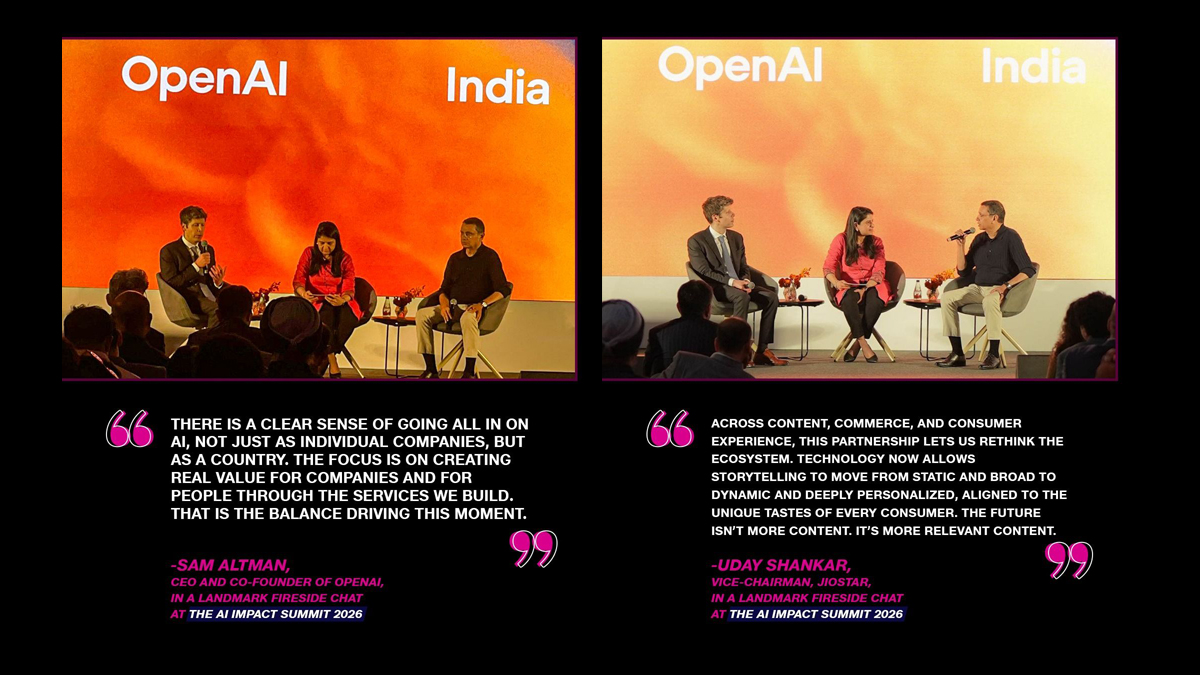
DELHI: At the AI Impact Summit 2026, a defining conversation unfolded between Uday Shankar, vice-chairman, JioStar, and Sam Altman, ceo and co-founder, OpenAI, spotlighting how AI is transforming creation, distribution and consumption of content.
The discussion coincided with Jiostar’s landmark announcement: a partnership between JioHotstar and OpenAI that will embed ChatGPT-powered conversational search and discovery into the platform. The move aims to deliver seamless, multilingual, deeply personalised experiences for India’s 500 million-plus viewers, fundamentally redefining how content is discovered and consumed.
“There’s a lot of noise about content overload. We see a different reality. In a country as diverse as India, there isn’t enough content that truly reflects its cultural and regional nuance. That’s the opportunity,” said Shankar. “Across content, commerce and consumer experience, this partnership lets us rethink the ecosystem. Technology now allows storytelling to move from static and broad to dynamic and deeply personalised, aligned to the unique tastes of every consumer. The future isn’t more content. It’s more relevant content.”
Altman added perspective on India’s AI momentum: “What feels different here is the energy. There is a clear sense of going all in on AI, not just as individual companies, but as a country. Safety has to be taken seriously. Ensuring that benefits are widely distributed has to be taken seriously. But above all, the focus is on creating real value for companies and for people through the services we build. That is the balance driving this moment.”
The partnership signals a shared commitment to responsibly scale AI-powered experiences that deliver tangible business value while making a meaningful impact on consumers. By combining India-specific content nuance with OpenAI’s generative intelligence, Jiostar is betting on a future where discovery, engagement and relevance replace sheer volume—setting the stage for a new era in personalised entertainment.

iWorld
Meta plans 8,000 layoffs in new AI-led restructuring wave
First phase from May 20 may cut 10 per cent workforce amid AI pivot.
MUMBAI: At Meta, the future may be artificial but the cuts are very real. The social media giant is reportedly preparing a fresh round of layoffs, with an initial wave expected to impact around 8,000 employees as it doubles down on its artificial intelligence ambitions. According to a Reuters report, the first phase of job cuts is slated to begin on May 20, targeting roughly 10 per cent of Meta’s global workforce. With nearly 79,000 employees on its rolls as of December 31, the move marks one of the company’s most significant workforce reductions in recent years.
And this may only be the beginning. Sources indicate that additional layoffs are being planned for the second half of the year, although the scale and timing remain fluid, likely to be shaped by how Meta’s AI capabilities evolve in the coming months. Earlier reports had suggested that total cuts in 2026 could reach 20 per cent or more of its workforce.
The restructuring comes as chief executive Mark Zuckerberg continues to steer the company towards an AI-first operating model, committing hundreds of billions of dollars to the transition. Internally, this shift is already visible: teams within Reality Labs have been reorganised, engineers have been moved into a newly formed Applied AI unit, and a Meta Small Business division has been created to align with broader structural changes.
The trend is hardly isolated. Across the tech sector, companies are trimming headcount while investing aggressively in automation. Amazon, for instance, has reportedly cut around 30,000 corporate roles nearly 10 per cent of its white-collar workforce citing efficiency gains driven by AI. Data from Layoffs.fyi shows over 73,000 tech employees have already lost jobs this year, compared with 153,000 in all of 2024.
For Meta, the move echoes its earlier “year of efficiency” in 2022–23, when about 21,000 roles were eliminated amid slowing growth and market pressures. This time, however, the backdrop is different. The company is financially stronger, generating over $200 billion in revenue and $60 billion in profit last year, with shares up 3.68 per cent year-to-date though still below last summer’s peak.
That contrast underlines the shift underway. These layoffs are less about survival and more about reinvention. As Meta restructures itself around AI from autonomous coding agents to advanced machine learning systems, the question is no longer whether the company will change, but how many roles will be left unchanged when it does.