DTH
Paid DTH sheds 7.5 million subscribers as India’s TV and radio map is redrawn
Tata Play still leads a base of 48.56 million, while IPTV and community radio expand and pay channels rise to 342, says the TRAI report


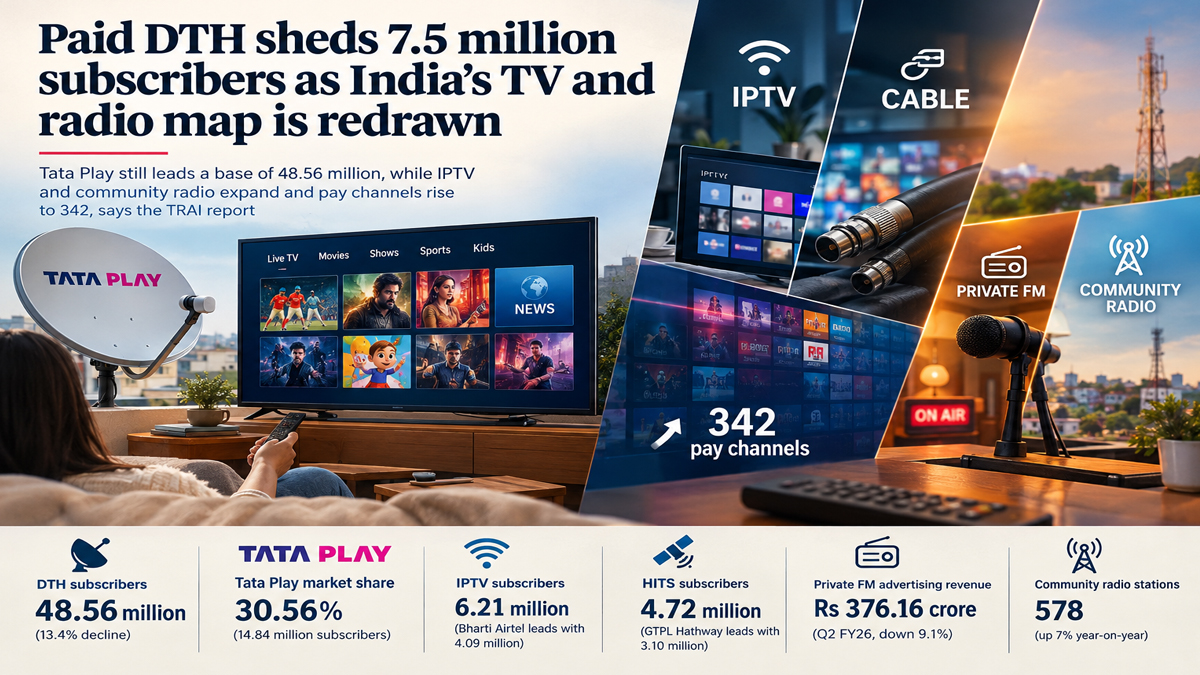
NEW DELHI: Indian television is changing how it reaches the sofa. In the year to 30 June 2026, paid direct-to-home (DTH) lost 7.51 million subscribers, a fall of 13.4 per cent, taking the active base of the four paid operators to 48.56 million from 56.07 million. The slide continued in the latest quarter, with the base easing from 49.05 million in March. Yet the Telecom Regulatory Authority of India (TRAI) report for April-June 2026 is not simply a story of decline. It shows a sector in transition, with money, viewers and listeners moving to new formats.
Start with the league table. Tata Play remains the biggest DTH operator, with 14.84 million subscribers and a 30.56 per cent share. Bharti Telemedia follows with 13.58 million (27.97 per cent), then Sun Direct with 10.93 million and Dish TV India with 9.21 million. Together they make up the 48.56 million. The numbers exclude DD Free Dish, the free DTH service of Prasar Bharati, so the wider DTH universe is larger than these figures suggest.
Step back and the pecking order is clearer. Selected operators across all platforms reported a combined active base of 96.73 million subscribers on 30 June, including those inactive or temporarily suspended for up to 90 days. DTH still leads with 48.56 million, about 50.2 per cent of the total. Cable, through multi-system operators (MSOs), has 37.24 million (about 38.5 per cent). Internet Protocol Television (IPTV) has 6.21 million and Headend-in-the-Sky (HITS) operators 4.72 million, the two together roughly 11.3 per cent. DTH is shrinking, but it remains the biggest platform by some distance.
The challengers are concentrated. In IPTV, Bharti Airtel leads with 4.09 million subscribers, about two-thirds of the segment, followed by Hathway Digital with 1.28 million. In HITS, GTPL Hathway has 3.10 million and NXTDIGITAL 1.61 million. In both segments two names hold nearly all the reported base, which hints at how quickly a newer platform can scale when a strong distributor backs it.
A word of caution is due, and it is TRAI’s own. The figures come from selected operators rather than every registered player. Of 736 registered MSOs, 127 reported subscriber numbers. Of the 76 IPTV operators with self-declarations filed with the Ministry of Information and Broadcasting, 12 reported. Both HITS operators did. So the cable and IPTV totals are likely to understate their true size, and the comparison with DTH, where all four operators report, should be read with care.
The content on offer is growing even as the pipes change. India had 915 permitted private satellite television channels on 30 June, of which 906 were available for downlinking. Of these, 342 were pay channels, up from 333 a year earlier and unchanged from March. The pay lineup is 238 standard-definition and 104 high-definition channels. General entertainment is the biggest genre with 108 pay channels, followed by movies with 63, news and current affairs with 61, sports with 41, kids’ programming with 24 and infotainment with 23. The rest are free-to-air (FTA).
On to radio, where the picture is mixed. Private FM broadcasters reported advertising revenue of Rs 376.16 crore in April-June, down 9.1 per cent from Rs 414.03 crore in the previous quarter, which itself had slipped from Rs 419.29 crore in October-December 2025. Against the same quarter last year, when revenue was Rs 383.14 crore, the dip is a milder 1.8 per cent. That is worth remembering when the sequential figure looks sharp.
The reach, though, is widening. Private FM channels numbered 386 in June against 390 in March, entirely because five channels surrendered their permissions. But the number of cities with operational private FM rose to 121 from 120, and private FM operators numbered 30, down from 31. Fewer channels in more cities suggests operators are pruning and spreading at the same time.
Community radio is the quiet winner. Operational stations rose to 578 in June from 566 in March and 540 a year earlier, an increase of 38 stations, or about 7 per cent, over the year.
The conclusion is straightforward. Paid DTH has work to do to hold its base, and FM radio needs advertisers to return. But IPTV, HITS, community radio and a growing bouquet of pay channels show that Indian audiences are not leaving media. They are choosing new ways to watch and listen.