Connect with us

Hindi

IFFI 2016: India, S. Korea keen on co-productions

Published

on

NEW DELHI: Minister for Information and Broadcasting (MIB) M Venkaiah Naidu has said the government is keen to work and cooperate with South Korea in the domain of film production in a way that could benefit both countries.

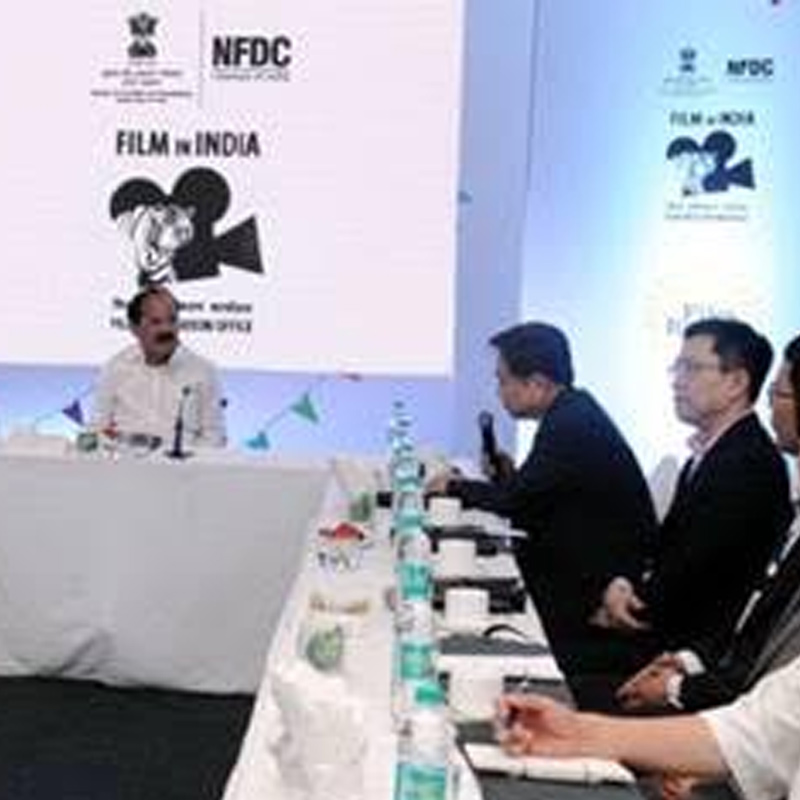
Speaking at a meeting with the Korean delegation yesterday in Panaji, the Minister said the government gave great importance to the 2014 agreement between the two countries on co-production and exchange of ideas and expressed satisfaction at Korea being the main partner in the cultural sphere and the focus country at the International Film Festival of India (IFFI).

MIB Secretary Ajay Mittal said the Film Facilitation Office was set up by the National Film Development Corporation (NFDC) to address issues on film production and facilitating mutual cooperation.

Advertisement

Korean ambassador to India Cho Hyun shared his ideas and themes for future film making. The delegation also expressed its happiness of the remake of the South Korean movie `Montage’. Hyun also remembered the role India played on the peace keeping operations in the Korean War.

A large Korean delegation is attending the IFFI this year and veteran Korean filmmaker Im Kwon Taek had been awarded the Lifetime Achievement Award at the inauguration of the festival.

A total number of 18 films are being screened from South Korea and the opening film was `Tunnel’ whose director Kim Seong-hun said later at a press meet that it was his first visit to India and he was thrilled to meet a new audience at this venue. The other directors and producers present at the event talked about their films’ genres and storylines.

Advertisement

The Korean Film Council (KOFIC) representative, also present at the conference, talked about the screening of 18 films at the fest and further strengthening the foundation of Indo-Korean relationship through this step. He added that Korea produces three films per year under co-production and has a budget of $ 300,000.

Director Lee Joon-ik of ‘Dongju: The Portrait of a Poet’ spoke about the removal of censorship in South Korea and its impact on the Korean film industry. He said that in the 70s, Hollywood had 80 per cent share in the Korean market. But with the complete removal of censorship, now the Korean cinema has gained 30 per cent of the market share, reducing Hollywood share by up to 50 per cent.

Korean Film has come of age in terms of technology and production said Korean filmmakers. The directors believe that if the Indian audience enjoy Hollywood cinema, they will surely like Korean cinema as well, because just like Hollywood, Korean cinema is also technology-driven and, at times, is way ahead of Hollywood.

Advertisement

The film ‘Tunnel’ tears down the conventional disaster movie genre. Through a disaster, which seems lifted from ordinary reality, the film reminds us all of the forgotten dignity of human life. The director shifts smoothly between emotional extremes to create a distinctive and realistic disaster movie that brings something new to the genre.


Click to comment

Leave a Reply

Your email address will not be published. Required fields are marked *

Hindi

Remembering Gyan Sahay, the lens behind film, television and advertising

From a puppet rabbit selling poppadums to Hindi cinema, he framed it all.

Published

on

MUMBAI: There are careers, and then there are canvases. Gyan Sahay, the veteran cinematographer, director, and producer who passed away on 10 March 2026 in Mumbai, had one of the latter. Over several decades in the Indian film and television industry, he turned lenses, lights, and the occasional puppet rabbit into something approaching art.

A graduate of the Film and Television Institute of India (FTII) in Pune, Sahay built his reputation as a director of photography across a career that stretched from the early 1970s all the way to the digital age. He was the kind of craftsman who understood that a well-composed shot is not merely a technical achievement but a quiet act of storytelling.

For most Indians of a certain age, however, Sahay will forever be the man behind the rabbit. His direction of the iconic long-running television commercial for Lijjat Papad, featuring its now-legendary puppet bunny, gave the country one of its most cheerfully persistent advertising images. It was the sort of work that sneaks into the national subconscious and takes up permanent residence.

Advertisement

His big-screen credits as cinematographer include Anokhi Pehchan (1972), Pagli (1974), Pas de Deux (1981), and Hum Farishte Nahin (1988). In 1999, he stepped behind a different kind of camera altogether, making his directorial debut with Sar Ankhon Par, a drama that featured Vikas Bhalla and Shruti Ulfat, with a cameo by Shah Rukh Khan for good measure.

On television, Sahay was particularly prized for his command of multi-camera production setups, a skill that made him a go-to technician for large-scale shows and reality programmes. In an industry that has never been especially patient with complexity, he was the calm hand on the rig.

In later life, Sahay turned teacher. He participated regularly in masterclasses and Digi-Talks, often hosted by organisations such as Bharatiya Chitra Sadhna, sharing hard-won wisdom on cinematography, the comedy of timing in a shot, and the sweeping changes brought by the shift from celluloid to digital. He was also said to have been involved in a project concerning a biographical film on Infosys co-founder N.R. Narayana Murthy.

Advertisement

Tributes from the film industry poured in following the news of his passing, with colleagues remembering him as a senior cameraman who served as a rare bridge between two entirely different eras of Indian cinema. That is, perhaps, the finest thing one can say of any craftsman: he kept up, and he brought others along with him.

Continue Reading

Advertisement News18
Advertisement All three Media
Advertisement Whtasapp
Advertisement Year Enders

Copyright © 2026 Indian Television Dot Com PVT LTD

This will close in 10 seconds

×