MAM
Crompton Greaves eyes growth in air cooler market

MUMBAI: Come summer and fans and air conditioner category has its sleeves rolled up to create brand visibility and awareness. It is the time when sales boost up by at least 3 times for fans, air conditioners and coolers.
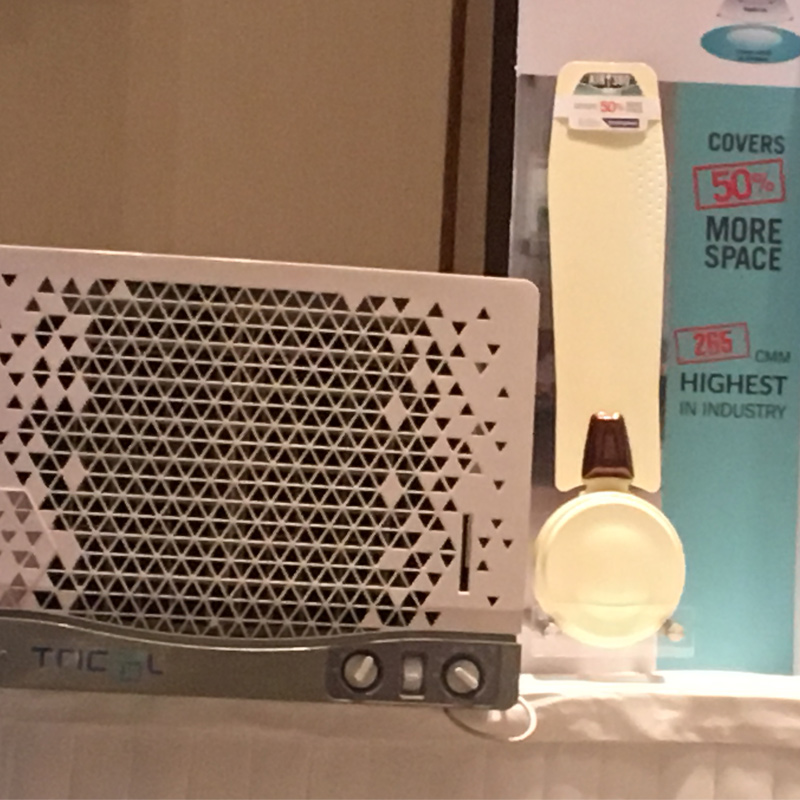
This summer, another electrical company has launched its new products in the category, the brand – Crompton Greaves. A legendary brand in India since 1878, the company recently unrelieved its ‘Air 360’ fan and the ‘Tricool’ window cooler.
In 2016, Crompton Greaves Consumer Electricals Ltd (CGCEL) decided to demerge itself from its consumer business to form a separate entity. That’s when the brand decided to target younger consumers in order to keep up with changing times. The company manufactures and markets a wide spectrum of consumer products, ranging from fans, lamps and luminaries, to pumps and household appliances such as water heaters, air coolers, kitchen appliances, etc. Crompton has steadily grown at the rate of 30 per cent year-on-year over the last few years.

Keeping in mind the consumer need of fanning a larger area, Crompton has launched its new range of fans which have a unique elevated blade design that claims to deliver air to over 50 per cent more room space than regular fans. Targeted at the urban youth, the fans are semi-premium (lower end of the premium) and are priced between Rs 2375-Rs 2575. Crompton’s market share in fans category was only 24 per cent in 2016 but has now reached 28 per cent and 90 per cent of the gain in market share is due to the company’s premium fans range. But, the company still faces stiff completion from Havells, Orient, Usha and Bajaj in the category.
The company also launched its new window cooler which claims to deliver 60 per cent better cooling than a standard plastic cooler and is priced at Rs 12500. The new range of coolers and fans will be available at leading counters in select markets. Although it is a tough and cluttered business, CGCEL CEO Mathew Job says that south India is the company’s strongest market in terms of market share for fans category. But that isn’t the case for coolers. The company only has a small market share in the category but wants to expand it in the coming years.
The average television spends, which were at a mere Rs 8-10 crore prior to the demerger, has now swelled to Rs 50-60 crore annually, which is roughly two per cent of the company’s total annual revenue. Since the ads have been launched during Indian Premier League (IPL) 2018, Job says the company will adopt a robust marketing strategy and will spend big on television as it helps in building awareness for this category. Although the campaign broke on IPL, it will expand to other general entertainment and news channels in the coming weeks. This will be eventually followed up by digital and in-store marketing.
Crompton has a strong dealer base across the country and a wide service network that offers robust after sales service to its consumers. The company’s distribution has increased from 50 per cent in 2016 to now being 80 per cent across India. By 2016, Crompton fans were available only in 40 per cent of the stores across India but are now available in over 60 per cent of stores across the nation.
Though an age-old brand, the company is coming up with ways to entice the younger customers and stay relevant to them using modern marketing techniques.
Also Read :
Pepe Jeans launches India centric ad with Siddharth Malhotra
India’s taxi war may be headed for a truce
The influence of influencer marketing






MAM
Valvoline launches FIFA World Cup 2026 global campaign
Campaign highlights fan journeys and mechanics powering travel worldwide
MUMBAI: From kick-off to kilometres, Valvoline is fuelling more than just engines this World Cup. Valvoline Global Operations has unveiled its global campaign for the FIFA World Cup 2026, spotlighting the journeys fans undertake to witness the game while quietly tipping the hat to the mechanics who keep those journeys on track. Titled “The Original Engine Oil. For the Driven.”, the campaign leans into the emotional and physical commitment of football fans travelling across cities and countries, reframing mobility as an integral part of the sporting experience.
At its core is Valvoline’s first FIFA World Cup-themed ad film, which parallels the evolution of the brand spanning over 160 years with the enduring passion of fans. Produced in Chile by We Are Laugh, the film stitches together moments of anticipation, preparation and connection that define matchday journeys, whether it’s a cross-country drive or a short ride with friends.
The narrative extends beyond fans to spotlight the often-overlooked ecosystem behind the scenes mechanics and service professionals who ensure every trip runs smoothly. The brand positions itself as a constant companion across these miles, reinforcing its legacy in powering mobility.
Valvoline Global chief brand officer Michael Kirtman said, the campaign celebrates both the fans who “go the distance” and the people who make those journeys possible.
The rollout has already begun in India and will expand globally in May, covering markets such as the United States, China, Australia, Canada, Thailand and Saudi Arabia. The campaign will be amplified through a multi-channel mix, including television, digital out-of-home, radio, social platforms and experiential activations.
In a World Cup defined by goals and glory, Valvoline is telling a quieter story, the one measured not in minutes, but in miles.