I&B Ministry
Industry welcomes I&B ministry’s guidelines to restart Film, TV and OTT production

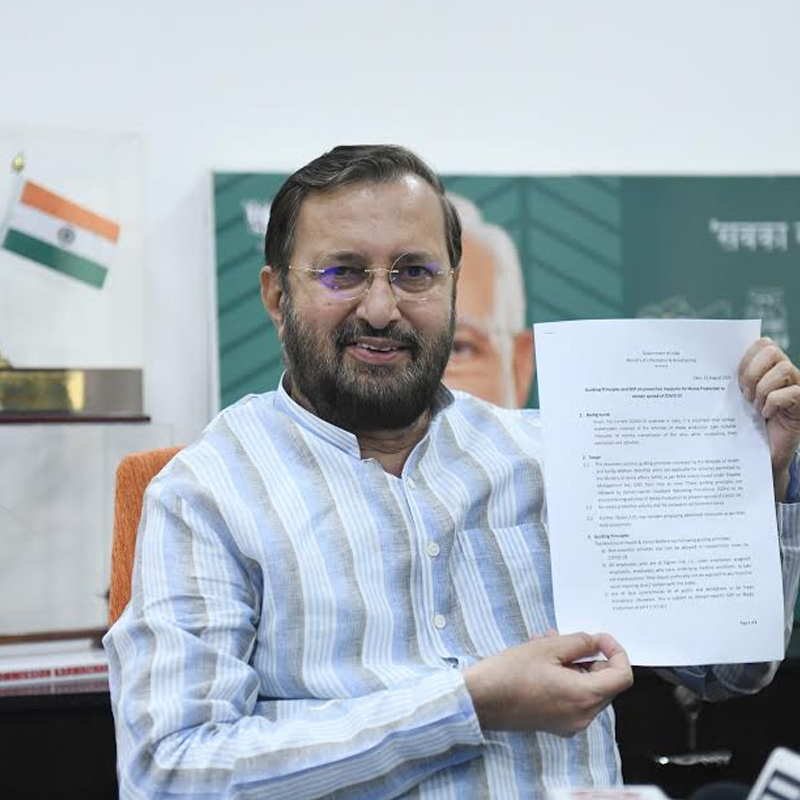
MUMBAI: Yesterday, Information and Broadcasting Minister Prakash Javadekar released a comprehensive set of standard operating procedures (SOPs) aimed at the resumption of production for film, television, and OTT originals. The announcement came in as a sigh of relief for many in the industry. The SOPs are in line with the protocols followed across the globe, which also specifies safe distances on shooting locations, in edit rooms, studios, and others. It includes rules on sanitization, fumigation, face masks, and availability of PPE kits. The SOPs also mention the need for an appointment of an on-set Covid2019 coordinator. Javadekar said, “Today we are laying out standard operating procedures as per the international experience and with the consultation of the health ministry and the home ministry.”
Today @MIB_India have released a detailed SOP for resuming work in the media production industry. The general principles behind the SOP will help create a safe working environment for cast and crew in the industry. pic.twitter.com/UU0NbqONeO
— Prakash Javadekar (@PrakashJavdekar) August 23, 2020
He further explained that contact minimisation is at the core of the SOPs. It will be ensured by minimal physical contact and sharing of props and PPEs for hairstylists and make-up artists, among others. Javadekar also highlighted that the characters in front of the camera would be exempted from wearing masks. Making this announcement on Doordarshan Javadekar said that formulating SOP measures as part of the overall decision to revive economic activities. He added, “For the last six months, this industry had come to a standstill, and many people had lost their jobs. We hope all States will adopt these SOPs.”


For a detailed list of the SOPs, click here. In a special interaction with indiantelevision.com film producer, Ramesh Taurani said, “I think it is a very good step from the government. Shoots have already started, but now they can be done in other locations as well, as the new SOPs will benefit everyone. These are practical and manageable SOPs, and the film industry is very happy. Now things will happen at a macro level. As the film shooting has started workers, actors, technicians can start work with full protection. It is a good step towards restarting the economy, as more people will get employment. The announcement came from the central government, and now it is up to the respective state government to take it forward.” Apart from laying down the social distancing norms, the ministry has also asked the production houses to ensure extensive planning. It also states that physical distancing of at least six feet is to be followed as far as feasible at all locations at all times, while sitting, standing in queues, etc. FICCI official spokesperson said, "It is a welcome move and the industry has been looking forward to this. It will help open the industry in a phased manner with all the necessary precautions . We are looking forward to working with the government to ensure we get back to business with all the norms that have been put in place. This move from central government is the umbrella document for state governments to adopt so that there is basic uniformity across the country . This is one plan laid out by the central government for the state government to follow and they can add some important details as per the specific requirement." Aspects such as scenes, sequences, set-ups, camera locations, positions of various crew members, seating arrangements, food and catering arrangements, staggered meal timings, etc. shall be planned while giving due consideration to physical distancing norms. According to the guidelines, measures shall be taken by the production team to involve a minimum number of cast and crew members during the shoot. IFTPC chairman TV wing JD Majethia shares, “It is a very welcome move. We all have been waiting for this for a very long time. It is a relief that the centre has eased out the restrictions. As shooting is now allowed across India, it would be easier for film, television, and OTT shows to shoot in different locations and studios, which was difficult to do earlier. Many people will get their employment back, hopefully in Maharashtra. If trains are allowed from next month onwards, a lot of people will get their jobs back.” He further added that the guidelines laid down by the I&B ministry are more detailed, and they have included a lot of aspects. “The measures are clear in nature. Everyone will know what to do in these circumstances. However, the state government can add or modify policies as per their requirement. States with less number of cases can ease out restrictions, whereas things will be stricter in areas where there are a higher number of cases,” adds Majethia. The Ministry has also advised that no visitors or audiences are to be allowed. In the case of outdoor shootings, necessary coordination has to be done with local police and administration to minimize spectators.
The SOP ensures adequate distancing at shoot locations and other work places and contains measures including proper sanitization, crowd management and provision for protective equipments pic.twitter.com/BCTTIzKffG
— Prakash Javadekar (@PrakashJavdekar) August 23, 2020
It is a moment of joy for film and OTT platforms as the Covid2019 halted the shoots at other locations, especially with large crews. "It's great news for the TV and film industry. What's more interesting is that the SOPs suggest some points for the opening of the exhibition. We are now looking forward to the opening of cinemas and getting the whole movie industry back on track," says SVF Entertainment co-founder director Mahendra Soni. Juggernaut Productions chief operating officer OTT-business Samar Khan mentions that the issuance of these SOPSs is a step in the right direction. He adds, “All of us have been eagerly awaiting the resumption of shoots but are also aware that crew safety is of utmost importance, following these guidelines will ensure that we can maintain the highest standards of safety while gradually resuming work.”

The ministry has also advised the industry to discontinue usage of lapel mics or at least to ensure that these are not shared. It also highlights that costumes, hair wigs, and makeup items for actors should not be shared. The SOPs states that artists should be encouraged to do their hairstyling and make-up remotely with the help of professionals. Panorama Studios run by Kumar Mangat Pathak and Abhishek Pathak is a subsidiary of Panorama Studios International. Abhishek Pathak has also directed movies like Ujda Chama and Boond. He thanked the I&B ministry for focussing on contact minimisation. "We welcome these guidelines. Yes, shooting will be a huge challenge in the Covid2019 era, but I think with vigilance and precautions, we can make a comeback steadily. This decision brings huge relief for industry dwellers whose livelihood depends on the creation of movies, series, and other content." Planet Marathi founder and filmmaker Akshay Bardapurkar who also produced AB Aani CD said that it is great news from the I&B minister himself. “However now with the opening of the shoots it would be great also to see theatres also opening up. He mentions that more than 100 films are stalled, and producers are suffering. I hope that the central government issues SOPs for theatres soon and opens them too,” adds Bardapurkar.