iWorld
Industry bigwigs sound the alarm on piracy from OTT platforms

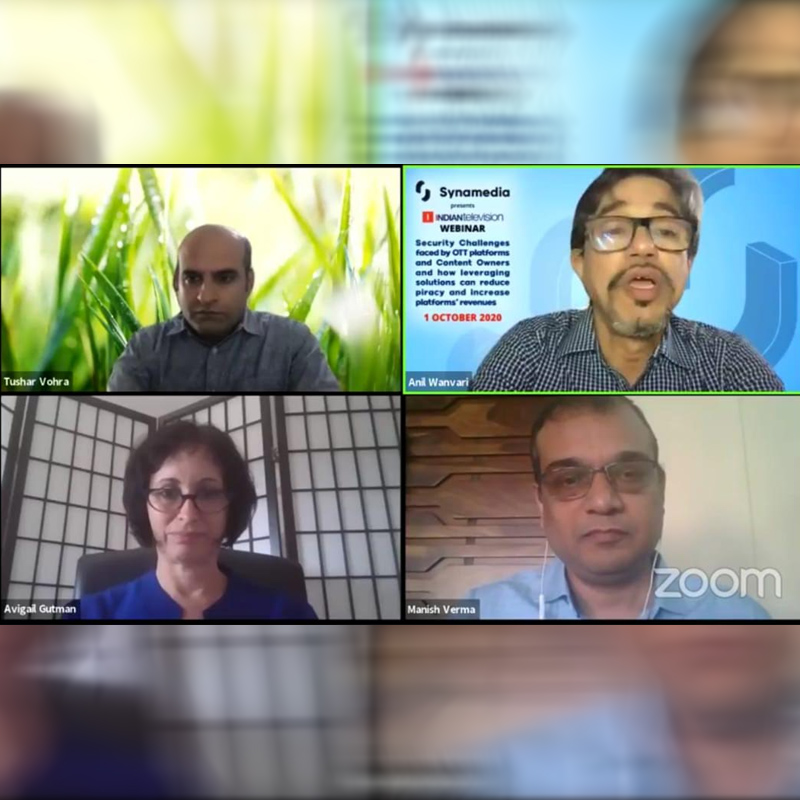
KOLKATA: Digital piracy is nothing new. But it has registered a massive uptick as millions of people have been forced to stay cooped up in their homes because of the Covid2019 pandemic. Illegal streaming could cost the industry around $12.5 billion by 2024 and the only way to curb the threat is a concerted effort by policy makers and service providers, according to experts.
In a webinar hosted by Indiantelevision.com, panellists agreed that a 360 degree approach can help win the battle against piracy. ZEE5 India technology head Tushar Vohra, SonyLIV technology head Manish Verma, Synamedia intelligence and security operations VP Avigail Gutman participated in the discussion, which was moderated by Indiantelevision.com founder, CEO and editor-in-chief Anil Wanvari.
Gutman elaborated on how piracy from streaming platforms has come to be the most significant problem in the last five-ten years. Content is being extracted from the devices from where it is legitimately supplied, says Gutman. Along with that, another kind of copyright violation has emerged including identity theft and skimming of customer credentials. While there are many security solutions that prevent older forms of piracy, streaming is now “the lowest hanging fruit” for pirates.

Security Challenges of OTT platforms & Content Owners & how leveraging solutions can reduce piracy https://t.co/UxmRJPOqKs
— Indiantelevision.com (@ITVNewz) October 1, 2020
With more and more people switching to digital platforms, piracy is also increasing in tandem, states SonyLIV’s Manish Verma, agreeing to the fact that the issue is ever-evolving. He explained that it started with a very simple process like deep linking of content. It went one step further when people started using proxy and VPN to stream content illegally. This gradually devolved into credential theft, identity sharing, screen mirroring and copying the content on screen.
Verma believes that the rise in content piracy has a lot to do with malpractices on social media platforms like Telegram, which allows people to share large multimedia files without supervision. The messenger app became immensely popular after the government crackdown on peer-to-peer file sharing sites, better known as torrents. While the company behind the app claims to have a zero tolerance policy on pirated content, its encryption makes it nearly impossible to find out what users are sharing.
“With content acquisition and content production costs increasing – whether it is for original content or live sports events –it is very important for us to see what all we can do to stop piracy,” he added.
ZEE5’s Vohra pointed out how they witnessed a big spike in piracy in the wake of Covid2019 crisis. As TV content dried up with the beginning of lockdown, the platform saw a huge increase in credential theft, and original content getting pirated. This is only going to increase as people have now already tasted original premium content, he warned.
“It is easy for pirate services to lure audience as they combine content from several platforms and offer it freely or for a much lower price,” Vohra said. Clearly, 360 investment from content owners, communities, governments and lawmakers is the need of the hour to tackle this challenge.
With the evolution in the nature of piracy, security solutions have also changed. Verma said that at the outset, the platform used to take basic steps earlier as the volume of traffic and impact wasn’t very high. Then they went from encrypting content, user URLs, using DRMs to blocking proxy and VPN access. Now, they’re looking at more advanced measures at different layers to make the service completely watertight against piracy.
On the other hand, ZEE5’s Vohra said that the company believes in creating a barrier. It is trying to warn pirates that ZEE5 can catch them by figuring out their IP, user id, device etc. The platform is working on a forensic watermark to be launched on the web player in October. Later, it will be launched on all applications expect for KAIOS by end of December. He is optimistic that the OTT service will be in a better position after six months.
“We were engaging with the government of India for data protection laws and we stressed content protection as one of the most important clauses that the lawmakers should take up. We are seeing good results from that engagement. We are hopeful that a new law that doubles down on copyright protection will be introduced by April,” Vohra added.
Gutman concurred that there is great need for stricter law enforcement as hackers are attacking DRMs exploiting the loopholes, legitimate CDNs, video services. As piracy becomes increasingly sophisticated, it demands equally progressive regulations to check it.