News Headline
India’s M&E story set to double: Uday Shankar urges industry to back storytellers, not just screens

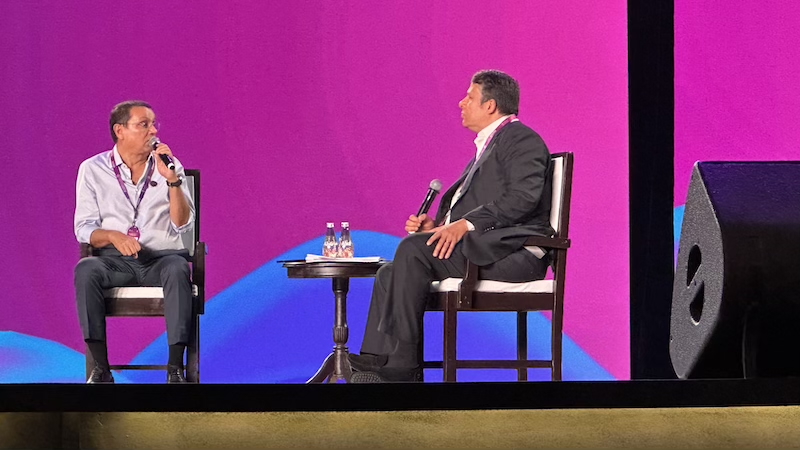
MUMBAI: India’s media and entertainment industry is sitting on the edge of a blockbuster sequel—if it can get the script right. That was the central message from Uday Shankar, vice chairman of JioStar and co-founder of Bodhi Tree Systems, at the Waves 2025 Summit. His session—“Media in India: Past 25 Years & Journey Ahead – to 2047”—with Media Partners Asia’s Vivek Couto was a masterclass in both history and prophecy.
“From a country with barely a few state-run channels, we’ve become one of the world’s most voracious consumers of video,” Shankar said. “But what got us here won’t get us there.”
Shankar began with a rewind to the early 1990s when, as he put it, “Satellite TV sneaked into India while the regulators were looking the other way.” This accidental revolution unleashed a tidal wave of demand, innovation, and ultimately, ubiquity. By the 2000s, television had wormed its way into the remotest villages.

“India’s success wasn’t scripted by policymakers or global giants,” he pointed out. “It was local grit, local creativity, and Indian capital.”
Today, he said, the transformation is even more dramatic. With over 700 million video consumers and platforms like JioStar commanding 500 million users—many of them paid subscribers—India has gone from media laggard to streaming juggernaut.
While western media circles love predicting the death of linear TV, Shankar shut down that eulogy. “TV is not dying in India. In fact, we’ve added pay-TV subscribers,” he noted. “The reason? We backed the medium with the right kind of content. Content that understands India.”
Streaming, too, is thriving—especially when priced with precision. “People said Indians wouldn’t pay for content. Wrong. They will, if it’s priced right and respects their time.”
But not all is well on the content front. Despite world-class distribution, India’s storytelling muscle, Shankar warned, is underdeveloped. “We’re importing formats that worked elsewhere and force-fitting them into our own culture,” he said. “We need more content—and more local content.”
He championed a full-fledged push into Tier II and III markets, and beyond the usual suspects of Hindi, Tamil and Telugu. “Bhojpuri, Haryanvi, Kumaoni—these audiences are starved for stories in their own language,” he said. “Let’s not give them leftovers.”
While billions flow into content investment, Shankar identified a severe talent bottleneck. “You can’t serve 750 million viewers with 6,000 content creators. It’s absurd,” he said. “We need an army of new-age writers, directors, showrunners—young blood with their ears to the ground.”
He pulled no punches on Hindi cinema saying it had “fallen out of touch” and was “creatively stuck in a loop.” The south Indian industries, by contrast, were lionised for their energy, risk-taking, and affordability. “Look at Tamil Nadu or Telangana or Karnataka —affordable tickets, packed theatres, and movies that connect. That’s the model,” he said.
If there was any doubt about the depth of domestic commitment, Shankar squashed it with numbers. The merged JioStar entity, he revealed, spent Rs 25,000 crore on content in 2024, expected to rise to Rs 30,000 crore this year, Rs 32,000 -Rs 33,000 crore in 2026—roughly $10 billion over three years.
“This isn’t speculative cash chasing vanity metrics,” he said. “It’s focused investment meant for Indian consumers, with returns from Indian markets.”
Despite all the growth, Shankar acknowledged a glaring weakness: outdated monetisation models. “The industry is still stuck between advertising and subscriptions—meanwhile, new players are eating into revenues with creator content, commerce, and gamification.”
His prescription? Rethink what it means to monetise a viewer. “Should a subscription just be access? Or can it be bundled with loyalty programmes, micropayments, creator communities? There’s a whole universe we haven’t touched.”
Shankar also fired a warning shot at policymakers. “India’s regulatory framework still treats TV and digital like twins,” he said. “They’re not. They’re cousins at best—raised differently, with different needs.”
He urged the creation of a sandbox-like regulatory structure—one that encourages innovation and gives breathing space for Indian platforms to grow, rather than mimicking Western regimes.
In conclusion, Shankar set his sights high. “We’re at $30 billion today. The US is at $200 billion. China is pushing $75 billion. Why should we settle for less?”
With 65 per cent of Indians under the age of 35, he argued, India has the youngest, hungriest audience on the planet. “If we invest in our people, our platforms, and—most importantly—our stories, we won’t just match the world. We’ll lead it.”
From satellite smuggling to streaming scale, the Indian M&E journey has been wild. Now, says Shankar, it’s time to script Act II—with more voices, sharper ideas, and fewer borrowed templates.