News Broadcasting
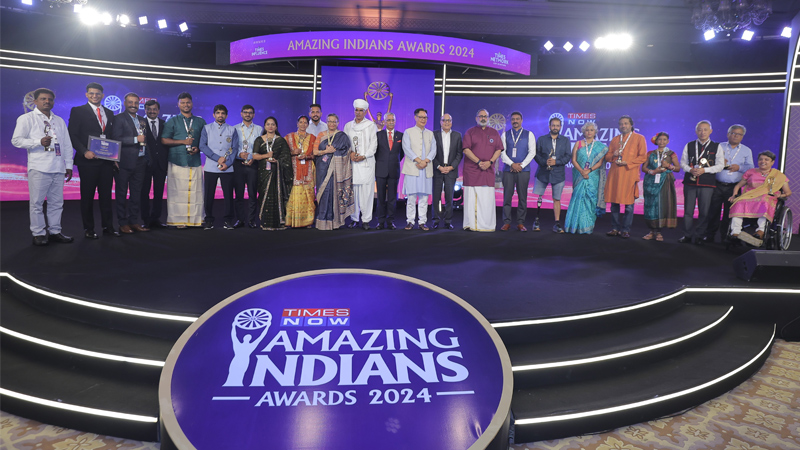
Times Now honours 13 inspiring Indians at the Amazing Indians Awards 2024
Mumbai: Times Now recently hosted the Amazing Indians Awards 2024 in New Delhi. A premier national platform, Amazing Indians Awards 2024 celebrated the indomitable spirit of 13 exceptional individuals whose relentless courage, determination, and selfless actions have not only inspired change but also left a lasting impact on the lives of many, reinforcing the true spirit of service and leadership.
The chief guest for the event, minister of parliamentary affairs & minister of minority affairs Kiren Rijiju, delivered the special address and felicitated the winners along with the Jury members. Union Environment minister Bhupender Yadav sent a video recorded message of congratulations and appreciation for the winners which was aired at the event. Adding to the grandeur of the ceremony, was a captivating dance performance by the visually impaired dancers of Samarthanam Trust for the Disabled.
Amazing Indian Awards 2024 winners felicitated across 12 categories included Pauzagin Tonsing (education), Raimati Ghiuria (agriculture), Dr. Sarita Subramaniam (wnvironment sustainability), Vishal Singh (food management & nutrition), Peera Ram (animal welfare), Shaikh Raziya (girl child & women’s right empowerment), Sipong Chingmak Chang (healthcare), Preeti Srinivasan (healthcare), Piyush Tiwari (road safety), Ranjeet Yadav (rural and slum development), Nimalan V R (sanitation & water), Kadivendi Mahipal Chary (social innovation using technology), and Aditya Mehta (sports enablers). The winners were shortlisted through an exhaustive pan-India screening process by an esteemed panel of jury comprising Sanjeev Sanyal, Rajeev Chandrasekhar, General M. M. Naravane, Prasoon Joshi, Renu Sud Karnad, and duly evaluated by Ernst & Young (process partner).
At the Times Now Amazing Indians Awards 2024, Paris 2024 Olympic Bronze Medallists Aman Sehrawat, (India’s youngest-ever Olympic medallist in the 57kg freestyle wrestling category), and Harmanpreet Singh, (captain of the Indian men’s Hockey team), were felicitated for their remarkable achievements.
Speaking at the Times Now Amazing Indians Awards 2024, minister of parliamentary affairs & minister of minority affairs Kiren Rijiju said, “Words are not enough to capture the achievements of the Amazing Indians. As our Prime Minister Narendra Modi often says, ‘Sabka Saath, Sabka Vikas,’ this event has given us the opportunity to meet inspiring individuals from every corner of the country, united on one platform. The jury must’ve had a herculean task to select winners, because every nominee is truly exceptional. These Amazing Indians have not only inspired us but also filled us with a sense of pride and happiness. As someone holding responsibility in the government, we will continue to support those who are contributing to India’s growth. Times Now has created a wonderful platform to bring people from across the country together to celebrate these achievements. Thank you, Olympic medallists Aman Sehrawat and Harmanpreet Singh, for making the country proud and bringing happiness to the nation. Seeing such sporting success stories and contributions from all walks of life has truly made India proud.”
Times Network COO, news broadcasting business, Varun Kohli said, “As India’s most influential news leader, Times Now has always been a catalyst for change. The Amazing Indians Awards exemplify this mission by honouring the extraordinary achievements of everyday people who, through compassion and dedication, make a significant impact. We are committed to celebrating these remarkable changemakers, confident that their inspiring stories will encourage others to help build a better India.”
The Times Now Amazing Indians Awards 2024 celebrated the remarkable contributions of those who have defied odds and made a profound, lasting difference in the lives of others, etching their spirit of perseverance into the fabric of India’s progress.

News Broadcasting
Induction cooktop demand spikes 30× amid LPG supply concerns
Supply worries linked to West Asia tensions push households and restaurants to turn to electric cooking alternatives
MUMBAI: As geopolitical tensions in West Asia ripple through global energy supply chains, the familiar blue flame in Indian kitchens is facing an unexpected challenger: electricity.
What began as concerns over the availability of liquefied petroleum gas (LPG) has quickly evolved into a technology-driven shift in cooking habits. Households across India are increasingly turning to induction cooktops and other electric appliances, initially as a backup but now, for many, a necessity.
A sudden surge in demand
Recent data from quick-commerce and grocery platform BigBasket highlights the scale of the shift. According to Seshu Kumar Tirumala, the company’s chief buying and merchandising officer, demand for induction cooktops has risen dramatically.
“Induction cooktops have seen a significant surge in demand, recording a fivefold jump on 10 March and a thirtyfold spike on 11 March,” Tirumala said.
The increase stands out sharply when compared with broader kitchen appliance trends. Most appliance categories are growing within 10 per cent of their typical demand levels, while induction cooktops have witnessed explosive growth as households rush to secure an alternative cooking option.
Major e-commerce platforms including Amazon and Flipkart have reported rising searches and orders for induction stoves. Quick-commerce apps such as Blinkit and Zepto have also witnessed stock shortages in major metropolitan areas including Delhi, Mumbai and Bengaluru.
What was once considered a convenient appliance for hostels, small kitchens or occasional use has suddenly become an essential addition in many homes.
A crisis thousands of miles away
The trigger for this shift lies far beyond India’s kitchens.
Escalating conflict in the Middle East has disrupted shipping routes through the Strait of Hormuz, one of the world’s most critical energy corridors. Nearly 85 to 90 per cent of India’s LPG imports pass through this narrow waterway, making the country particularly vulnerable to supply disruptions.
The ripple effects have been swift.
India currently meets roughly 60 per cent of its LPG demand through imports, and tightening global supply has already begun to affect domestic availability and prices.
Earlier this month, the price of domestic LPG cylinders increased by Rs 60, while commercial cylinders rose by more than Rs 114.
To discourage panic buying and hoarding, the government has also extended the mandatory waiting period between domestic refill bookings from 21 days to 25 days.
Restaurants feel the pressure
The strain is not limited to households. Restaurants, hotels and roadside eateries are also grappling with supply constraints as commercial LPG availability tightens under restrictions imposed through the Essential Commodities Act.
In cities such as Bengaluru and Chennai, restaurant associations report that commercial LPG availability has dropped by as much as 75 per cent, forcing many establishments to rethink their kitchen operations.
Some restaurants have reduced menu offerings, while others are rapidly installing high-efficiency induction systems, creating hybrid kitchens where electricity now shares the workload with gas.
For smaller eateries and roadside dhabas, the shift is less about sustainability and more about survival.
A potential structural shift
The government has maintained that there is no nationwide LPG crisis and has directed refineries to increase production to stabilise supply.
Nevertheless, the developments of March 2026 may already be triggering a longer-term behavioural shift.
For decades, LPG has been the backbone of cooking in Indian households. However, recent disruptions have highlighted the risks of relying on a single fuel source.
Increasingly, households appear to be hedging against uncertainty by adopting electric cooking options to guard against price volatility and delivery delays.
If the current trend continues, the induction cooktop, once viewed as a niche appliance, could emerge as a quiet symbol of India’s evolving kitchen economy.