MAM
Waves 2025 Brings Big Deals and Bold Dreams to India’s Media Sector
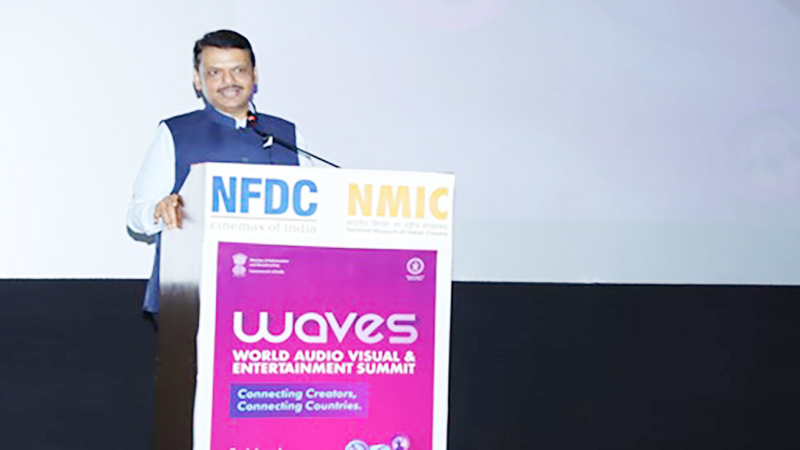
MUMBAI: If the Indian media sector were a movie, Waves 2025 would be the montage sequence fast cuts of big money, bold ideas and breakout talent all coming together for a dramatic makeover. Held in Mumbai, the Waves Summit 2025 saw the Government of Maharashtra sign MoUs worth nearly Rs 8,000 crore, giving the media and entertainment sector a starring role in the state’s growth narrative. Among the headliners:
. Rs 3,000 crore from Prime Focus to build a 200-acre Film City
. Rs 2,000 crore from Godrej for a film, TV and media campus in Panvel
. Rs 1,500 crore each from the University of York and the University of Western Australia to set up their first Indian campuses in Mumbai
And just like that, education and entertainment are sharing billing on the marquee.
Waves 2025 also introduced the Nifty Waves Index, listing 43 media and entertainment companies finally giving the sector its own Sensex-style snapshot. Meanwhile, the Indian Institute of Creative Technology (IICT) inked partnerships with industry giants including Google, Apple, Microsoft, Meta, Adobe, Nvidia, and Toon Boom, rolling out opportunities for scholarships, internships, rendering parks, game design courses and creative entrepreneurship.
Waves Bazaar cemented its role as the sector’s B2B-B2G power corridor. Launched in January 2025, the digital-first marketplace has already hosted 2,450 projects, with 6,442 buyers and 6,106 sellers participating across film, animation, XR, gaming and advertising verticals. It’s India’s global swipe-right moment for creative deals.
Elsewhere, WaveX turned into a high-stakes pitch fest where creative dreams met venture capital muscle. From 1,504 applicants, 30 high-potential M&E startups in gaming, storytelling, immersive tech and the creator economy pitched live to 29 marquee investors including Lumikai, Jio, and Warmup Ventures. With 127 startups securing connections or partnerships, and applications vetted by IAMAI and KPMG, this wasn’t just razzle, it was rigor with returns.
Enter the Create in India Challenge, a flagship talent hunt that hosted 34 creative contests across animation, AR/VR, gaming, music and films. Finalists competed in the buzzing Creatosphere, a zone dedicated to next-gen creators. Eight expert masterclasses helped sharpen their edge, while the finals turned the stage into a launchpad.
Not to be left out, Waves Culturals gave attendees a feel of India’s artistic pulse through performances blending traditional and global forms. The event’s heart, however, was the Bharat Pavilion, inaugurated by prime minister Narendra Modi on 1 May 2025. Designed as an immersive tribute to India’s storytelling roots, it showcased four thematic zones Shruti (oral traditions), Kriti (written heritage), Drishti (visual storytelling), and Creator’s Leap (future tech).
Over in the FM lane, the 8th National Community Radio Conference saw 12 CR stations receive national awards for innovation and inclusivity. With 531 CR stations and over 400 representatives attending, it was a mic-drop moment for grassroots broadcasters.
Add to that the launch of the first Indian Film Festival in New Zealand and fresh Indo-UK film collaborations and you’ve got an M&E summit that doesn’t just talk global, it screens it.
From classroom tie-ups to cultural showcases, and from startup pitches to mega MoUs, Waves 2025 didn’t just imagine India as a global creative powerhouse it laid down the blueprint, cast the crew and started shooting.
And with Maharashtra calling action on infrastructure, investment and innovation India’s media industry is no longer just watching the story unfold. It’s writing the script.

Digital
Content India 2026 opens with a copro pitch, a spice evangelist and a £10,000 prize for Indian storytelling
Dish TV and C21Media’s three-day summit puts seven ambitious projects before an international jury, and two walk away with serious development money
MUMBAI: India’s content industry gathered in Mumbai this March for Content India 2026, a three-day summit organised by Dish TV in partnership with C21Media, and it wasted no time making a statement. The event opened with a Copro Pitch that put seven scripted and unscripted television concepts before an international panel of judges, and by the end of it, two projects had walked away with £10,000 each in marketing prize money from C21Media to support development and international promotion.
The jury, comprising Frank Spotnitz, Fiona Campbell, Rashmi Bajpai, Bal Samra and Rachel Glaister, evaluated a shortlist that ranged from a dark Mumbai comedy-drama about mental health (Dirty Minds, created by Sundar Aaron) to a Delhi coming-of-age mystery (Djinn Patrol, by Neha Sharma and Kilian Irwin), a techno-thriller about a teenage gaming prodigy (Kanpur X Satori, by Suchita Bhatia), an investigative crime drama blending mythology and modern thriller (The Age of Kali, by Shivani Bhatija), a documentary on India’s spice heritage (The Masala Quest, hosted by Sarina Kamini), a documentary on competitive gaming (Respawn: India’s Esports Revolution, by George Mangala Thomas and Sangram Mawari), and a reality-horror competition merging gaming and immersive fear (Scary Goose, by Samar Iqbal).
The session was hosted by Mayank Shekhar.
The two winners were Djinn Patrol, backed by Miura Kite, formerly of Participant Media and known for Chinatown and Keep Sweet: Pray & Obey, with Jaya Entertainment, producers of Real Kashmir Football Club, also attached; and The Masala Quest, created and hosted by Sarina Kamini, an Indian-Australian cook, author and self-described “spice evangelist.”
The summit also unveiled the Content India Trends Report, whose findings made for bracing reading. Daoud Jackson, senior analyst at OMDIA, set the tone: “By 2030, online video in India will nearly double the revenue of traditional TV, becoming the main driver of growth.” He noted that in 2025, India produced a quarter of all YouTube videos globally, overtaking the United States, while Indians collectively spend 117 years daily on YouTube and 72 years on Instagram. Traditional subscription TV is declining as free TV and connected TV gain ground, forcing broadcasters to innovate. “AI-generated content is just 2 per cent of engagement,” Jackson added, “highlighting the dominance of high-quality human content. The key for Indian media companies is scaling while monetising effectively from day one.”
Hannah Walsh, principal analyst at Ampere Analysis, added hard numbers to the picture. India produced over 24,000 titles in January 2026 alone, with 19,000 available internationally. The country now accounts for 12 per cent of Asia-Pacific content spend, up from 8 per cent in 2021, outpacing both Japan and China. Key exporters include JioStar, Zee Entertainment, Sony India, Amazon and Netflix, delivering over 7,500 Indian-produced titles abroad each year. The top importing markets are Saudi Arabia, the UAE, Egypt, the United States and the Philippines. Scripted content dominates globally at 88 per cent, with crime dramas and children’s and family titles performing particularly strongly.
Manoj Dobhal, chief executive and executive director of Dish TV India, framed the summit’s ambition squarely. “Stories don’t need translation. They need a platform, discovery, and reach, local or global,” he said. “India produces more movies than any country, our streaming platforms compete globally, and our tech and creators win international awards. Yet fragmentation slows growth. Producers, platforms, and tech move in different lanes. We need shared spaces, collaboration, and an ecosystem where ideas, technology, and people meet. That is why we built Content India.”
The data, the pitches and the prize money all pointed to the same conclusion: India is not waiting for the world to discover its stories. It is building the infrastructure to sell them.