Connect with us

MAM

CMOs court AI but still swear by human touch in Dentsu’s 2025 report

Published

on

MUMBAI: In the age of algorithms, it seems imagination still has the final word. Dentsu Creative’s freshly released CMO Report 2025 reveals that while artificial intelligence is now deeply woven into marketing practice, senior marketers insist human creativity, empathy and cultural intelligence remain irreplaceable.

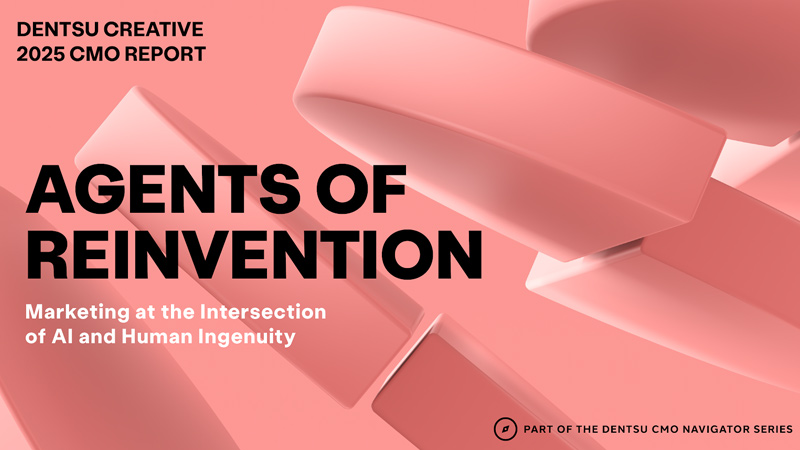
The study, titled Agents of Reinvention: Marketing at the Intersection of AI and Human Ingenuity, draws insights from 1,950 plus CMOs across 14 markets from India and the US to Japan and Brazil. Its central paradox? In a world governed by AI, humanity becomes the most valuable differentiator.

Key findings highlight the balancing act CMOs face:

Advertisement

. 30 per cent plus use AI daily, but 78 per cent agree AI can never replace human imagination, up 13 points from 2024.

.  87 per cent say strategy now demands more empathy and creativity, not less.

. 71 per cent fear invisibility without “winning the algorithm”, yet 79 per cent worry optimisation breeds sameness.

Advertisement

.  84 per cent believe brands must win share of culture, not just share of voice.

.  90 per cent see social and influencer content as outperforming traditional ads, while 91 per cent believe brands are built through creator collaborations (though 82 per cent fret about losing control).

   Innovation budgets are rising too 70 per cent plus plan to allocate over 20 per cent of spend to innovation in 2026 and beyond.

Advertisement

The report also flags a striking shift in Connected AI adoption: 89 per cent expect “agentic AI” where digital agents curate travel, shopping and more to reshape business, but the same proportion say trust and taste will matter more than ever.

Global dentsu leaders underscored this duality. Global CCO Yasu Sasaki noted that AI “is exceptional at prediction, but creativity is unpredictable by nature,” while CSO Patricia McDonald warned that “if every brand chases the same signals with the same tools, we’re just running harder to stand still.”

For India Dentsu CEO of creative & media brands Amit Wadhwa summed it up neatly: “Algorithms may shape what we see, but imagination, empathy and culture shape what we remember.”

Advertisement

In other words, CMOs in 2025 aren’t just coding for clicks, they’re betting that the brands which out-human the algorithm will be the ones that endure.


Click to comment

Leave a Reply

Your email address will not be published. Required fields are marked *

MAM

ASCI study uncovers how Gen Alpha navigates ads in endless digital feeds

‘What the Sigma?’ ethnographic report maps blurred boundaries between content and commerce for 7–15-year-olds.

Published

on

MUMBAI: Gen Alpha isn’t scrolling through the internet, they’re living rent-free inside its never-ending dopamine drip, and the ads have already moved in next door. The Advertising Standards Council of India (ASCI) Academy, partnering with Futurebrands Consulting, has published ‘What the Sigma?’, an immersive ethnographic study that maps how Indian children aged 7–15 (Generation Alpha) consume, interpret and live alongside media and commercial messaging in a hyper-digital environment.

The research draws on in-home interviews, sibling and peer conversations, and discussions with parents, teachers, counsellors, psychologists, marketers and kidfluencers across six cities. It examines not only what children watch but how algorithms, content creators, peers and parents shape their relationship with the constant stream of shorts, vlogs, gameplay, memes, sponsored posts and ‘kid-ified’ adult material.

Five core themes emerged:

Advertisement
  1. Discontinuous Generation, Gen Alpha is not growing up alongside the internet, they are growing up inside it. Cultural references, humour, aesthetics and language sync globally in real time, often leaving adults functionally illiterate in their children’s world. A reference that lands instantly for a 10-year-old in Mumbai or Visakhapatnam feels opaque or disjointed to most parents.
  2. Authority Vacuum, Parents and teachers frequently lose cultural fluency in digital spaces. The algorithm responsive, inexhaustible and perfectly attuned to preferences becomes the most attentive presence in many children’s daily lives. Rules around screen time feel increasingly difficult to enforce when adults cannot fully see or understand the content landscape.
  3. Digital as Society, Online and offline no longer exist as separate realms, they form one continuous reality. The phone is not a tool children pick up; it is the primary social environment they inhabit.
  4. Great Media Mukbang, Content flows as an ambient, boundary-less, multi-sensorial stream. Entertainment, advertising, commerce, gameplay, memes and vlogs merge into one undifferentiated feed. The line between active choice and passive absorption has largely collapsed.
  5. Blurred Ad Recognition, Children aged 7–12 typically recognise only the most overt advertising formats. Influencer promotions, gaming integrations and vlog sponsorships often register as organic entertainment. Children aged 13–15 show greater ad literacy but remain highly susceptible to narrative-integrated, passion-driven and emotionally resonant brand messaging. Discernment remains low across the board in a non-stop stream.

ASCI CEO and secretary general Manisha Kapoor said, “ASCI Academy’s study is an investigation into the content life of Generation Alpha not to judge them but to understand them. Their cultural reference points seem disjointed from those of earlier generations. Insights on how they perceive advertising is the first step towards building more responsible engagement frameworks, given that they are the youngest media consumers in our country right now.”

Futurebrands Consulting founder and director Santosh Desai added, “While earlier generations have been exposed to digital media, for this generation it is the world they inhabit. This report explores not only what they watch but how they are being shaped by algorithms, content and advertising.”

The study proposes four adaptive, principles-led pathways:

  • Universal signposting of commercial intent using design principles that make advertising recognisable even to young audiences.
  • Ecosystem-wide responsibility shared among advertisers, platforms, creators, schools and parents.
  • Future-ready safeguards built directly into children’s content experiences rather than as optional background settings.
  • Formal media and advertising literacy embedded in school curricula to teach age-appropriate understanding of persuasion and commercial intent.

In a feed that never pauses, Gen Alpha isn’t merely watching content, they’re swimming in an ocean where entertainment, commerce and identity swirl together. The real question isn’t whether they can spot an ad; it’s whether the adults building the ocean can agree on where the lifeguards should stand.

Advertisement
Continue Reading

Advertisement News18
Advertisement All three Media
Advertisement Whtasapp
Advertisement Year Enders

Copyright © 2026 Indian Television Dot Com PVT LTD

This will close in 10 seconds