MAM
Amazon, Apple emerge as most valuable global brands 2021: Kantar

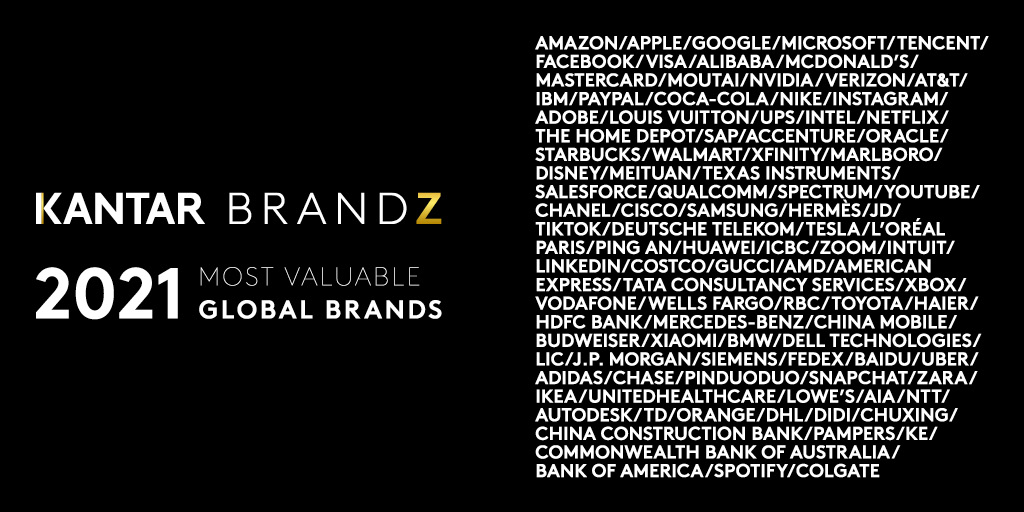
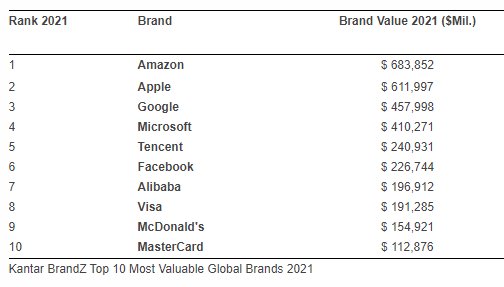
New Delhi: Multinational giant Amazon consolidated its position as the world’s most valuable brand, growing 64 per cent to $ 684 billion, Kantar said in its latest BrandZTM Most Valuable Global Brands 2021 ranking released on Monday.
Amazon’s brand value grew by almost $268 billion this year and it became the first half-a-trillion-dollar brand, alongside Apple, at number two, valued at $612bn. The other brands that figured in the top ten most valuable global brands in 2021 were: Google, Microsoft, Tencent, Facebook, Alibaba, Visa, McDonald’s, and MasterCard.
China’s TikTok and USA’s Tesla are among the brands that doubled their brand values during the pandemic. Tesla even emerged as the fastest growing brand and became the most valuable car brand, growing its value by 275 per cent year-on-year to $ 42.6 billion, said the report.

 Tech brands dominate global rankings
Seven of the top ten brands are from the tech sector. Tech has also enabled non-tech brands to achieve significant growth, for example Gucci – harnessing the power of TikTok during the pandemic, and Domino’s – leveraging online and delivery services. New entrant Zoom was one of the big tech stories of 2021, with its ease of use and reliability driving momentum with business and personal users. It entered the ranking at 52 with a valuation of $36.9bn.
World’s most valuable brands show record growth
Despite the economic downturn brought by the devastating wave of Covid-19, the report found that the world’s most valuable brands experienced record growth. Their total worth reached $7.1 trillion – equivalent to the combined GDP of France and Germany. This was largely driven by confidence derived from vaccine availability, economic stimulus packages, and improving GDP outlooks, said Kantar Group.
“Despite many facing a difficult year, our research has again proven that strong brands deliver superior shareholder returns, are more resilient, and recover more quickly,” said Kantar CMO, Nathalie Burdet. “With global e-commerce growing from 12 per cent to 15 per cent of all sales in 2020, it has been a positive year for brands involved in that value chain.”
Apparel brands overtake M&E brands
Despite reduced travel and lockdowns globally, apparel brands have collectively grown even more than media and entertainment brands in the ranking, as people redefined the boundaries between work and leisurewear. Adidas, Nike, and Puma all secured over 50 per cent value growth. Whilst, collectively, fast fashion did not grow as fast, notably, Uniqlo (+88 per cent) and H&M (+47 per cent) grew valuations significantly. The Top 20 retailers grew their brand value by a combined 48 per cent.
Success of subscription-based models
Microsoft innovated offers to adapt to new working environments and transitioned to subscription models to improve convenience and scalability, recording a growth of 26 per cent. Xbox (+55 per cent), Disney (+13 per cent), and Netflix (+55 per cent) all saw growth, while Spotify entered the ranking following a 454 per cent growth in subscribers from 2015-20 and a significant improvement in consumer brand equity.
Reputation: A Key factor
According to the report, reputation, especially for sustainable and ethical purposes, is increasingly a driver for brand growth. The luxury category saw 34 per cent brand growth with, predominantly, French and Italian luxury companies such as LVMH investing in their corporate reputation through pandemic-related initiatives, sustainable transformation, and support for social movements such as BLM. Similarly, L’Oréal Paris successfully bucked the trend across beauty brands in the pandemic, securing brand growth by flexing its assets and driving female empowerment.
Emphasis on Trust and Reliability
“Our analytics have uncovered that 70 per cent of what makes a brand successful is executing four fundamentals well: providing superior experience across consistently branded touchpoints, a range of well-designed and functional products and services, convenience, and exposure through great advertising. However, COVID-19 has emphasised consumer values such as trust and reliability. Those brands that are evolving their values, projecting leadership on these issues are demonstrating differentiation and standing out,” said Burdet.