MAM
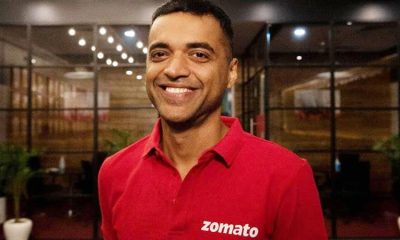
Zomato’s Deepinder Goyal joins magicpin board
MUMBAI: IPO-bound Zomato’s co-founder and CEO Deepinder Goyal has joined the board of magicpin, as an independent director. Founded by Anshoo Sharma & Brij Bhushan, and backed by Lightspeed Venture Partners, Waterbridge and Samsung, magicpin is a savings app that connects hyperlocal merchants and brands- both online and offline, with consumers.
Goyal joins the existing board and advisors that consist of Lightspeed Venture Partners MD Bejul Somaia, boAt Lifestyle CEO Vivek Gambhir, and Waterbridge MD Manish Kheterpal. Since launching in 2016, the homegrown app today has over 1.5 lakh merchants on the platform, serving 50 lakh consumers across fifty cities. It has also launched the OrderHere platform that enables local merchants to set up their online store within minutes, and serve online customers. magicpin simplifies catalog creation and management for local merchants/brands and offers integrated payments and logistics from logistics providers in India including Shadowfax, Dunzo, Rapido and Loadshare.
Speaking on joining the board, Deepinder Goyal said, “I am delighted to join the magicpin board. They are a high-quality team and I am excited about how they are being a driver of growth for local merchants across categories. I am looking forward to contributing to the company’s success.”
magicpin co-founder and CEO Anshoo Sharma said, “We are excited about Deepinder joining our board. He brings a wealth of experience from scaling up Zomato into the tech giant it is today. We are looking forward to his guidance and mentorship as we step into our next phase of growth.”
As lockdown measures ease across the country, magicpin is poised to scale up merchants and brands on its platform for online and in-store demand. It is already driving over $ one billion in annual revenues for its existing partners and continues to grow at a rapid pace, the company stated.

Brands
Kwality Wall’s reports standalone losses following strategic HUL demerger
Ice cream major faces Rs 64 crore Ebitda loss amid commodity inflation and muted Q3 sales
MUMBAI: Kwality Wall’s (India) Limited (KWIL) has released its first set of financial results as a standalone entity, revealing a challenging start to its independent journey. Following its successful demerger from Hindustan Unilever Limited (HUL) on 1st December 2025 and its subsequent listing on 16th February 2026, the company is navigating a transition period marked by structural changes and high input costs.
For the quarter ended 31st December 2025, the company reported revenue of Rs 222 crores. Despite the revenue base, the bottom line was impacted by several factors, resulting in an Ebitda loss of Rs 64.2 crores. When calculated on a Pre-IND AS 116 basis, the Ebitda loss stood at Rs 83.8 crores.
Organic Sales Growth (OSG) declined by 6.5 per cent year-on-year during the quarter. Volume growth, however, saw a marginal increase of 1.2 per cent. The company reported a gross margin of 41.5 per cent. Additionally, exceptional expenses amounting to Rs 94 crores were recorded, primarily linked to non-recurring costs during the transition phase.
Performance across portfolios and channels was mixed. Within the impulse portfolio, brands such as Magnum and Cornetto recorded mid-single digit volume growth, indicating steady demand in on-the-go consumption. However, the in-home portfolio, which includes take-home packs, experienced muted consumption. The company is planning a relaunch of this category with improved offerings ahead of the 2026 season.
Quick commerce (Q-Com) continued to emerge as a strong growth driver, delivering robust double-digit growth during the quarter. Meanwhile, the company also expanded its physical distribution network by increasing the number of company-owned cabinets across markets.
Margin pressure during the quarter was driven by a combination of one-off factors and broader cost inflation. Gross margins were impacted by around 600 basis points due to trade investments made for stock liquidation. Additionally, cocoa price inflation contributed to another 400 basis points of pressure on margins.
Deputy managing director Chitrank Goel attributed the muted performance partly to prolonged monsoons and transitional challenges linked to the GST framework. Operating expenses also increased as the company invested in establishing its standalone supply chain, operational systems and corporate infrastructure following the demerger.
Looking ahead, the management remains focused on a volume-driven growth strategy. To restore profitability, the company has initiated a cost productivity programme aimed at reducing non-consumer-facing costs. It is also working on building regional manufacturing networks to optimise logistics expenses and improve operational efficiency.
The commodity outlook for the near term remains mixed. Dairy prices are expected to remain firm due to tight supply conditions and rising fodder costs. Sugar prices may also move higher following increases in the Minimum Selling Price (MSP). While cocoa prices have moderated recently, currency depreciation has offset some of the potential cost relief for the company.