MAM
GUEST COLUMN: One accurate measurement is worth a thousand expert opinions


MUMBAI: Management guru Peter Drucker once said, “Because its purpose is to create a customer, the business enterprise has two — and only these two – basic functions: marketing and innovation.”
Marketing is more important today than ever before as it leads to brand creation, which is the growth driver of the business. A brand is the biggest moat and one of the most powerful intangible assets a business has. Today around 11 per cent of a company’s revenue is spent on marketing. The second most important quote of Peter Drucker was, “If you can’t measure it, you can’t improve it.” And, how true is this even today in this age of data overload.
Around 70 per cent of marketing spends are on media. Advertisers have never been under more pressure to prove ROI. TV has been leading and digital has been growing over the years. Together they contribute to around 80 per cent of spending. Measurement of both remains important, but it’s critical to focus on the right metrics which can drive action.

TV viewership has undergone changes over the years, especially with digitisation, NTO & OTT. The pandemic has led to increasing the overall TV viewership with rural growing faster. If one has to look at genre level, then News, FTA & Regional has been on a continuous growth & Niche has been facing challenges. The good part about TV is that it has an industry-accepted third-party measurement system which drives most of the decisions on planning and investment. However, the industry needs to sort the recent ambiguity on news measurement.
The consumer looks at TV and digital as a continuum. The majority of OTT content is TV shows, acting as catch-up TV. Growth of connected TV has been fast, though on a smaller base and with NTO 2.0 closer, it’s an indication that TV might keep tilting the balance towards rural & OTT will emerge as new Urban TV. The question is “When”? The audience being the key, can TV take a step further towards digital with improving targeting capabilities at a geo level as well as consumer interest and affinity?
Digital has been growing and the launch of 4G and Jio has accelerated the growth. Specific measurement is possible at the customer level due to the availability of large data sets; however, digital comes with the challenge of a common currency and a heavy reliance on self-claimed platform level data.
Platforms do not talk to each other leading to higher inefficiencies in planning. Over the last 18 months, digital spending has been moving to lower-funnel actions driving purchase and conversion. Evolved businesses do understand the need to balance the spending across the funnel (TOF) to get more efficiency on performance marketing without compromising on brand building.
One of the major changes over the last few years is the advent of the creator economy. Scale is a challenge here and the industry needs to enable this. There is a need to move beyond views and likes. Coupon codes and affiliate links are solving the attribution question. However, the focus should also be to measure brand advocacy.
With large data sets and extremely sharper targeting capabilities, digital also faces the wrath of privacy which is now being spoken at various industry forums and is at a cusp of change with regards to customer opt-in and usage of data.
Hence TV & digital will have to come closer and there is a need for standardisation of the measurement mechanics, for improving the investment decisions. While the basic measures like monitoring reach, frequency, views, etc. are important to track, other outcomes remain critical like brand searches including marketplace, direct traffic, time spent, footfalls, etc. Tracking customer satisfaction, mind metrics, and NPS is also a key measure of brand health.
While today’s consumer is multiscreen, measurement of media is operating in silos and the absence of single-source data adds to the woes. The industry has to take steps to arrive at a cross-media third-party measurement currency that helps measure effectiveness as well as efficiency of marketing spending.
And finally, brand metrics across the marketing funnel, like awareness, consideration, and purchase intent will remain critical varying from business to business depending on customer engagement. The power of the brand will be determined by the ability to charge a price premium, loyalty, and advocacy, and it is imperative to measure these continuously.
(Rahul K Shah is general manager, Motivator at GroupM. The views expressed in this column are personal and Indiantelevision.com may not subscribe to them.)






Brands
Jubilant FoodWorks faces Rs 47.5 crore GST demand, plans appeal
Tax authorities flag alleged misclassification of restaurant services
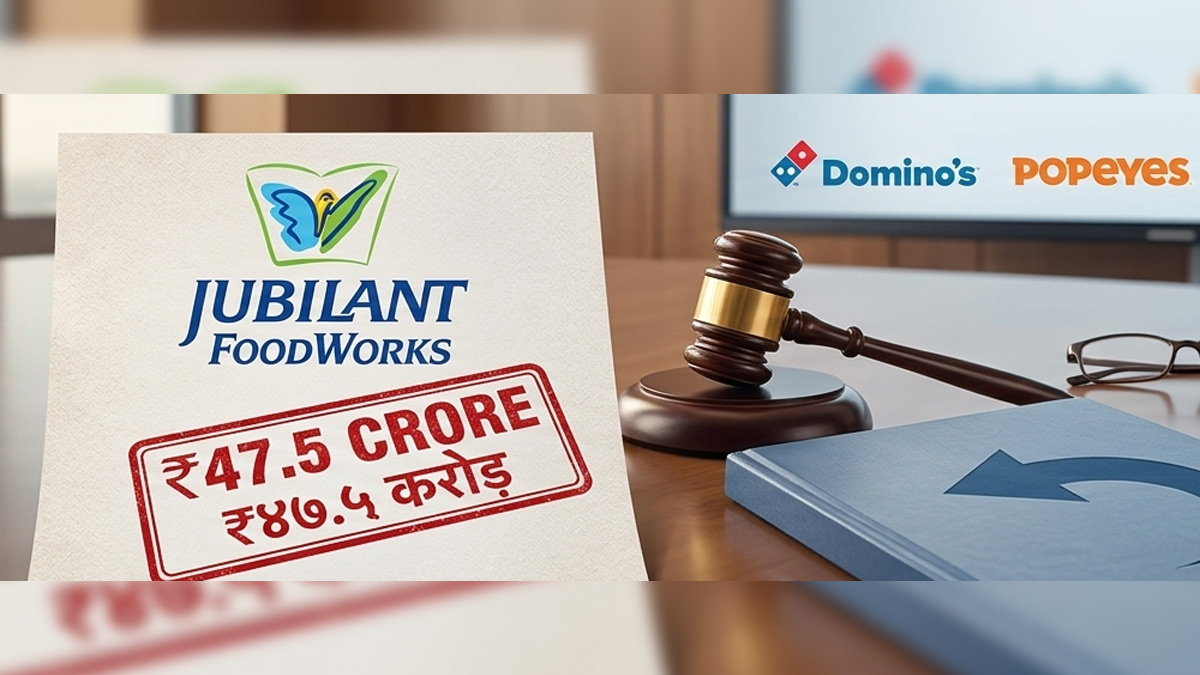
MUMBAI: Jubilant FoodWorks Limited has landed in a tax tussle after receiving a GST demand of Rs 47.5 crore from the office of the additional commissioner of CGST and central excise in Thane, Maharashtra.
The order, issued under the provisions of the Central Goods and Services Tax Act, 2017, relates to an alleged incorrect classification of certain services under the category of restaurant services. According to the tax authorities, this classification resulted in a short payment of goods and services tax for the period between the financial years 2019-20 and 2021-22.
The demand includes Rs 47.5 crore in GST along with an equal amount as penalty, in addition to applicable interest. The order was received by the company on March 13, 2026.
In a regulatory filing to the BSE Limited and the National Stock Exchange of India Limited, the company said it disagrees with the order and believes its arguments were not adequately considered.
The company is preparing to challenge the decision and plans to file an appeal. It added that once the redressal process is complete, the demand is likely to be dropped.
Despite the sizeable figure attached to the notice, the company said it does not expect any material impact on its financials, operations or other activities.
The disclosure was signed by Suman Hegde, EVP and chief financial officer, who confirmed that the company received the order at 19:06 IST on March 13 and has already initiated steps to contest it.
The development places the quick service restaurant major in the middle of a tax debate that could hinge on how certain restaurant-linked services are classified under GST rules. For now, the company appears ready to take the matter from the tax office to the appeals desk.







