Connect with us

Brands

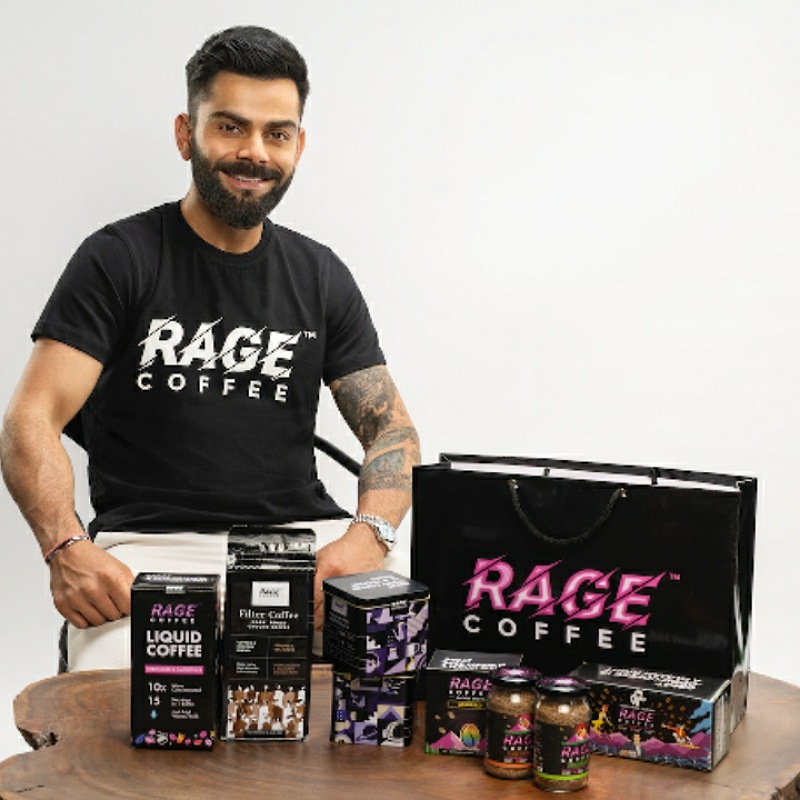
Rage Coffee onboards Virat Kohli as brand ambassador & investor

Published

on

Mumbai: Rage Coffee, a Delhi-based FMCG company that manufactures, markets, and distributes packaged coffee products has onboarded cricketer Virat Kohli as an investor and brand ambassador. With this association, the coffee brand said it seeks to entrench itself as a fan favourite in the market and create a pathway for customer acquisition.

“I’ve been using Rage Coffee products for some time, and I am excited to be a part of its growth journey. The team at Rage Coffee has shown high levels of business execution and stupendous growth over the last couple of years,” commented Virat Kohli. “Rage Coffee has developed some trailblazing products that conform with my innovative approach and align with my lifestyle. I see tremendous potential for the brand to become one of the most iconic coffee companies of our time.”

Previously, the digitally native coffee company had raised five million dollars of growth capital as part of its series-A funding round led by Sixth Sense Ventures in August 2021.  

Advertisement

The brand is planning to expand its online presence and offline footprint pan-India and will utilise the fresh capital for marketing and distribution purposes, according to the statement. “Rage Coffee will use the funds to scale production, launch innovative new products and add senior management talent,” it added.

“Virat Kohli has set some unrivalled records in the top echelon of world cricket and is rightly known as the best batsman in the world,” said Rage Coffee founder and CEO Bharat Sethi, about roping in Virat Kohli as a brand ambassador and investor. “Apart from being a world-class athlete, Virat is also a fitness enthusiast who is committed to an attitude that fosters a healthy lifestyle and it seamlessly aligns with the ethos that Rage Coffee promotes. Our association with him sets us on a journey where we envision perfection through our constant efforts directed at being the best in our segment. Rage Coffee and Virat both share a mutual objective – to strive for excellence!”  

Advertisement
Click to comment

Leave a Reply

Your email address will not be published. Required fields are marked *

Brands

E-commerce growth rises, but profits come under pressure

Shop Culture flags rising costs, weak systems and a $5.38 billion quick-commerce boom reshaping global retail

Published

on

MUMBAI: E-commerce is booming, but profits are thinning. A new report by Shop Culture warns that brands clinging to outdated, growth-at-all-costs strategies are being outpaced in a costlier, more complex 2025 landscape.

Global online retail is expected to cross $6.86 trillion this year, with 2.77 billion shoppers making at least one purchase. Yet returns are under strain: average return on ad spend has slipped to 2.87:1, exposing cracks in how brands chase scale without building sustainable margins.

Three shifts are rewriting the rules. First, retail media is getting pricier, with Amazon’s average cost per click rising 15.5 per cent year-on-year to $1.12. Second, while 77 per cent of e-commerce professionals now use AI daily, many see limited gains as weak systems blunt its impact. Third, geography is no longer expansion, it is strategy. The share of Shop Culture clients operating across multiple markets has more than doubled, from 30 per cent in 2024 to 65 per cent in 2025.

Advertisement

Subarna Mukherjee, founder and ceo, Shop Culture, is blunt: “The e-commerce industry has a nostalgia problem. In 2022, the playbook was simple: list aggressively, spend on ads, and ride the wave of post-pandemic digital adoption. It worked. Revenue grew rapidly. But by 2025, the industry is seeing the consequences of those structural shortcuts. E-commerce itself is not slowing down, the challenge lies in how brands are operating within it.”

Nowhere is the shift sharper than in India’s quick-commerce boom. The segment is set to hit $5.38 billion in 2025, growing 17 per cent and emerging as the fastest-growing globally. What began as a convenience play is fast becoming a margin buffer. In one case, quick commerce drove 70 per cent of a packaged food brand’s online revenue, delivering 130 per cent year-on-year growth. A beauty brand, meanwhile, saw selling prices rise 25 per cent higher than on traditional marketplaces.

Expansion, too, is being rethought. The report argues that brands chasing the largest markets first often stumble. Better outcomes come from sequencing entries based on efficiency, regulatory readiness and competition, with markets such as the UK and Germany offering smarter entry points than the United States.

Advertisement

Compliance has turned from a checkbox into a revenue lever, especially in Europe. Brands with ready frameworks can go live in 8 to 12 weeks, while others risk delays of six months or more due to listing and documentation hurdles.

AI, for all the hype, is no silver bullet. Across more than 1,500 listings, it improved conversion rates by 10 to 15 per cent, cut TACOS by 7 to 10 per cent and reduced stockouts by 20 per cent, but only when layered on strong foundations. As Mukherjee puts it: “AI is not a growth strategy, it is an amplifier. It enhances strong systems and exposes weak ones.”

The message for 2026 is stark. Growth alone will not save brands. Margins, discipline and smarter strategy will. In a market still expanding at breakneck speed, the real race is no longer for scale, it is for survival.

Advertisement
Continue Reading

Advertisement News18
Advertisement All three Media
Advertisement Whtasapp
Advertisement Year Enders

Copyright © 2026 Indian Television Dot Com PVT LTD

This will close in 10 seconds