MAM
Boosting local market manufacturing will help the Indian M&E industry to become a supplier to the world: CII Big Picture Summit 2022

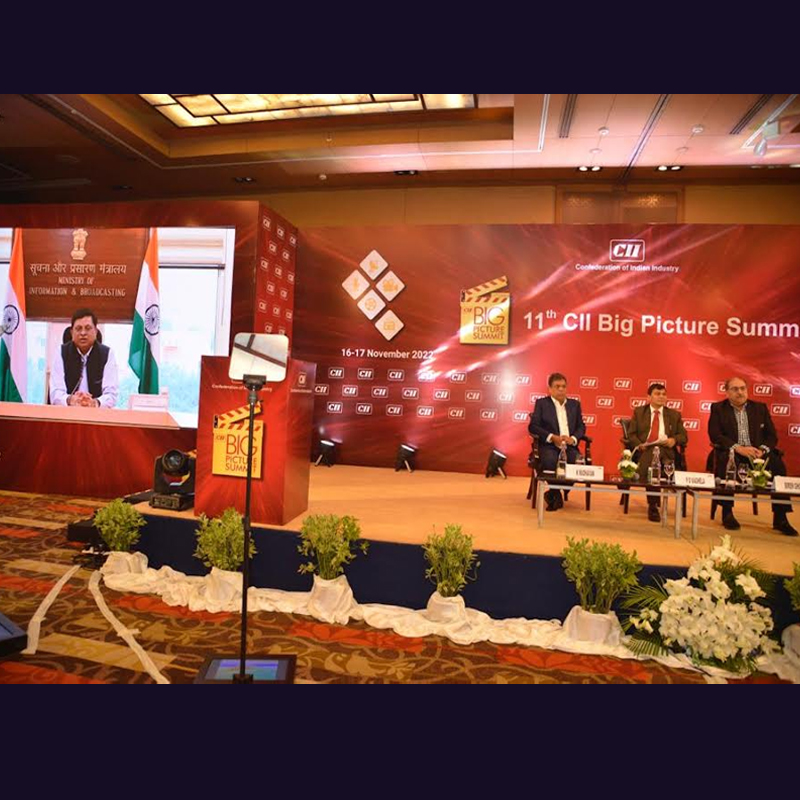
Mumbai: The 11th edition of the Big Picture Summit 2022, organised by the Confederation of Indian Industry (CII), is a two-day event that is taking place on 16-17 November. The Summit witnessed the participation of various eminent panellists and marked the release of the CII-BCG report on “Shaping the Future of Indian M&E” and the CII-IBDF-KPMG report on “Sports Broadcasting in India.”
CII Big Picture Summit 2022, with a range of sessions, has participation from content creators, broadcasters, buyers, studios, production companies, publishers, distributors, and developers across the gamut of the Media & Entertainment (M&E) landscape.
On 16 November, the first day of the event, discussions centred around global trends and opportunities, the bounce-back of revenues to pre-pandemic levels, domestic consumer preferences, and local opportunities for a global audience through digital platforms that have never existed before, especially for the creative industry, storytellers, and technology providers.
Speaking at the event, the ministry of information and broadcasting (MIB) secretary Apurva Chandra, stated that MIB, along with the Indian M&E industry, has set a goal of making the M&E sector a $100 billion industry by 2030. Chandra acknowledged the announcement by the ministry on the incentive policy for cinema at the Cannes Film Festival this year, out of which many proposals have been accepted for foreign productions in India.
He further revealed, “The animation, visual graphics, gaming, and comics (AVGC) taskforce, which was launched as a part of the budget 2022, has completed its deliberations and is in the process of finalisation. The government will soon work towards actioning on the recommendations that come out of the report.” As regards the broadcasting sector, Chandra stated that the ministry has recently revised the guidelines for uplinking and downlinking for satellite television channels in India to ease the burden of compliance on channels.
Telecom Regulatory Authority of India (Trai) chairman Dr. P.D. Vaghela highlighted the significance of the Indian M&E sector in the national growth story and economic prosperity. With about half of the population being young, the Indian demographic dividend presents a huge opportunity for Indian M&E services. Television is the largest and fastest-growing segment, representing around 50 per cent of the total media and entertainment revenue.
He added that during the last decade, the M&E sector in the country has undergone several radical changes and is experiencing a paradigm shift due to the advancement of technologies and innovations in the creation, distribution, and consumption of media. He stressed that the traditional media would lose ground unless it understands, adopts, and merges its own business models with society 5.0, AI, machine learning, and other technologies that are being unleashed. Vaghela further mentioned, “The government needs to come out with policies that are flexible in nature and allow new players to easily enter the industry while at the same time not strangling the traditional sector with numerous regulations.”
MIB joint secretary Sanjiv Shankar mentioned the various efforts made by the ministry in the recent past to ensure significant interventions in the regulatory framework, largely based on ease of doing business, Atmanirbhar Bharat, and Make in India. He stressed on the Broadcast Seva portal, which offers a single point facility to various stakeholders and applicants to apply for various permissions, registrations, licences, etc., for the development and integration of the broadcast industry.
CII National Committee on media & entertainment chairman and Disney Star country manager & president K Madhavan, in his opening remarks commended CII for bringing together key stakeholders and policy makers together to discuss the future of India’s M&E industry and its potential in shaping societies. The M&E sector in India is underpenetrated, with a contribution of 0.9 per cent to the GDP compared to 3-4 per cent for many developed countries.
He further advocated the potential for growth for the industry, owing to the presence of 300 million households in India, of which about 100 million households still have no access to television headsets. He further urged for timely support by policymakers in the areas of privacy, ensuring a supportive IPR protection measure, and announcing content-related policies while taking note of changing consumer habits and helping the industry to reinvent itself and adapt to creating travelable content.
CII National Committee on media & entertainment chair & CII sub committee for AVGC & Immersive Media – vice chairman, and Technicolor India country head Biren Ghose in his closing remarks mentioned about the need to evolve in the ways content is being created and urged the stakeholders to look at growth from a different lens, particularly away from a linear vertical growth. Moreover, he mentioned fostering collaboration between government, industry, and academia for the continued growth of the M&E sector.
Furthermore, Trai advisor Anil Bharadwaj said that while Trai is trying to enable a positive, consultative-based, industry-friendly approach with regards to the new tariff order (NTO), the industry needs to focus on building capacities and centres of excellence.
CII has been driving several initiatives to take the Indian M&E sector to new heights and expand its global footprint in close collaboration with MIB. These include representing the Indian film and entertainment industries at the prestigious Cannes Film Market for the past 20 years, at the Berlin Film Festival for the past five years, and at the Toronto Film Festival for the past three years. CII’s strength in policy advocacy is acknowledged and accepted by both the government and media industries.