Digital
The screen ate everything: inside India’s unstoppable content boom
The average adult surrenders nearly seven hours a day to a screen, for India’s media industry, that is not a warning. It is the greatest opportunity in a generation.

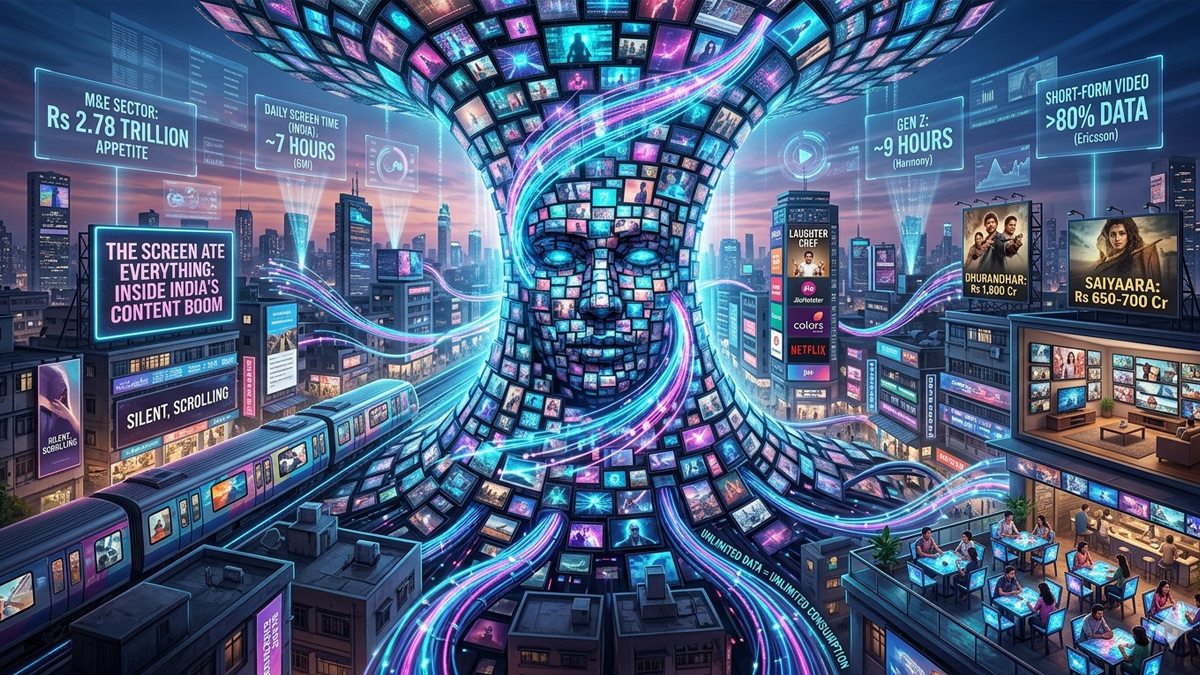
MUMBAI : There is no longer any meaningful distinction between watching television, scrolling through a feed and simply being alive. In 2026, the screen has woven itself into every waking hour. According to the latest GWI and DataReportal Global Overview reports, the average adult worldwide now gives 6 hours and 54 minutes a day to one device or another. In South Africa and Brazil, two of the world’s most hyper-connected markets, that figure swells to a stupefying 9 hours and 24 minutes. Far from signalling a crisis, this represents something far more remarkable: an industry that has expanded the very definition of human leisure time and filled it, profitably, with content. The attention economy is not merely growing. It is flourishing.
A RS 2.78 TRILLION APPETITE
The numbers behind this boom are extraordinary. India’s media and entertainment sector expanded by 9 per cent in 2025 to reach Rs 2.78 trillion, powered by a surge in digital subscriptions and a muscular rebound in live events. Its advertising market commands Rs 1.5 trillion; its live concert economy, a buoyant Rs 13,000 crore and rising. Globally, the industry is on course to hit Rs 330.34 trillion by 2030, a figure that would comfortably dwarf the GDP of most nations.
To understand how India arrived here, it helps to rewind two decades. A spokesperson from JioStar, one of the country’s dominant media platforms, maps the journey with clarity. Back then, the Indian media landscape rested on four pillars: linear television, cinema halls, radio and the physical newspaper. Entertainment had a fixed time and a fixed place. Families gathered in the evenings. Communities came together on weekends. Access, not appetite, was the limiting factor.
That constraint has been comprehensively dismantled. With the arrival of affordable internet, the democratisation of data and the explosion of smartphones, there is no longer a dedicated hour set aside for entertainment. The moment a person finds a spare minute, the phone is out. Someone opens LinkedIn. Another reaches for Instagram. A third catches up on JioHotstar. The screen has become not a destination but a reflex, and India’s media economy has grown to meet every one of those reflexes. Today’s audience, spokesperson argues, is resolutely “medium-agnostic”. They do not follow channels or devices. They follow experiences, and they will find those experiences on whatever screen is closest and most convenient.
THE INFRASTRUCTURE THAT MADE IT POSSIBLE
Much of this transformation is, in meaningful ways, a distinctly Indian story. Data costs in this country are among the lowest anywhere on earth, a direct consequence of Jio’s entry into the market and its deliberate strategy of prioritising scale over short-term margin. The arrival of 4G, and subsequently 5G, flooded the market with unlimited data plans at accessible price points. Where consumers once rationed themselves to 1GB or 2GB of free data bundled into a prepaid recharge, they now operate on unlimited plans as a matter of course. The JioStar spokesperson is clear-eyed about the significance of this shift. Unlimited data has produced, almost by design, unlimited consumption. Content, gaming and digital entertainment taken together are at all-time high. The infrastructure built to acquire subscribers at scale has quietly become the backbone of an entirely new media economy, one that is still expanding its boundaries.
SILENT, SCROLLING AND SEARCHING DIFFERENTLY
How people consume content has shifted as dramatically as how much of it they devour. Between 80 per cent and 85 per cent of video watched on Facebook and LinkedIn is now viewed without sound. Captions, once an afterthought bolted on for accessibility, have become the primary mode of consumption in offices, commutes and crowded cafés alike. Search behaviour has lurched just as sharply. For the first time, 52 per cent of Gen Z report trusting product information on social media more than on Google. TikTok and Instagram Reels have, in practical terms, become the internet’s new front page for anyone under 30. Short-form video now accounts for more than 80 per cent of all global mobile data traffic, a dominance that no legacy broadcaster, search engine or newspaper once thought conceivable.
EVERY SCREEN, EVERY STORY
Perhaps the most persistent myth in Indian media is that the platforms are at war with each other, that streaming is cannibalising television, that cinema is a dying art form, that print is finished. JioStarspokesperson dismisses this framing with some force, and the data supports the scepticism. Television viewing across India has held steady at between three and three and a half hours a day for the better part of a decade. It has not grown dramatically, but it has emphatically not shrunk either. In pockets of South India, it has actually risen. The Hindi-speaking market, which spans 26 states and five union territories across a vast and diverse geography, has maintained its consumption levels with remarkable consistency.
Cinema, supposedly finished off by streaming, has just delivered one of its strongest box office years in a decade. Film “Dhurandhar” crossed Rs 1,800 crore. “Saiyaara”, a romance built around two complete unknowns with no star power to speak of, made Rs 650 to 700 crore and triggered a national conversation. The JioStar spokesperson draws an explicit parallel to the phenomenon of “Kaho Naa Pyaar Hai” a generation ago: a film that came from nowhere, carried by two fresh faces, and became the only song anyone was singing for months. The mechanism is identical. The emotion was relatable. The storytelling was honest. The audience responded. Great content, the spokesperson argues, has always found its audience. The screen it reaches them on is a secondary consideration.
This year represents a genuine revival of Hindi cinema, built on one simple principle: telling stories that people actually want to hear. The appetite for honest, emotionally resonant narratives has never been stronger. “Laughter Chef” performs strongly on Colors, on JioHotstar and would do equally well on YouTube if distribution were opened up. “Taarak Mehta Ka Ooltah Chashmah“, a show that has stood the test of time across decades, performs brilliantly on SAB TV, on Sony, on Sony LIV and on YouTube simultaneously. Netflix runs Indian television content, including shows developed originally for broadcast audiences, and performs well with it. Kapil Sharma, a television star by any traditional definition, has found a substantial second audience on streaming.
The lesson the spokesperson draws from all of this is straightforward. There is no such thing as TV content or digital content. There is only great content and the question of which screen offers the most convenience at a given moment. A person travelling from Malad to Parel will watch on their phone. The same person, relaxing at home on a Saturday evening, will choose the television for the large-screen experience. They are not two different consumers. They are the same consumer, moving fluidly between devices, following the story rather than the platform.
The data increasingly suggests that India’s media ecosystem is not splitting into television audiences and streaming audiences so much as converging into a hybrid one. Findings from Ormax Media’s OTT Audience Report 2025 estimate that 491 million Indians now consume both OTT and linear television, while only 110 million sit exclusively in the OTT camp. In practical terms, more than four out of five OTT viewers in India still continue to watch television as well. The long-predicted era of mass cord-cutting, at least in India, remains more theory than reality.
Television, meanwhile, continues to operate at enormous scale. Roughly 750 million Indians still tune into TV every week, a figure that has remained broadly stable over the past two years despite the explosive growth of streaming platforms. Monthly television reach touched 831 million viewers at a one-minute threshold, substantially ahead of YouTube’s estimated reach even at far shorter viewing thresholds. The implication is difficult to ignore: OTT in India is expanding the market for video consumption rather than replacing traditional television outright.
The larger opportunity may ultimately lie beyond both ecosystems. More than 565 million Indians still consume neither OTT nor television content regularly, with the majority concentrated in rural and non-metro markets where smartphone access, internet affordability and regional-language availability remain uneven. As those consumers gradually enter the digital ecosystem, the industry expectation is not that they will choose between television and streaming, but that they will move fluidly across both. India’s media future increasingly appears less like a winner-takes-all platform war and more like a coexistence economy built around screens of every size.
That coexistence is already reshaping how the industry thinks about distribution itself. The question is no longer whether audiences prefer theatres, television or streaming, but how each platform amplifies the other at different stages of a story’s life cycle. The industry’s pandemic-era experiment with direct-to-digital film releases ultimately reinforced that lesson rather than weakening it. The pandemic-era experiment with direct-to-digital film releases, the spokesperson notes, ultimately proved the opposite of what its proponents intended. Producers eventually returned to theatrical distribution not because streaming failed, but because nothing generates word of mouth like a cinema hall. The communal experience, the conversations it sparks, the organic marketing it produces, no streaming platform has yet replicated it. When “Dhurandhar” arrived on OTT, the spokesperson said, it broke digital records because its theatrical run built the curiosity and the cultural conversation that streaming alone cannot manufacture. Every component of the ecosystem has a role. Television, streaming and cinema are not rivals. They are sequential chapters in the life cycle of great content.
THE THEORY OF ABUNDANCE
India is living through its golden years, and every sector of the media business is on a growth trajectory. The relevant strategic question is not which platform wins at the expense of another, but whether creators and companies can understand their consumers well enough to serve them the right content at the right moment on the right screen. Yash Raj Films’ (YRF) structural playbook—anchoring the market with massive tentpoles like the Spy Universe while simultaneously backing story-led breakout hits like Saiyaara—is the model worth invoking: no frantic daily episode drops, no aggressive platform wars, simply the patient cultivation of cultural intellectual properties that people love so deeply they will seek them out on any screen available. There is plenty of consumption, plenty of attention and plenty of money to be made. The winners will be the ones who get their content right, make it accessible and trust the audience to find it.
CONTENT AS THE NEW INFRASTRUCTURE
The average TikTok user burns through 34 hours on the app every month, according to engagement data from DataReportal and data.ai. In India, the only significant market on the planet where print is still growing, figures from the Audit Bureau of Circulations (ABC) and FICCI-EY show that 139 million copies of newspapers are sold every single day. Across a world of 6.04 billion internet users — a milestone recently tracked by the International Telecommunication Union (ITU) — the hunger for content is not plateauing. It is compounding. Content in 2026 is not a distraction or a leisure category. It is infrastructure, as essential to daily life as roads, electricity or running water. The creators and companies that understand this are not anxiously chasing audiences. They are embedding themselves, story by story, inside the hours that people cannot imagine living without.
The challenge is no longer finding an audience. It is earning one. In an always-on, perpetually swiping world, the winners will be those who can ignite enough curiosity in the first two seconds, before the thumb moves on, the algorithm pivots and the moment passes. In the attention economy, the prize goes not to the loudest voice or the biggest platform, but to the best story. It always has.
A VISION AHEAD: TWO STRATEGIC THOUGHTS FOR THE FUTURE
As the industry looks to sustain this massive momentum, two critical focal points will define the next phase of growth:
Diversifying Monetisation Beyond Ads and Subscriptions: While advertising and subscriptions have built this multitrillion-rupee market, relying purely on two revenue pillars leaves platforms vulnerable to market saturation. The next frontier involves deep-diving into hybrid models. Media giants must look toward experiential commerce, direct content-to-retail integrations, interactive gamified monetization, and leveraging massive content communities for hyper-localized hyper-commerce.
How AI is Changing the Landscape: Artificial Intelligence is no longer a tool just for the back-room editors; it is actively reconstructing the media ecosystem. AI is rapidly lowering the cost of hyper-localized regional content creation, personalising real-time dynamic viewing experiences, and predicting audience responses down to the second. From micro-targeting scripts to transforming how engagement algorithms hold attention in those crucial first two seconds, AI is shifting the industry from a creative gamble to a highly precise, adaptive science.
None of this displaces the central truth the rest of this story insists upon: in the attention economy, the prize still goes to the best story, not the smartest tool. AI helps us achieve cinematic spectacle at lower costs than traditional production, widens the languages it can reach and raises the odds that it finds its audience, but it cannot manufacture the honesty and emotional resonance that made Saiyaara a national phenomenon. The most successful players will treat AI as the precision instrument that serves the creative eco-system, using the science to make sure great storytelling reaches every screen, in every language, at exactly the moment the audience is ready for it.
KEY STATS AT A GLANCE
| Metric | Figure | Source |
| Global daily screen time | 6 hours 54 minutes | GWI / DataReportal |
| Daily screen time (South Africa & Brazil) | 9 hours 24 minutes | GWI |
| Daily social media time | 2 hours 21 minutes | GWI / DataReportal |
| Gen Z daily screen time | ~9 hours | Harmony Healthcare IT |
| Average daily TV viewing in India | 3 to 3.5 hours | BARC India |
| India M&E sector size (2025) | Rs 2.78 trillion | FICCI-EY Report |
| India advertising market | Rs 1.5 trillion | Pitch Madison Advertising Report |
| India live concert economy | Rs 13,000 crore | EY India |
| Global M&E projected value (2030) | $3.98 trillion | PwC Global Outlook |
| Short-form video share of mobile data | 80 per cent plus | Ericsson Mobility Report |
| Silent video viewing (FB & LinkedIn) | 80 to 85 per cent | Internal Platform Data (Meta/LinkedIn) |
| Gen Z trusting social media over Google | 52 per cent | Forbes / Adobe Survey |
| Average TikTok usage per month | 34 hours | Data.ai (App Annie) |
| Indian newspaper copies sold daily | 139 million | Audit Bureau of Circulations |
| Total global internet users | 6.04 billion | ITU / DataReportal |