Hindi
Content Hub panel explores comedy’s shrinking comfort zone in India
Writers and creators debate satire, censorship and laughs in the viral era

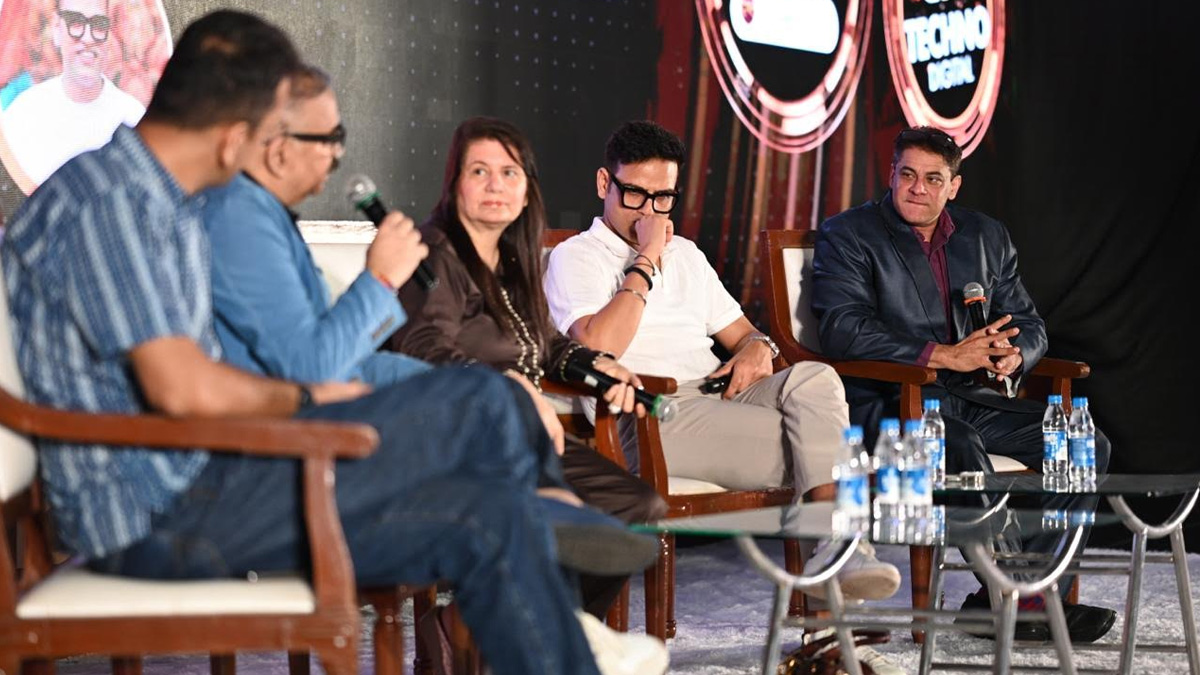
MUMBAI: In India’s comedy business today, the punchline may land before the legal notice does. And that nervous laughter echoed through a spirited panel discussion at The Content Hub x VFX & More Summit and Awards 2026, where writers, creators and showrunners unpacked the increasingly tricky art of making people laugh in a hyper-sensitive, hyper-online world. The session, titled ‘The Fine Line of Laughter: Creating Comedy in a Sensitive World’, brought together Cyrus Broacha, Bharat Kukreti, Binaiferr Kohli, Kunal Aneja and Vankush Arora for a freewheeling conversation that blurred the line between panel discussion and live comedy set.
At the heart of the discussion was a question troubling nearly every comedy writer and performer today, where exactly is the line between satire and offence, and who keeps moving it?
The panel broadly agreed that comedy has become significantly tougher to navigate, especially on television. Writers spoke about how jokes today operate within invisible boundaries where religion, caste, politics and social sensitivities often become no-go zones. Several participants noted that while audiences still enjoy edgy humour, creators now constantly second-guess whether a joke might spiral into outrage once clipped, shared and amplified online.

Television, according to the panel, remains the most tightly controlled format. Speakers described TV comedy as a medium where creators are expected to deliver constant laughs while operating within strict broadcast standards. Digital and YouTube, on the other hand, were seen as relatively freer spaces, although even web creators admitted that the absence of clearly defined boundaries creates its own anxieties.
One recurring observation through the session was that comedy writing itself has evolved. Slapstick and simplistic gags have steadily given way to humour rooted in everyday situations, behavioural quirks and social observations. Writers argued that modern audiences respond more strongly to relatable scenarios and layered reactions than to loud punchlines alone.
The importance of casting and performance in comedy also emerged as a major talking point. Panellists stressed that even a brilliantly written joke can collapse if the actor’s timing, pauses or reactions fail to support it. In comedy, they said, reactions often become funnier than the punchline itself. Performers such as Kapil Sharma, Sudesh Lehri and Krishna Abhishek were cited as examples of artists who can elevate average material through conviction and comic timing.
The discussion repeatedly returned to the collaborative nature of comedy writing. Improvisation, particularly during rehearsals, was described as central to refining scripts, shaping reactions and finding rhythm. However, speakers also acknowledged that improvisation has limits, especially in ensemble comedy, where overstepping another actor’s space can disrupt scenes rather than enhance them.
Interestingly, the panel dismissed the idea that memes and short-form content are replacing long-format comedy altogether. While attention spans may have shortened, creators maintained that audiences still return for well-written stories and memorable characters if the content genuinely connects. According to the speakers, strong writing and emotional relatability continue to matter far more than format length.
Satire, however, was identified as the genre facing the steepest challenge. Several panellists observed that political satire has become increasingly difficult to sustain on mainstream platforms due to shifting sensitivities and inconsistent reactions to controversial humour. Yet there was also optimism that audiences still crave intelligent satire, particularly as newer digital platforms create room for more experimental formats.
The panel also reflected on changing times in Indian comedy. Veterans recalled an earlier era of television and prank shows where creators enjoyed greater spontaneity and fewer restrictions. Today, creators said, virality itself has become both opportunity and risk, with even offhand jokes capable of triggering backlash far beyond their intended audience.
As the session wrapped up, one message stood out clearly: comedy may now come with disclaimers, filters and fear of fallout, but the appetite for laughter remains untouched. In a content economy crowded with outrage and algorithms, humour still survives as one of the hardest, riskiest and most rewarding forms of storytelling.