Sports
2026 FIFA World Cup is the biggest stress test the internet has ever seen
Forty-eight teams, six billion viewers and two exabytes of data: football’s grandest tournament is about to become the world’s largest real-time experiment in AI, streaming and digital infrastructure

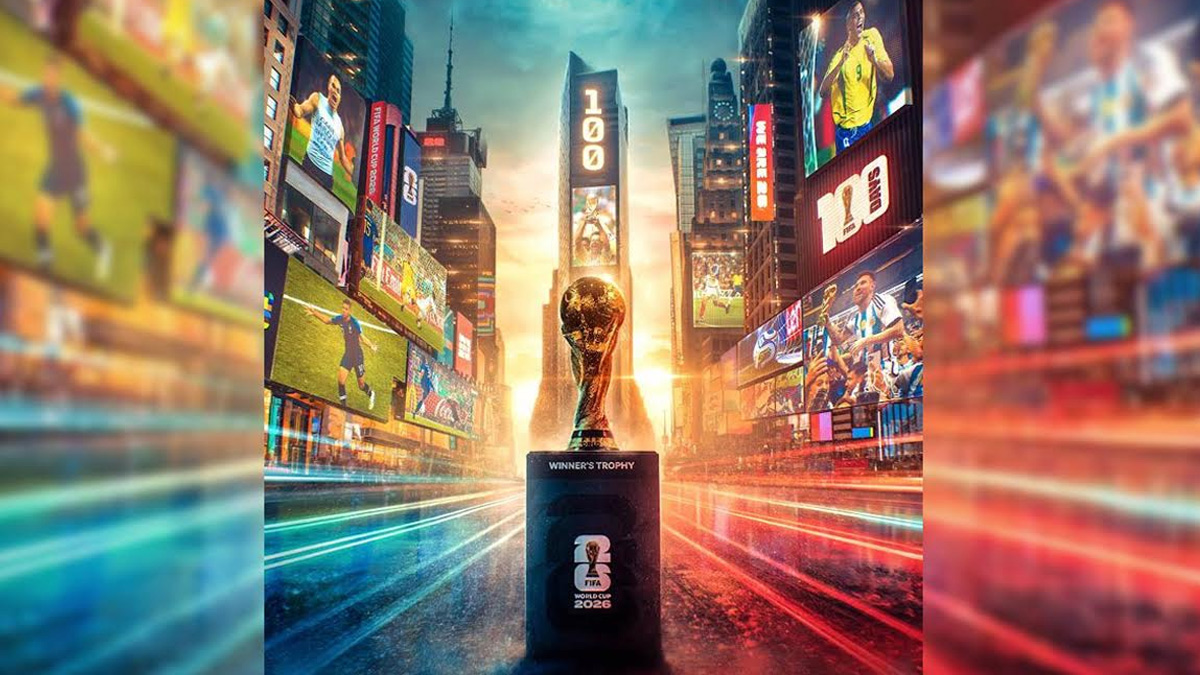
MEXICO: On June 11th, a football match in Mexico City will kick off the most technologically ambitious sporting event in human history. The 2026 FIFA World Cup, jointly hosted by the United States, Canada and Mexico, expands for the first time to 48 teams and 104 matches across 16 host cities. Bank of America is the official sponsor. Its research arm has just published a thematic guide to what it calls the most consequential sporting event ever staged, and the numbers are extraordinary in every direction.
Start with the scale. The 48 participating nations represent 27 per cent of the world’s population and 62 per cent of global GDP. Total engagement is projected to exceed 6 billion people, roughly three-quarters of humanity, up from 5 billion at the Qatar tournament in 2022. Attendance is forecast at 6.5 million, nearly double the record of 3.6 million set when the US last hosted in 1994. That 1994 tournament, for context, was held before most of the world had heard of the internet. A great deal has changed.
A $41bn shot in the arm
The economics are staggering. The global sports industry generated $2.3 trillion in revenues in 2025, making it the world’s tenth largest economy by GDP, and is forecast to reach $3.7 trillion by 2030. A joint FIFA-World Trade Organization study estimates the 2026 tournament alone could generate $80.1bn in global output, add $40.9bn to global GDP and support approximately 824,000 jobs. The United States, which hosts 11 of the 16 host cities, stands to gain the most: $30.5bn in economic output, $17.2bn in GDP and around 185,000 jobs.
The 16 host cities, stretching from Vancouver and Toronto in Canada through New York, Los Angeles, San Francisco, Dallas, Houston, Boston, Atlanta, Seattle, Philadelphia, Miami and Kansas City in the US, to Mexico City, Monterrey and Guadalajara in Mexico, collectively boast a combined GDP of $11 trillion, a population of 130 million and 33 million international visitors annually. Their residents include the headquarters of JPMorgan, Apple, Alphabet, Meta, Amazon, Microsoft, Walt Disney and ExxonMobil. Since the US last hosted in 1994, its population has risen by 77 million, its economy has grown 340 per cent in nominal terms and the S&P 500 market cap has soared 2,097 per cent.
The tournament itself is expected to be the most lucrative in history. Total four-year cycle revenues for 2023 to 2026 are projected to rise nearly 50 per cent to $11 billion, up from $7.6bn generated by the Qatar cycle. Broadcasting rights alone are projected at $4.3bn, up 26 per cent on 2022, while sponsorship revenues are forecast at $2.7bn, up 50 per cent to a new record. Ticket and hospitality revenues are estimated at $3bn, equal to the combined ticket income of the previous six World Cups combined.
The internet’s great reckoning
The digital stakes are just as extraordinary. During the 2022 final, a single minute of play, the moment Messi scored Argentina’s opening goal against France, was watched by 1.5 billion people simultaneously across all platforms. That one minute is estimated to have consumed 4 to 5 per cent of global internet traffic and generated more than 500 terabytes of video streaming data and 800 million social media reactions. And that was when most people still watched on linear television.
In 2026, linear TV will no longer be the dominant screen. Digital streaming nearly matched broadcast in Qatar, with 2.7 billion digital viewers versus 2.9 billion on linear TV, while social media generated 2.2 billion engagements, a 621 per cent jump on Russia 2018. BofA’s report estimates the 2026 final could consume up to 7 per cent of global internet traffic. Broadcasters are preparing for 200 terabytes of bandwidth reserve to handle up to 50 million concurrent viewers per match.
The data generated will be on an entirely different scale from anything that has come before. Direct tournament data is expected to exceed 90 petabytes, 45 times more than Qatar 2022, which was itself the most connected tournament in history. When AI models, simulations, operations, social platforms and fan activity are included, total data creation could approach 2 exabytes, the equivalent of 45,000 years of 4K video, produced in just over a month.
The first AI World Cup
This is where the BofA report makes its most striking claim. The 2026 tournament, it argues, marks the transition of artificial intelligence from a supporting tool to a control layer. Every one of the 48 teams will have access to Football AI Pro, a platform developed by FIFA and Lenovo that analyses hundreds of millions of data points and more than 2,000 performance metrics in real time, covering pressing, movement, tactics and transitions, delivering insights as text, charts or short video clips. For the first time, elite analytics will be democratised across all teams regardless of budget.
Every player will be digitally scanned in approximately one second to create a precise 3D avatar used in offside and VAR decisions. Each of the 16 venues will have a digital twin, a real-time virtual replica monitored by AI-powered intelligent command centres tracking crowd flow, security, biometric data from player wearables and predictive alerts before incidents escalate. Generative AI will orchestrate operations across three countries simultaneously, an unprecedented logistical challenge.
The tournament will also be the most visible global deployment of autonomous vehicles to date. Seven companies are operating robotaxis across 10 of the host cities, with Waymo alone offering public rides in seven of them and testing in three more. San Francisco, with more than 800 Waymo vehicles in the Bay Area alone, remains the global reference point for robotaxi scale. Dallas, with 15 autonomous deployments, leads on freight and delivery. Beyond vehicles, Hyundai’s Boston Dynamics will deploy its Atlas and Spot robots across several US host cities for stadium operations and fan engagement. Mexico will use robot dogs for security and first-response duties.
Sport as a financial asset class
Football’s economics have become as ferocious as its transfer market. The top 10 most valuable US sports teams, led by the Dallas Cowboys at $13bn, are worth $99bn combined, dominated by the NFL and NBA. The top 10 football clubs globally are valued at a combined $56bn, led by Real Madrid at $7.7bn, FC Barcelona at $6.7bn and Manchester United at $6.5bn. The English Premier League generated £6.8bn in revenues in 2024 to 2025.
Transfer fees have inflated at roughly 37 per cent in 2025. If that rate holds, the first $1bn football transfer between clubs arrives by 2031. The top 10 transfers of the past decade total $1.7bn, led by Neymar’s $257m move from Barcelona to PSG and Kylian Mbappé’s $208m transfer from Monaco to PSG. Nearly 50 per cent of Premier League owners are now American, per Pitchbook, while 36 per cent of clubs in Europe’s big five leagues have backing from private equity, venture capital or private credit investors.
The US sports betting market hit a record revenue of nearly $17bn in 2025. Americans legally staked approximately $167bn on sport last year, an 11 per cent year-on-year increase. For the World Cup specifically, total bets and trading are projected to reach $5.9bn in the US alone, up from $1.8bn in Qatar 2022, with $2.7bn of that expected from prediction markets. As of April 2026, $780m had already been staked on the tournament on Polymarket alone, with France priced as the most likely winner, having climbed from third favourite to outright market leader.
The World Cup trophy itself, made of approximately 4.9kg of pure gold, is now valued at $747,000. Its value has risen 3,000 per cent since 1974.
France to win, says everyone. AI adds Spain
BofA’s own Global Research survey, conducted across 65 respondents in April 2026, points to France as the most likely champion, cited by around 40 per cent of respondents, with Spain the most commonly anticipated finalist opponent. Around 50 per cent of respondents expect Mbappé to be top scorer and win the Golden Boot, while Lamine Yamal received the most votes for player of the tournament at around 25 per cent. Japan, Norway and Morocco were identified as the likeliest surprise packages. Asked the same question via Microsoft’s Copilot, artificial intelligence agreed on France but added Spain as an equally probable winner.
Prediction markets broadly concur. France has moved from third favourite to outright market leader since March 2026.
The infrastructure plays
For investors and analysts watching from the sidelines, the report identifies the sectors best positioned to capture World Cup-driven demand: travel and lodging, beverages, sportswear, restaurants, broadcasting, social media and online betting. Sports tourism, the fastest-growing segment of the global sports economy, generated $672bn in revenues in 2025 and is expected to account for 41 per cent of industry revenues by 2030, up from 30 per cent today.
The accumulated air miles of all people travelling to watch the games could reach three times the distance between Earth and the edge of the solar system. Somewhere, a carbon accountant is reaching for a spreadsheet.
The 2026 World Cup is not merely a football tournament. It is a live, crowd-dense, three-country stress test of every technology that the past decade of digital transformation has produced: AI, edge computing, 5G, autonomous vehicles, real-time data infrastructure and the streaming economy. The beautiful game has always been a mirror of the world that surrounds it. Next month, the world it reflects back will be running on 2 exabytes of data, 90 petabytes of direct tournament information, and the breathless hope that France, or possibly Spain, lifts a trophy worth three-quarters of a million dollars in solid gold.
The whistle blows on June 11th. Everything else is infrastructure.