Connect with us

e-commerce

Instamart report maps India’s summer shopping habits in 2026

Ice cream peaks at 9 pm, dahi tops orders as categories surge up to 300 per cent WoW.

Published

on

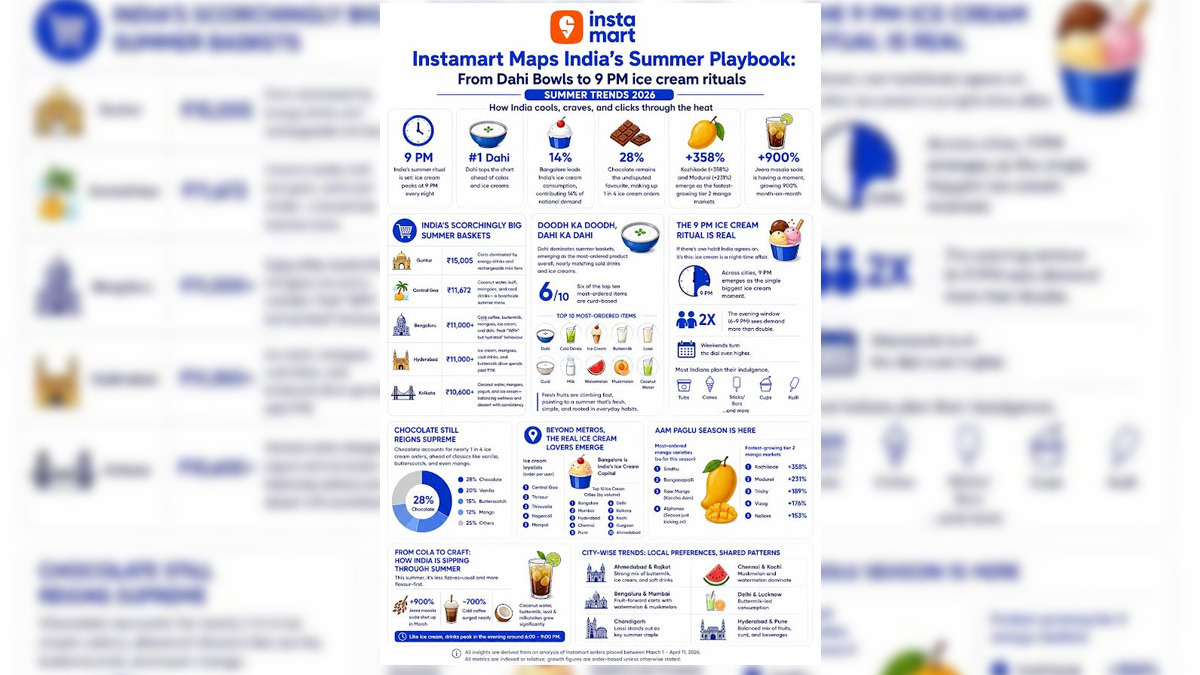
MUMBAI: When the heat rises, India doesn’t just sweat, it shops with muscle memory. Instamart’s Summer Trends 2026 report paints a vivid picture of how the country navigates rising temperatures, revealing a pattern less about experimentation and more about ritual. From curd with every meal to a near-universal 9 pm ice cream habit, summer consumption appears deeply predictable and sharply responsive to heat.

As temperatures climbed through March and April, orders across key categories surged by as much as 300 per cent week-on-week. Mangoes, cold coffee, fizzy drinks and fruit popsicles led the charge, while cooling appliances such as fans and air coolers saw demand jump over 280 per cent. Summer accessories clocked the highest spike, with sunglasses soaring 650 per cent year-on-year.

At the centre of India’s summer basket sits a familiar hero, dahi. The dairy staple emerged as the most-ordered item overall, with six of the top ten products being curd-based. Fresh produce is also gaining ground, with watermelon and muskmelon seeing steady traction signalling a shift towards simple, cooling foods rooted in everyday habits.

Advertisement

Then comes the nightly ritual. Across cities, 9 pm stands out as the peak hour for ice cream orders, with demand between 6 pm and 9 pm more than doubling. Family-sized tubs dominate, suggesting planned indulgence rather than impulse buys. Chocolate remains the undisputed favourite, accounting for nearly one in four ice cream orders, ahead of vanilla, butterscotch and even seasonal mango.

Spending patterns reveal just how seriously India takes its summers. In Guntur, one user spent Rs 15,005 on energy drinks and mini fans, while carts in Goa, Bengaluru and Hyderabad crossed Rs 11,000, filled with everything from coconut water to cold coffee and ice cream. Kolkata followed closely with spends exceeding Rs 10,600.

While metros continue to drive volume, smaller cities are quietly outpacing them in intensity. Locations such as Central Goa, Thrissur, Thiruvalla, Nagercoil and Manipal recorded higher orders per user, suggesting that India’s summer cravings are as strong beyond big cities as within them.

Advertisement

Mango season, meanwhile, is off to an early start. Sindhu mango currently leads orders, followed by Banganapalli and raw mangoes, with Alphonso yet to peak. Bengaluru tops the charts in mango demand, outpacing Hyderabad and Chennai combined, while cities like Thanjavur, Pondicherry and Mangaluru are emerging as strong contributors.

Even beverages are getting an upgrade. Jeera masala soda surged 900 per cent in March, while cold coffee grew nearly 700 per cent, alongside rising demand for coconut water, buttermilk, lassi and milkshakes. Like ice cream, drink consumption peaks in the evening, reinforcing the rhythm of India’s summer routine.

Regionally, preferences vary but patterns align. Ahmedabad and Rajkot favour buttermilk and soft drinks, Chandigarh leans on lassi, while Bengaluru and Mumbai skew fruit-heavy. Chennai and Kochi opt for melons, and Delhi and Lucknow double down on buttermilk.

Advertisement

The takeaway is simple: India’s summer isn’t chaotic, it’s choreographed. And as the mercury climbs, so does a nation’s instinct to order exactly what it knows will cool it down.

Click to comment

Leave a Reply

Your email address will not be published. Required fields are marked *

e-commerce

Visa report tracks rise of India’s affluent, experience-led spending

Affluent base doubles to 130 lakh, travel 58 per cent of elite spends.

Published

on

MUMBAI: In India’s new luxury playbook, it’s less about owning more and more about living better. A new whitepaper by Visa Consulting and Analytics (VCA) maps a decisive shift in India’s affluent economy, where spending is becoming more intentional, experience-led, and closely tied to personal identity rather than pure income growth.

Titled India’s Affluent Economy 2025–2026, the report draws on a Visa-commissioned Yougov study and VisaNet data across travel, dining, retail and lifestyle categories. The headline number is hard to miss: individuals earning over Rs 10 lakh annually have nearly doubled from 69 lakh to 130 lakh, significantly expanding the country’s discretionary spending base.

But it’s not just about scale, it’s about behaviour. As consumers move up the affluence ladder, discretionary categories are taking a larger share of credit card spends, positioning cards as key enablers of premium, lifestyle-driven consumption.

Advertisement

The geography of wealth is shifting too. Affluence is no longer confined to metros such as Mumbai, Delhi and Bengaluru, with cities like Ahmedabad, Surat, Jaipur and Lucknow increasingly mirroring metro consumption patterns.

The report highlights a clear pivot from ownership to access. More than 50 per cent of affluent consumers now use cards for elite memberships, while 7 in 10 are drawn to limited-edition drops and curated collections. Increasingly, luxury is defined by seamless access be it concierge-led travel or curated dining where time saved is as valuable as money spent.

Spending patterns reinforce this shift. Among the ultra-elite, travel accounts for 58 per cent of discretionary spends, far outpacing retail and luxury combined at 28 per cent. Cross-border spending penetration stands at 63 per cent, signalling a growing global outlook among India’s affluent.

Advertisement

Closer home, indulgence is becoming routine. Nearly 4 in 5 affluent consumers dine at premium establishments at least three times a year, while 1 in 4 visit luxury venues more than five times annually. Dining spends are also climbing, with Rs 20,000 emerging as a new entry-level benchmark per experience and Rs 50,000 marking premium territory.

Retail, meanwhile, is becoming more selective. Three in four affluent consumers make a high-end purchase at least once a quarter, while one in four shops premium every two weeks. Luxury retail intensity is also rising, with 2 in 5 consumers spending over Rs 5 lakh annually, and a smaller but significant segment exceeding Rs 10 lakh.

Technology and wellness are carving out new roles in this ecosystem. High-end gadgets now see average spends of Rs 60,000 or more per purchase, while ultra-elite consumers are eight times more likely to visit spas and show five times higher engagement with cosmetic stores than non-affluent groups.

Advertisement

The broader takeaway is structural. Affluent consumers are no longer buying products, they are buying ecosystems. Integrated experiences across travel, dining, wellness and payments are becoming central to how this segment lives and spends.

As India’s affluent base expands beyond metros and aligns more closely with global consumption patterns, the real opportunity lies not just in size, but in speed. For brands, the message is clear: relevance will be defined by how early and how seamlessly, they plug into this evolving lifestyle economy.

Advertisement
Continue Reading

Advertisement News18
Advertisement
Advertisement
Advertisement
Advertisement Whtasapp
Advertisement Year Enders

Indian Television Dot Com Pvt Ltd

Signup for news and special offers!

Copyright © 2026 Indian Television Dot Com PVT LTD