MAM
The future of PR in India: 10 trends every brand and marketer must know

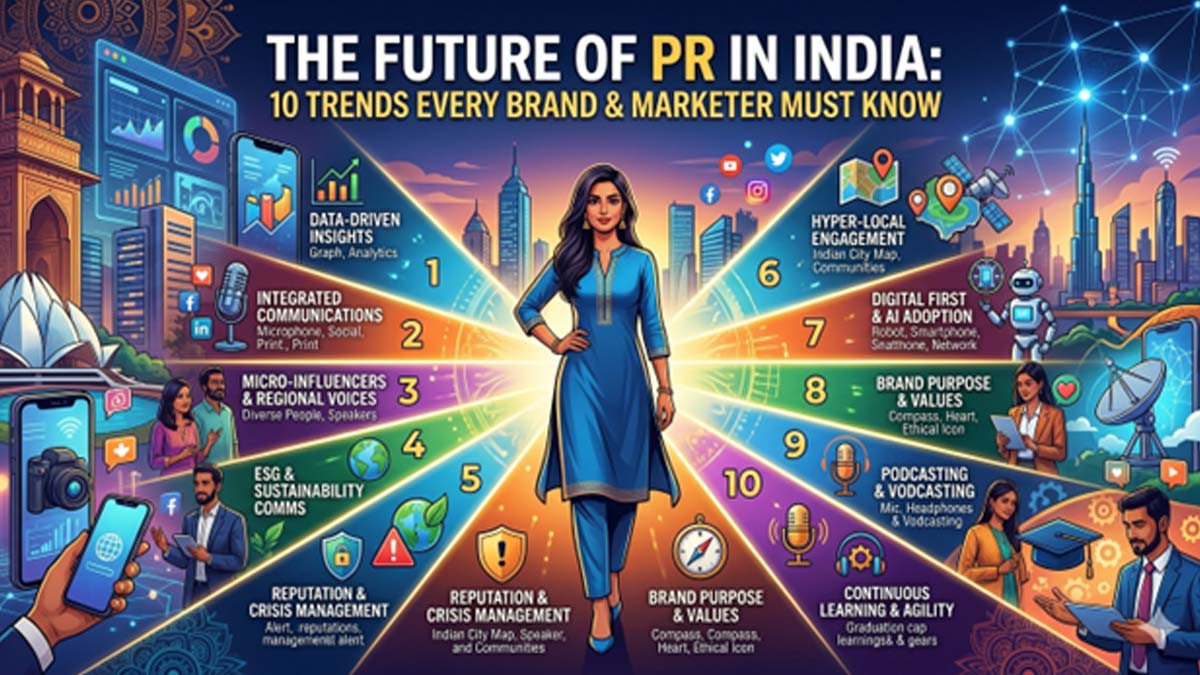
India’s public relations industry is undergoing its most significant transformation in a generation. The convergence of artificial intelligence, regional media explosion, creator-led communication, and data-driven storytelling is rewriting the rules of how brands earn attention and build trust. For founders, CMOs, and marketers who want to stay ahead, understanding these shifts is not optional — it is the difference between building a brand that resonates and one that gets left behind.
Why 2026 is a defining year for PR in India
India is now the world’s third-largest startup ecosystem, home to over 100 unicorns and a digital economy projected to reach $1 trillion by 2028. As brands compete for share of voice in an increasingly crowded and fragmented media landscape, public relations has evolved from a nice-to-have into one of the most powerful tools for sustainable brand growth. At the same time, the very definition of PR is changing — from press releases and journalist relationships to a sophisticated, multi-channel discipline that blends storytelling, data, technology, and community building.
For brands looking to navigate this new landscape, staying current with the trends reshaping Indian PR is not just strategically important — it is existentially critical. Here are the ten trends defining the future of PR in India in 2026.
The 10 trends reshaping PR in India
Data-Driven PR is Replacing gut-feel storytelling
The era of launching a press release and hoping for the best is firmly over. In 2026, the most effective PR campaigns in India are built on data — audience sentiment analysis, media consumption patterns, share-of-voice benchmarking, and competitor coverage mapping. Brands now have access to tools that can tell them exactly which journalists cover which topics, how often a story type gets picked up in a particular sector, and what emotional triggers drive the highest engagement in their target audience. PR that is not backed by data is increasingly PR that does not get results. For marketers, this means investing in measurement frameworks from day one — not as an afterthought at campaign close.
AI- powered media intelligence is changing campaign speed and precision
Artificial intelligence has moved from the technology pages into the everyday workflow of India’s leading PR agencies. AI tools now monitor brand mentions across thousands of sources in real time, detect sentiment shifts before they become reputation problems, and predict which news cycles a brand can credibly enter. For Indian brands, this means a fundamentally shorter distance between insight and action — campaigns can be activated in hours rather than days, and narrative opportunities can be captured at exactly the right moment. AI is also transforming journalist research, enabling PR teams to match story pitches with the precise editorial interests and recent coverage patterns of each individual media contact.
How Teamology helps brands navigate the new PR landscape
At Teamology Softech & Media Services, these shifts are not future projections — they are the present reality our clients operate in every day. As a digital-first best PR agency in India working across India and the Middle East, Teamology was built specifically for this new era of brand communication. Our approach integrates AI-powered media monitoring with deep human storytelling expertise, ensuring that every campaign we run is both data-informed and emotionally resonant.
We work with startups, SMEs, and growth-stage brands across sectors, including lifestyle, F&B, technology, and consumer brands — helping them build credible, consistent, and impactful public narratives. Whether it is securing national media placements, crafting a founder’s thought leadership voice, managing a reputational challenge, or entering a new market like the UAE, Teamology brings the strategic intelligence and creative craft that modern PR demands. Our commitment is simple: accessible PR that delivers real business outcomes, not just column inches.
Regional language PR is no longer optional – it is essentials
With over 600 million internet users in India consuming content in Hindi, Tamil, Telugu, Kannada, Malayalam, Bengali, and Marathi, brands that restrict their PR to English media are reaching a shrinking slice of their potential audience. Regional PR is the single most underinvested opportunity in Indian brand communication today. Digital publications, YouTube channels, and podcast networks in regional languages are growing at three times the rate of their English counterparts — and crucially, their audiences are highly engaged, deeply loyal, and largely untargeted by mainstream PR campaigns. Brands that develop regional PR strategies in 2026 will have a first-mover advantage that is extremely difficult to replicate.
Creators and influencers have become India’s new media house
A decade ago, a feature in the CAT-A news website was the gold standard of PR success. In 2026, a single well-placed creator collaboration can outperform both in terms of audience trust, engagement depth, and conversion impact. India’s creator economy — now home to over 80 million content creators — has fundamentally redistributed media power. Niche creators with 50,000 to 500,000 highly engaged followers often deliver more measurable brand outcomes than national publications reaching millions passively. The most sophisticated PR strategies in India now treat influencer partnerships as earned media, not paid promotion — and the agencies that understand this distinction are the ones building authentic, durable brand narratives.
“In 2026, the most trusted voice for your brand is rarely a journalist or an advertisement. It is a credible human being — a founder, a creator, or a community leader — speaking with genuine conviction. PR’s job is to enable that voice.”
The founder’s personal branding has become one of India’s most powerful PR tools
India’s startup culture has produced a generation of founders who are themselves powerful media assets. When a founder speaks with authority and authenticity about their industry — on LinkedIn, in podcasts, at conferences, or through media op-eds — it creates a halo effect that benefits the entire brand. Companies with visible, vocal, and credible founders consistently outperform their peers in earned media coverage, investor perception, talent attraction, and customer trust. In 2026, founder personal branding is not a vanity exercise — it is a core business strategy. PR agencies that can develop and sustain a founder’s public narrative are providing one of the highest-value services in the industry.
PR and SEO are merging into a single integrated discipline
One of the most significant structural shifts in Indian brand marketing is the convergence of public relations and search engine optimization. Every piece of earned media — a media feature, an industry award, a founder interview, a thought leadership article — creates high-authority backlinks that improve a brand’s organic search ranking. Simultaneously, SEO keyword research is increasingly informing PR story angles, ensuring that press releases and pitches are built around the exact terms that target audiences are searching for. Brands and agencies that treat PR and SEO as separate budgets are leaving compounding growth on the table. The future belongs to integrated strategies where every PR win is also an SEO asset.
Micro-Community PR is outperforming mass media coverage
As Indian consumers become increasingly discerning about the media they trust, the value of deeply engaged niche communities — whether WhatsApp groups, Discord servers, Reddit communities, or Substack newsletters — is rising rapidly. A brand that becomes genuinely valued within a community of 10,000 highly relevant consumers will often outperform a brand mentioned once to an audience of 10 million. PR strategies in 2026 need to account for this shift — investing in community listening, community-specific storytelling, and authentic participation in niche spaces rather than simply chasing headline numbers.
Real-time crisis communication is now a non-negotiable capability
India’s social media landscape is uniquely volatile — a brand controversy can go from a single tweet to national news coverage within hours. In this environment, the speed, tone, and consistency of a brand’s crisis response is often more important than the crisis itself. Brands that have pre-built crisis communication frameworks — with clear escalation protocols, spokesperson preparation, and platform-specific response templates — consistently manage reputational threats with far less damage than those who respond reactively. In 2026, crisis readiness is no longer a contingency plan. It is an ongoing business function, and the PR agencies equipped to deliver it are worth their weight in brand equity.
Why brands across India and the Middle East trust Teamology with their reputation
The trends outlined in this article are not theoretical for the team at Teamology Softech & Media Services — they represent the daily reality of the brands we partner with. From helping a lifestyle startup build its first national media presence to managing the reputational narrative of an established F&B brand entering the UAE market, Teamology’s work sits at the intersection of every major shift reshaping Indian PR today.
What makes Teamology different is not just the services it offers — it is the philosophy behind them. In a PR industry still dominated by agencies that charge premium retainers for generic playbooks, Teamology was deliberately built to be different: accessible in pricing, specialist in execution, and relentlessly focused on measurable outcomes. Every campaign is rooted in strategic intent and measured against real business results — not vanity metrics. If you are a brand preparing to grow your presence, enter a new market, or simply build the kind of reputation that opens doors, Teamology is the partner built for exactly that journey.
Purpose-led narratives are becoming India’s most powerful brand differentiator
India’s consumers — particularly the 400 million millennials and Gen Z who now drive purchasing decisions — are increasingly choosing brands that stand for something beyond their product. Sustainability, social impact, inclusivity, and authentic community contribution are no longer CSR footnotes — they are central to how brands earn and retain public trust. The most durable PR in 2026 is not about shouting brand messages — it is about demonstrating brand values through consistent action and authentic storytelling. Brands that build purpose into their PR strategy from the ground up are creating a competitive moat that advertising budgets simply cannot replicate.
Cross-border PR is giving Indian brands a global voice
India’s global ambitions have never been stronger. From D2C brands targeting the Indian diaspora in the UK and US, to tech companies expanding into Southeast Asia, to consumer brands entering the Gulf, cross-border PR is one of the fastest-growing service areas in India’s communications industry. The challenge is significant: every market has its own media landscape, cultural sensitivities, journalist relationships, and platform preferences. The agencies that have built genuine cross-market capabilities — combining local expertise with global strategic thinking — are an increasingly rare and valuable asset for brands with international growth ambitions. India-to-Middle East is particularly active, with dozens of Indian brands making the UAE their first international market each year.
What this means for your brand right now
The ten trends outlined above are not distant projections — they are happening right now, across every sector of India’s economy. The brands building their PR strategies around these realities in 2026 are the ones that will own their narrative in 2027 and beyond. The brands that are waiting for the landscape to settle before they invest are already falling behind.
The most important insight to take away is this: PR in India in 2026 is not a cost — it is a compounding investment. Every piece of earned media, every thought leadership article, every community engagement, and every well-managed crisis adds to a reservoir of brand credibility that no advertising spend can buy. The brands that understand this — and partner with agencies equipped to deliver it — are building the most durable competitive advantages available in the Indian market today.