Connect with us

Sports

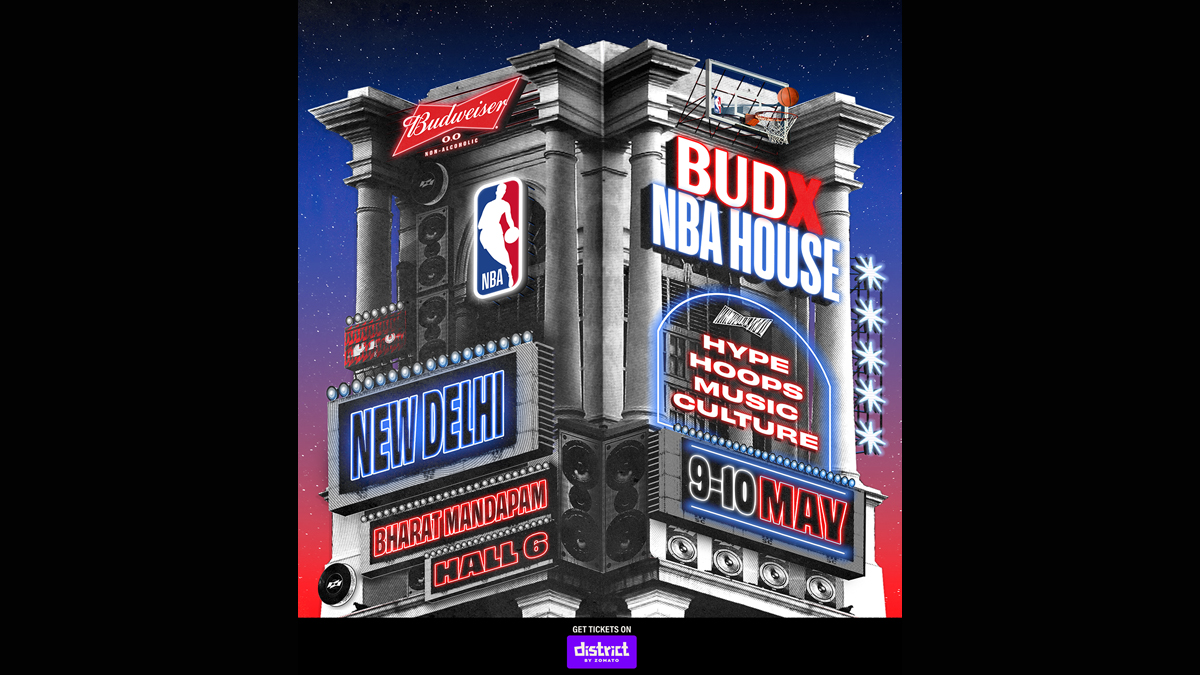
BUDX NBA House returns to India in Delhi

Fan experience with Isiah Thomas and DeMarcus Cousins set for May 9–10 at Bharat Mandapam.

Published

on

MUMBAI: BUDX NBA House is dribbling back into India because when basketball meets Delhi, even the courtside seats start feeling like courtside culture. The NBA and Budweiser India have confirmed the return of BUDX NBA House, an immersive fan experience blending basketball, music and culture. Following its debut in Mumbai last year, the event moves to New Delhi on Saturday 9 and Sunday 10 May 2026 at Bharat Mandapam, Exhibition Hall No. 6, coinciding with the 2026 NBA Playoffs.

The two-day programme (for ages 16 plus) features on-court activities, live performances by international and Indian artists, meet-and-greets with two-time NBA champion and Naismith Hall of Famer Isiah Thomas and four-time NBA All-Star DeMarcus Cousins, BUDX Masterclasses with expert workshops and panels, a 3-on-3 celebrity game, streetwear showcases, photo ops with the Larry O’Brien Trophy, and appearances by Sacramento Kings mascot Slamson, the Kings Dancers and dunk team. The Kings, who played the first NBA games in India in 2019, return for a second consecutive year.

NBA India country head Rajah Chaudhry said, “Hosting BUDX NBA House in New Delhi for the first time marks an exciting next step in our continued efforts to engage fans across India in new and creative ways. The response in Mumbai last year showcased the incredible passion for basketball in the country.”

Advertisement

AB Inbev vice president of marketing & trade Marketing for India Vineet Sharma added, “After witnessing the phenomenal response to the first-ever BUDX NBA House in Mumbai, we’re excited to bring an elevated and more immersive edition to fans in New Delhi.”

Last year’s Mumbai edition welcomed more than 6,000 fans over two days. BUDX NBA House has previously been held in Brazil, Canada, China, France, Germany, Mexico, the US and the UK, with Australia set to host its first edition on 14–17 May 2026.

The Delhi event will be produced, promoted and ticketed by District by Zomato. Further details on partners and programming will be announced soon.

Advertisement

The 2025-26 NBA season is streamed live in India on Prime Video, the NBA Youtube channel and NBA League Pass.

In a country where cricket reigns supreme, the NBA is quietly sinking three-pointers into culture proving that when hoops, hip-hop and heritage collide in Delhi, even the fans start believing the next big slam could be Indian.

Advertisement
Click to comment

Leave a Reply

Your email address will not be published. Required fields are marked *

Sports

IPL 2026: Know the tech and broadcast game behind India’s biggest sporting event

From AI-driven storytelling to real-time graphics and cloud production, broadcasters gear up to turn 700 million viewers into active participants

Published

on

MUMBAI: The Indian Premier League 2026 season kicks off on March 28. As we all know, the IPL is not merely a sporting event; it is a gargantuan logistical and technological undertaking that is transforming how over 700 million people consume cricket. As the first ball approaches, the battle for supremacy is as much in the broadcast control rooms as it is on the pitch.

With the merger of major media entities and the rise of “fan-aware” technology, broadcasters are entering this season with a sophisticated digital arsenal designed to turn passive viewers into active participants. The question is no longer whether audiences will watch, but how deeply they will engage.

The invisible engine: How broadcasters prepare for the storm
Preparation for an IPL season begins approximately six to eight months before the opening ceremony. It is a massive coordination of hardware, software and human expertise, executed with military precision.

Advertisement

Hundreds of high-tech cameras, including super slow-motion units and spider-cams, are deployed across venues. These are managed by mobile control rooms built into heavy-duty trucks that function as high-intensity production hubs. Alongside, miles of fibre optic cables, advanced audio systems and replay servers are transported across cities within tight 48-hour windows.

This logistical complexity is not incidental. Industry estimates suggest that specialised handling reduces equipment damage by 40 per cent, a critical factor when dealing with sensitive broadcast infrastructure at scale.

In the weeks leading up to the launch, technical teams finalise what is known as “signal-to-video” architecture. These systems are programmed to trigger graphics, such as player milestones or wicket alerts, within seconds of the live moment, ensuring that storytelling keeps pace with the game itself.

Advertisement

Increasingly, this preparation is also shifting beyond the stadium. With the rise of remote production, or REMI, several secondary feeds are now processed in the cloud. Editors sitting in Mumbai or Bengaluru can cut highlights from matches played in Chennai or Delhi in under a minute, fundamentally altering the speed of broadcast workflows.

Real-time data: From raw numbers to immersive storytelling
Today’s cricket viewer expects far more than a scorecard. The modern broadcast is built on what can best be described as contextual intelligence, where every ball carries layers of insight.

“India’s cricket audience today expects far more context and insight alongside the live action,” says Divyajot Ahluwalia, director at wTVision Solutions Pvt. Ltd. “Every IPL broadcast processes millions of real-time data points through ball-tracking, player tracking systems, and multi-camera production workflows, which are translated instantly into graphics such as wagon wheels, pitch maps and predictive trajectories. When presented effectively, this data does more than inform; it enhances how fans interpret strategy and momentum in the game. Broadcast innovation is fundamentally about converting complex data streams into clear, compelling visuals for audiences.”

Advertisement

This data-driven layer serves two critical functions. It enables strategic interpretation, allowing viewers to understand the reasoning behind decisions on the field. At the same time, it enhances momentum visualisation, with predictive tools such as win probability models ensuring that engagement remains high even during slower phases of play.

The AI layer: The invisible producer
Beyond visible graphics lies an even more transformative shift, the rise of AI-driven production.

Artificial intelligence is increasingly acting as an editorial assistant, scanning live data and historical patterns to flag potential storylines in real time. If a bowler has a known weakness against a particular batter in the death overs, the system can prompt producers to surface relevant comparisons before the moment unfolds.

Advertisement

AI is also powering real-time multilingual capabilities. Advances in voice technology now allow commentary to be translated instantly into multiple regional languages while preserving the tone and emotion of the original speaker. This is expanding reach without proportionally increasing production complexity.

Innovation trends shaping the 2026 season
The 2026 season marks a digital-first era in which the broadcast adapts to the viewer, rather than the other way around.

Augmented reality and virtual elements are now central to the viewing experience. Broadcasters are using AI-based keying to insert graphics behind players in real time, creating a sense of depth that makes statistics feel embedded within the field of play. Even experimental tools such as robotic cameras have evolved into interactive elements, capturing unique angles and adding personality to the broadcast.

Advertisement

Fan-aware personalisation is gaining ground. Streams can now be tailored to individual preferences, with tactical feeds offering deep analytics for serious followers, while social feeds integrate polls, reactions and influencer commentary for younger audiences.

The multi-screen ecosystem is becoming indispensable. With nearly 90 per cent of viewers using a second screen, broadcasters are integrating features such as click-to-WhatsApp and shoppable advertising. A viewer can move from watching a match to purchasing a product seen on screen within seconds.

Another emerging layer is hyper-personalised advertising. Using computer vision, virtual advertisements displayed during a match can be dynamically altered based on the viewer’s location, allowing the same live feed to carry different brand messages across markets.

Advertisement

Infrastructure reimagined: 5G, cloud and edge computing
Handling millions of real-time data points requires equally advanced infrastructure. Telecom providers are increasingly using 5G network slicing to create dedicated bandwidth for live broadcasts, ensuring seamless streaming even in densely packed stadiums.

At the same time, cloud-first production models are reducing dependency on on-site hardware. This shift is enabling faster turnaround times, greater scalability and more efficient coordination between geographically dispersed teams.

TV vs digital: A hybrid powerhouse
The divide between television and digital has effectively collapsed into a unified ecosystem. Traditional television continues to deliver scale and stability, reaching hundreds of millions of households, particularly in smaller towns and cities where appointment viewing remains strong.

Advertisement

Digital platforms, on the other hand, dominate in interactivity and personalisation, attracting urban audiences and younger viewers with features such as multi-camera angles, real-time engagement tools and targeted content delivery.

Rather than competing, the two formats now complement each other, creating a hybrid model that combines reach with engagement.

Are broadcasters ready?
With the scale of IPL expanding and audience expectations rising, the pressure on broadcasters has never been greater. Yet the evidence suggests a high degree of readiness.

Advertisement

From AI-assisted production and cloud-based workflows to augmented reality graphics and personalised viewing experiences, the broadcast ecosystem has evolved into a finely tuned machine. The integration of data, infrastructure and storytelling is no longer experimental, it is foundational.

As Ahluwalia underscores, the essence of modern broadcasting lies in simplifying complexity for the viewer. In 2026, that ambition is closer to being realised than ever before.

The implication is clear. The most important action is no longer confined to the pitch. It unfolds simultaneously in control rooms, data centres and cloud servers, where technology, creativity and precision converge.

Advertisement

In this season, the best seat in the house is no longer in the stadium. It is wherever a fan has a screen, a signal and the appetite for a richer, smarter game.

Continue Reading

Advertisement News18
Advertisement All three Media
Advertisement Whtasapp
Advertisement Year Enders

Copyright © 2026 Indian Television Dot Com PVT LTD

This will close in 10 seconds