Brands
“We aim to sell close to one lac EVs, this financial year”: TPEML’s Vivek Srivatsa

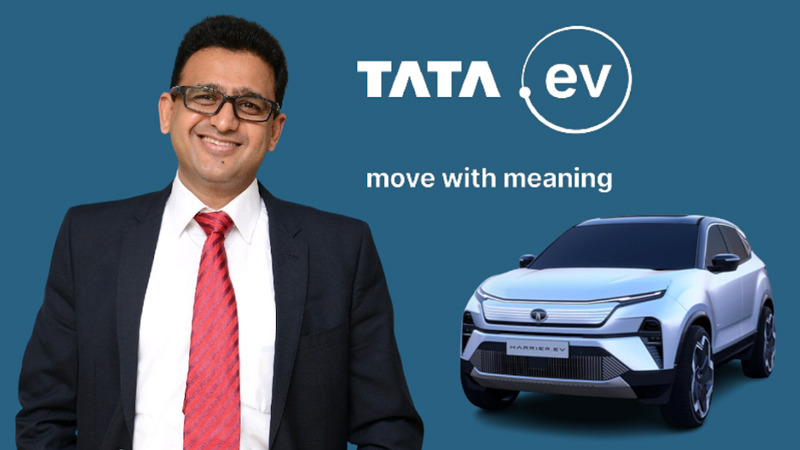
Mumbai: Incorporated on 21 December 2021, Tata Passenger Electric Mobility, a subsidiary of Tata Motors, has unveiled its new brand identity, TATA.ev, marking a pivotal step in India’s EV revolution. Aligned with sustainability and innovation, the identity embodies “Move with Meaning,” uniting values of sustainability, community, and technology. The Orbit logo and Evo Teal color symbolise a circular ecosystem and tech-forward commitment. This evolution reflects Tata’s drive toward a greener future while emphasising customer experiences. With a 70 per cent market share in four-wheeler EVs, Tata’s pioneering journey includes selling over one lakh EVs, showcasing a commitment to sustainable mobility.
Indiantelevision.com on the sidelines of the press conference, caught up with Tata Passenger Electric Mobility Ltd (TPEML) head, marketing, sales and service strategy Vivek Srivatsa to talk about the idea behind the EV business, their TG, market share, etc.
Edited Excerpts:
On Tata Motors being the first auto manufacturer to launch an EV in India
Yes, the first mainstream EV cars with the Nexon EV in 2020. When I say mainstream, it means you can use it like any normal car, i.e., it comes with the right warranty, safety, and all that. We launched the Nexon, the Tigor and the Tiago which was showcased last year in the IPL.
On TPEML’s market share and the idea behind getting into the EV business when India had not yet opened up to the business
We saw the signs early. A large part of Western Europe was adopting to EVs and India’s government was strongly pushing EVs and on the kind of subsidies being offered for both manufacturing as well as for customers in terms of GST reduction, made it a very compelling business case, as well as a use case for customers. Of course, it involves some capital investment and some R&D, but we thought we should do it for the betterment of the country in terms of moving towards more sustainable mobility sources.
But also, when we saw internally in Tata Group, we had all the ingredients ready to move into this, which probably other companies did not have. We had Tata Power, we had Top Auto Components who make the batteries for us. We have obviously Tata Motors expertise in making cars. We have TCS who make software. So, we have all the basic requirements already in place, we just have to create the ecosystem together and take advantage of the government’s subsidies and incentives to give a viable product.
On the buying trends of Indians today and are you urban-centric or reaching out to your TG’s in the tier-2 and tier-3 market
Electric vehicle (EV) adoption is surging robustly. The initial 10,000 sales spanned 44 months, while the subsequent 40,000 were achieved in just 15 months. The next 50,000 sales took only nine months. This strong acceleration indicates that achieving the next milestone of 100,000 sales might take 12 months.
When we launched Tiago, more than 25 per cent of our sales came from the smaller towns. Smaller towns have an inherent advantage in that there is no restriction on parking space. Requiring parking space for charger installation poses a challenge in urban areas, while smaller towns face no such issue. Two-wheeler EVs are already hugely used in smaller towns. So as a concept, it’s not alien to them. They are very focused on the cost of operation. EV is one-eighth or one-tenth the cost of operation of traditional cars and the distances they travel also is not too high. So, EV use case for smaller towns is actually perfect and we are seeing very fast adoption there.
On Tata Motors building up sustainability, educating your consumers and carrying it forward in various activities in CSR and other things
Firstly, at the Tata Group level, there is a group-level commitment under something called ‘Project Aalingan’ towards sustainability. Tata Motors is the same, we have committed to be carbon neutral by 2040 which is the most ambitious target for an Indian automotive company. We have committed to be water neutral by 2030. So, firm commitments have been made and that is internal. Through EV adoption and the work with our customers, we are pushing sustainability into the lifestyle of our consumers as well.
First is obviously, by using EV itself, we’re saving carbon emissions, but we’re taking it beyond with the new brand design and the practices to follow for our community will teach them other elements of the community in terms of long use items, i.e., the longer you use anything, the better it is for the environment, whether it is clothes, gadget or anything. Safe disposal is very important. CSR activities, like educating the underprivileged, and clothes donation for the underprivileged, among others are the ones we are going to formally pursue. These are anyway strong active pillars of what Tata Group does. So, it is actually an extension in a modern way. Not only are we focused on sustainability at a Tata Motors level, but we are also focused on the CSR activity, which actually is a parallel line to sustainability.
On conceiving the campaign film and its conceptualisation
The new brand design has been conceived by our partners, Landor & Fitch. They helped us lay this out. There were a few challenges because there are so many aspects. On the business side, it’s a growing business is a very demanding consumer. On the sustainability side, we have made firm commitments and we needed to showcase that also. Also, it has to be a brand design, which is able to be present across all our touchpoints, i.e., digital, retail, communicating offline, online, and digital. So, it took about a year for us to put this together. I think it will help us give a firm direction to, whatever we do in the future.
On the significance of the bridge
So, the bridge brings humanity to whatever we do. It allows us to express ourselves better. You can treat it like a floating underline. It allows us to express things better. It’ll also be immediately recognisable as a TATA.ev communication. It does bring in a certain level of expressiveness without
costing too much and not being on your face.
On their future plans and the EV’s price range
We aim to sell close to one lac EVs, this financial year. What we have committed is, we want to look at about 50 per cent of our portfolio or sales being on the electric side by 2030.
Our EV’s range starts from just below 10 lakhs and goes up to 22 lakhs right now.