Brands
Colour me connected as Birla Opus Paints brings screens down, spirits up
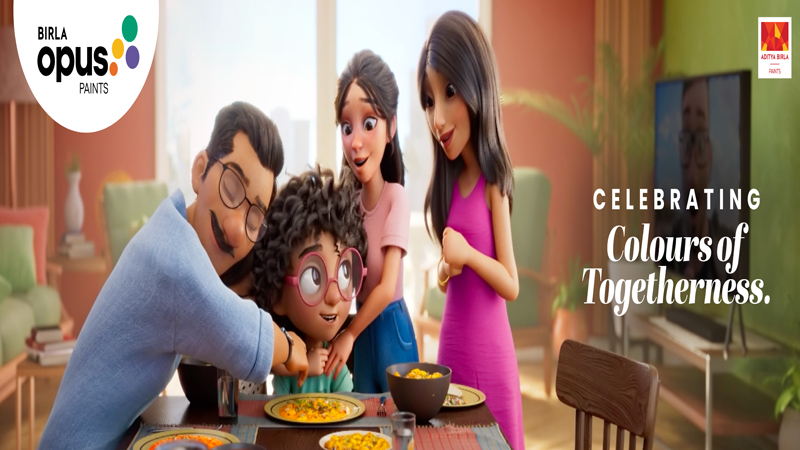
MUMBAI: If scrolling has replaced speaking at the family table, Birla Opus Paints thinks a little colour might just change the mood. Birla Opus Paints, part of Grasim Industries under the Aditya Birla Group, has unveiled its latest brand film, a warm, quietly observant take on how colour can rekindle connection inside modern homes.
Rooted in the brand’s philosophy of Duniya Ko Rang Do, the film continues the journey of the now-familiar Opus Boy, using gentle storytelling rather than spectacle. It opens on a scene that feels instantly recognisable: a family gathered around the dining table, physically together but emotionally miles apart, each member lost in their own screen. Conversation has given way to scrolling, and the room feels muted despite being full.
Enter the Opus Boy, who introduces colour into the space not as decoration, but as disruption. As hues spread across the table and surroundings, the mood subtly shifts. Phones are set aside, glances are exchanged, and the room slowly regains its warmth. What was static becomes animated; what felt distant feels connected again.
The narrative underlines Birla Opus Paints’ core belief that colour does more than refresh walls. It shapes emotion, behaviour and interaction, quietly influencing how people live within their homes. In this telling, colour becomes a catalyst for togetherness, a reminder that homes are not just lived in, but lived with.
Birla Opus Paints Head of Marketing Inderpreet Singh said the film reflects a reality many families face today. “We are more digitally connected than ever, yet increasingly distant within our own homes. The film shows how colour can help bring back that sense of togetherness, transforming not just spaces, but relationships too,” he noted.
The creative execution, developed by Leo India, stays true to the brand’s distinctive animation style introduced in 2024. Leo India chief creative officer Sachin Kamble said the campaign explores how colour can cut through everyday distractions and celebrate shared moments that often slip by unnoticed.
In an age of constant notifications and divided attention, Birla Opus Paints’ latest outing makes a simple proposition: sometimes, all it takes to bring people closer is a fresh perspective and a little colour.

Brands
India’s food culture takes a bold turn in 2025
From fusion desserts to experiential dining, four trends reshape how the nation eats.
MUMBAI: India’s plates just got a serious upgrade in 2025 because when tradition meets TikTok and fusion meets fitness, even the humble samosa starts feeling trendy. The Godrej Food Trends Report 2025 predicted several shifts in Indian eating habits, and the past year proved the forecasters right. From reimagined desserts to immersive dining experiences, Indian consumers showed they want authenticity, convenience, global flavours and health in equal measure.
Here are four trends that truly came alive in 2025 and are now shaping how India eats and dines:
1. Indian Desserts Get a Modern Makeover Traditional mithai found fresh life through fusion experiments. Cheesecakes, truffles and plated desserts inspired by classics like gulab jamun and rasgulla gained popularity, while chocolate-forward, fruit-led and lower-sugar options appealed to younger diners. According to the How India Eats 2025 report, desserts and ice-cream parlours were among the fastest-growing segments in organised food services. Examples: The Bombay Canteen’s Coffee Rasgulla Sundae and Le Chocolate Cakes and More’s Gulab Jamun Cake. Chef Aarohi Sanghavi of Maki Patisserie noted the shift toward seasonality and fresh Indian produce, while Chef Heena Punwani of Maska Bakery highlighted the appeal of flexible, weekend-special menus.
2. Social Media Becomes the New Menu Food discovery went fully digital. Instagram Reels, YouTube reviews and creator-led content heavily influenced dining choices, with food remaining one of the most consumed categories on social media. Restaurants began designing visually striking dishes specifically for shareability, while many diners found new spots through viral videos rather than traditional advertising. The How India Eats 2025 report revealed that over 75% of marketing spends by leading QSR chains now go toward digital channels. Cafes like Mokai and Candies became creator favourites, and brands such as Bastian Hospitality curated highly shareable pop-ups and events. Kavita Rajwade of IVM Podcasts emphasised how long-form storytelling helps decode food’s cultural and economic layers, while Pranav Joshi of Floydian Cookery admitted his page grew far beyond expectations.
3. Snacking Culture Goes Mainstream India’s love for snacks evolved into a full grazing lifestyle, with many opting for multiple small bites throughout the day instead of three structured meals. This shift spurred innovation in formats—from gourmet chips and fusion street food to protein-packed options. Restaurants responded with small-plate menus designed for sharing. The How India Eats 2025 report noted that late-night orders grew nearly 3x faster than dinner. Brands like The Whole Truth Foods and Green Snack Co. popularised clean-label snacks such as protein bars and roasted nuts. Madhushree Basu Roy of Pikturenama Studios predicted a mix of convenience, health consciousness and global influences, while freelance food writer Sharmila Vaidyanathan observed that consumers want the best of both worlds healthy options for routine snacking and traditional treats for special occasions.
4. Dining Becomes an Experience, Not Just a Meal The most noticeable shift was the rise of experiential dining. Consumers increasingly sought restaurants that offered more than good food, they wanted immersion, storytelling and chef-driven concepts. Venues like Papa’s in Mumbai (intimate tasting menus), Bombay Daak (theatrical regional flavours) and Masala Library (modernist presentations) turned meals into memorable events. Tasting menus, themed pop-ups and chef collaborations became more common, transforming dining out into entertainment. The How India Eats 2025 report highlighted how experience-led formats and storytelling are key to attracting younger diners. Chef Karan Upmanyu of ParTTwo in Bengaluru observed that new outlets are breaking away from rigid formats, focusing instead on creating relaxed spaces where people simply enjoy spending time.
As 2026 unfolds, these trends suggest India’s food culture is no longer just about what’s on the plate, it’s about how the plate makes us feel, connect and remember. From a quick Reel-inspired snack to a full theatrical dining experience, Indian diners are voting with their forks for food that is both rooted in tradition and unafraid to experiment. The table, it seems, has never been more exciting.