News Headline
TV set to reach nearly 1 billion viewers in India by 2029, says IIM Ahmedabad

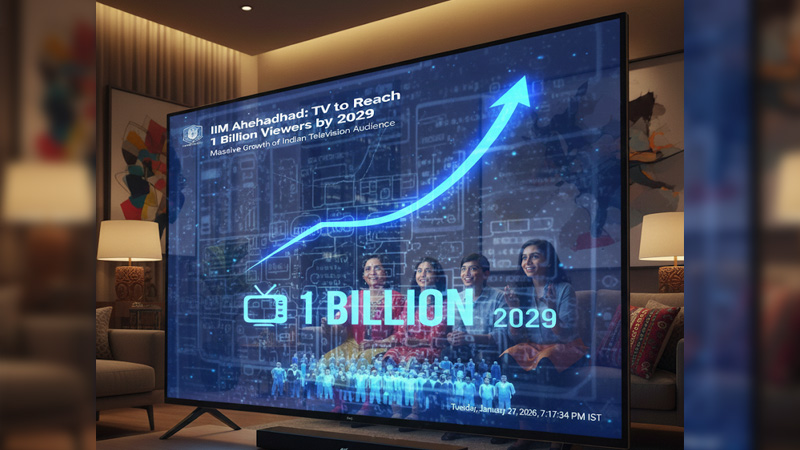
Ahmedabad: India’s television audience is on track to touch nearly one billion viewers by 2029, cementing the medium’s role as a mass cultural and economic force even in an increasingly digital country, according to a new report by the Indian Institute of Management Ahmedabad.
The study, titled Future of TV in India, projects that television viewership will expand at a steady annual pace of 2–3 per cent, driven by rising incomes, improving literacy, deeper internet penetration and rapid infrastructure growth in rural and lower-income states. At this rate, India’s television audience is expected to reach around 1.03 billion viewers by the end of the decade.
Authored by Viswanath Pingali, faculty in the economics area at IIM Ahmedabad, and Ankur Sinha, faculty in the operations and decision sciences area, the report is supported by the Brij Disa Centre for Data Science and Artificial Intelligence (CDSA) at the institute.
The findings challenge the assumption that television is losing relevance in the age of streaming. Instead, the report argues that TV and online video are expanding in parallel, reinforcing rather than cannibalising each other as connectivity spreads.
Rural India drives the next wave
A central conclusion of the study is that the next phase of television growth will be led by rural India and lower-income states, where rising household incomes and better infrastructure are steadily expanding access.
Lower-income states—defined as those with per capita GDP below the national average—are projected to reach television penetration levels comparable to today’s higher-income states by 2029. According to the report’s estimates, an increase of Rs 1 lakh in state GDP per capita in these regions could translate into 25 million additional television viewers.
As incomes rise and electricity, cable and broadband networks improve, television adoption is expected to accelerate sharply outside major urban centres, narrowing the long-standing rural–urban divide in media consumption.
Internet access boosts, not breaks, TV
Far from displacing television, internet penetration emerges as one of the strongest drivers of TV viewership growth, the report finds. States with rising numbers of internet subscribers consistently show higher television adoption, underscoring a complementary relationship between digital connectivity and traditional broadcast media.
As smartphones, broadband and data usage spread deeper into Indian households, television and online video consumption are expected to coexist and grow simultaneously, rather than compete in a zero-sum battle.
This trend, the authors argue, reflects how Indian households use multiple screens for different purposes—television for shared, long-form viewing and digital platforms for personal, on-the-go consumption.
What the data shows
The study is based on a robust statistical regression framework analysing variations in television audiences across Indian markets over multiple years. The model evaluates a wide range of economic, demographic and digital indicators, including:
• number of internet subscribers
• gross state domestic product (GSDP) per capita
• literacy rates
• dependency ratios
• income levels
• access to micro-credit
Demographic factors such as literacy rates and dependency ratios were found to have a statistically significant impact on television viewership at both the all-India and rural levels. Higher literacy levels, in particular, are closely correlated with increased television adoption.
Television’s social footprint
Beyond numbers, the report highlights television’s enduring role in shaping social outcomes. Features such as same-language subtitling are cited as contributors to improved literacy, especially in rural areas, by reinforcing reading skills through everyday viewing.
Television content, the study notes, also plays a role in increasing awareness around personal autonomy, financial independence and progressive attitudes towards gender norms, making it a powerful soft instrument of social change.
Authors speak
Commenting on the findings, Viswanath Pingali said the research was designed to establish data-led indicators that explain television’s long-term relevance.
The study, he said, aims to understand “television’s growth trajectory as a mature consumption medium and its broader role in India’s socio-economic development”.
Ankur Sinha added that the analysis revealed the consistent and measurable impact of internet penetration, income growth and demographic composition on expanding television audiences, particularly in markets that have historically been under-penetrated.
A medium that refuses to fade
The report concludes that television remains deeply embedded in India’s social fabric, even as consumption habits evolve. By combining variables such as internet subscribers, state GDP per capita, literacy rates and demographic trends, the study presents a forward-looking audience estimation model that offers independent academic validation of television’s enduring strength.
In a country racing towards a digital future, the message is clear: television is not dying—it is quietly growing, room by room, village by village, screen by screen.