News Broadcasting
ABP News-CVoter Poll: Modi Govt likely to return in 2024, South presents NDA challenge

Mumbai: The first opinion poll conducted by ABP News and CVoter before the 2024 Lok Sabha elections has thrown up interesting insights, bringing to light the public sentiment across the country on a range of issues, besides the choice of party and the prime minister post.
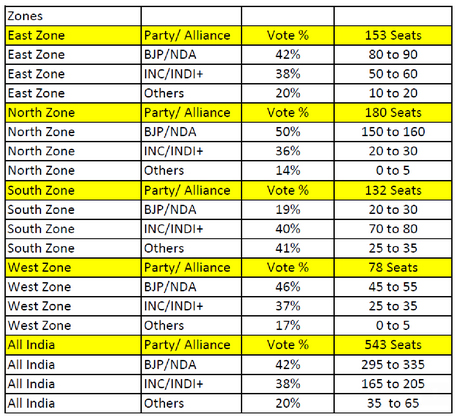
According to the survey, the ABP News-CVoter opinion poll has predicted a third term for the NDA, with the ruling alliance getting 295-335 seats out of the total 543. The Congress, together with the opposition bloc I.N.D.I.A, is projected to get 165-205 seats, with Others settling for 35-65 seats. Zone-wise projections show BJP/NDA bagging 80-90 seats out of 153 in the East Zone, the highest 150-160 seats out of 180 in the North Zone, 45-55 out of 78 in the West Zone, and 20-30 out of 132 in the South Zone. The South is the only zone where the BJP/NDA is behind, with the Congress/I.N.D.I.A projected to win 70-80 seats. In the other three zones, the INC/I.N.D.I.A is projected to get 50-60, 20-30, and 25-35 in the East, North, and West, respectively.
In the states too, the NDA appears to be comfortably ahead, according to the ABP News-CVoter opinion poll, with all BJP-ruled states, such as Madhya Pradesh (27-29), Chhattisgarh (9-11), Rajasthan (23-25), and Uttar Pradesh (73-75), looking to vote for NDA candidates. In Congress-ruled Karnataka too, the BJP is projected to win 22-24 seats with a vote share of 52 per cent against the Congress’ 4-6 seats and 43 per cent vote share. In MP, Chhattisgarh and Rajasthan, the Opposition alliance is projected to get only 0-2 seats each.
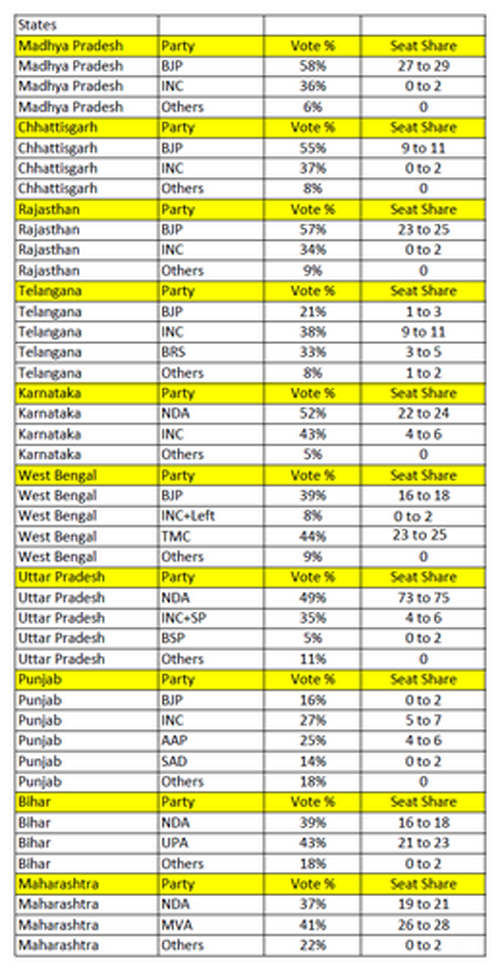
The states where the Congress and I.N.D.I.A are ahead are – Telangana (9-11), Punjab (INC 5-7, AAP 4-6), Bihar (21-23) and Maharashtra (26-28). In West Bengal, where the I.N.D.I.A seat share will be a matter of debate, ruling Trinamool Congress could get 23-25 seats and INC+Left- 0-2, against the BJP’s 16-18, if the elections are held now.
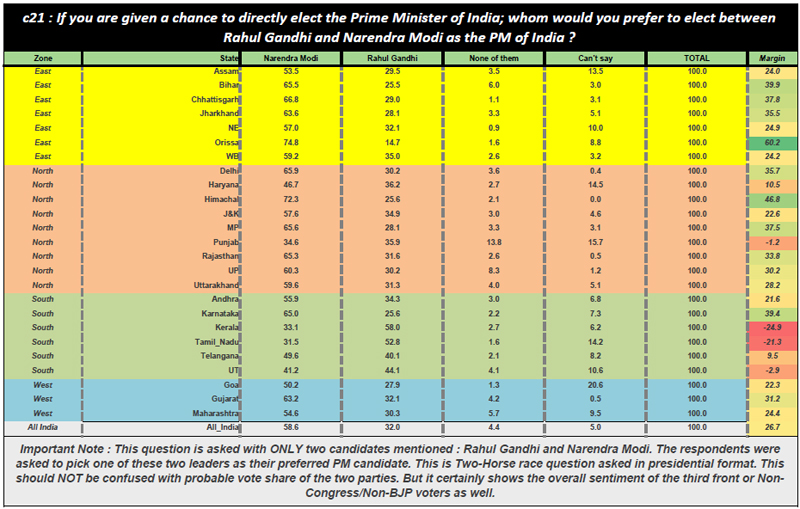
ABP News-CVoter also carried out a snap poll during which it asked total of 13,115 respondents across the 543 Lok Sabha constituencies a range of questions and found interesting responses. According to the snap poll, PM Narendra Modi is overwhelmingly ahead as the country’s choice for the top post, with 58.6 per cent people willing to bring him back for a third term. Given only two candidates to choose from, Rahul Gandhi and Narendra Modi, a majority of the respondents picked the latter. Gandhi was, however, ahead in the race in three states and one UT and lagged with a margin of around 10 percentage points in two states (Telangana and Haryana). The southern states of Kerala and Tamil Nadu, besides Punjab in the north, kept the Congress leader ahead of Modi. Overall, Rahul Gandhi drew 32% votes for the PM post, with 4.4 per cent and five per cent respondents, respectively, picking ‘None of them’ and ‘Can’t say’ as their answer.
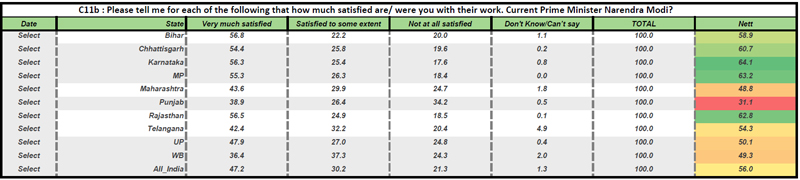
On the question of how satisfied people are/were with the work of the current Prime Minister, a total of 47.2 per cent of people across India said they were “very much satisfied” with PM Narendra Modi’s work, while 30.2 per cent said they were “satisfied to some extent” and 21.3 per cent said they were “not at all satisfied”.
An overwhelming majority answered in the affirmative when asked if the leadership changes made by BJP in Madhya Pradesh, Rajasthan and Chhattisgarh after registering victory in the recent assembly elections will benefit the party in 2024. In contrast, the response was mixed to a similar question posed in reference to the leadership changes made by Congress.
Further, people across states (from both rural or urban areas) and groups think unemployment will be the main issue in the 2024 Lok Sabha elections, and a majority of them believe the issue of caste census won’t help the Opposition. A majority of people also think the BJP should form an alliance with the JD(S) in Karnataka, and that the party will give a tough fight to the Trinamool Congress in West Bengal.



On questions related to Rahul Gandhi, the response was mixed when asked if his Bharat Jodo Yatra will help the Congress in LS polls, but more than 50 per cent of people on average said he, as Priyanka Gandhi Vadra, should contest the election from Uttar Pradesh. Rahul Gandhi wins hands down as the most preferred PM candidate from the I.N.D.I.A bloc. The respondents were given Nitish Kumar, Mamata Banerjee and Arvind Kejriwal as other options to choose from.


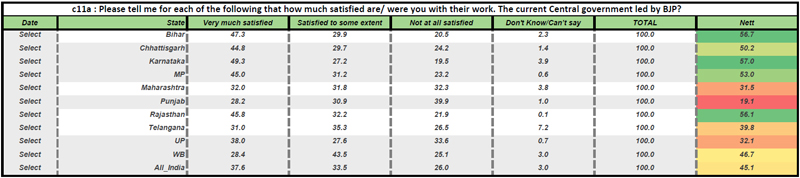
The ABP News-CVoter opinion poll also found that a majority of the respondents think I.N.D.I.A. will not remain united till the 2024 elections. Also, 37.6 per cent people said they were “very much satisfied” with the work of the Central government led by BJP.

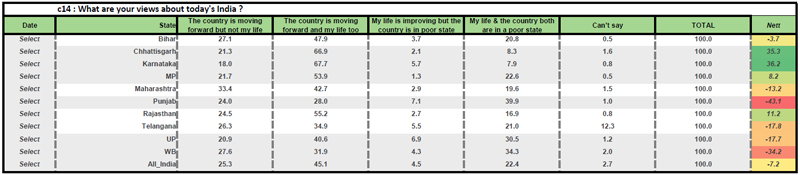
To a question about what they think about “today’s India”, 45.1 per cent people said they found the country moving forward and their life too, while 25.3 per cent said the country is moving forward but not their life, and 22.4% said both the country and their life are in a poor state.
Methodology:
The survey findings and projections are based on CVoter Opinion Poll CATI interviews (Computer Assisted Telephone Interviewing) conducted among 18+ adults statewide, all confirmed voters.
Survey date: 15 December to 21 December, 2023
Sample size – 13,115
Seats Covered 543
Margin Of Error: .+_/_- 5%
Confidence Level: 95%