MAM
Election tracker: Battling it, out-of-home

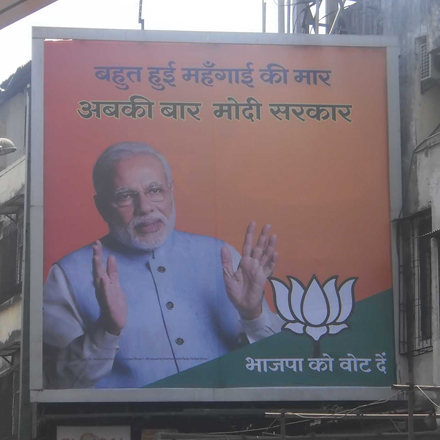
MUMBAI: This general election may be the first among many, where media has been so extensively (and blatantly) used by political parties and their prime ministerial hopefuls.
Far from fighting shy of marketing themselves, the main players – Congress and BJP – have spent nearly Rs 400 to Rs 500 crore each on publicity campaigns. An additional Rs 500 to Rs 1,000 crore will be spent on related activities such as banners, hoardings, organization of public meetings and transportation of key campaigners, among others. Not surprisingly, media agencies estimate around 2 to 2.5 per cent of overall advertisement spends this year to come from elections.

One can switch a channel, turn a page or surf away, but hoardings are hard to ignore or even miss. And this is the reason why of the whole advertising budget, parties are spending approximately 10-15 per cent of the total budget i.e. close to Rs300-400 crore on OOH, if not less, as per industry sources.
Possibly, with advertising rates on general entertainment channels (GECs) on television being prohibitive and posters having been banned in several cities of the country, outdoor remains the only viable option for election propaganda as it is cost-effective and has high reach as well. So you have hoardings of calling for a ‘Modi Sarkar’ or boating of ‘Bharat Nirman’ with NamO and RaGa staring down at you from the most non-descript locations in the country. What’s more, they have illumination for better visibility at night.
With elections just round the corner, outdoor advertising has picked up significantly, mostly fuelled by political parties, which is quite unlike the usual scenario where outdoor advertising is more prominent during the second half of the year.
Speaking of the growing appeal of OOH, Madison OOH Media Group CEO Arminio Ribeiro, says: “Given the flexibility of this medium in terms of narrow- and broad- casting and its localization and rapid awareness build-up benefits, outdoor has appealed to political parties to get their message across to the electorate through its multiple formats.”
In order to get the best quality hoarding, tapping the most crowded route through buses or railway has certainly increased the competition. Everyone is trying to avail the benefit of this golden opportunity and those who have the diverse range of inventories are the main gainers.
Sanjeev Gupta, managing director of Global Advertisers, which has been roped in for outdoor by both Congress and BJP, says, “With changing trends, political parties have also changed their approach and have become more professional. Therefore, our media plan included a mix of outdoor inventories to expand the reach of these campaigns and we expect to see more demand for outdoor in the coming months.”
While Postercope Asia Pacific regional director, Haresh Nayak, says: “Tier II and Tier III markets have been the focus for the last year, continuing to grow this year as well, showing deep penetration in rural areas to create brand awareness.”
Indeed, the FICCI-KPMG 2014 report finds that the OOH industry has grown by 5.5 per cent from CAGR (2007 to 2013), what with clients from real estate, telecom, media, auto, and now politics, driving it forward.







Brands
Trump announces $300bn Texas oil refinery with Reliance, calls it the biggest in US history
First new US refinery in 50 years planned at Brownsville port with Reliance

WASHINGTON: The United States may soon see the first brand-new oil refinery built on its soil in half a century.
Donald Trump announced a proposed $300 billion refinery project in Texas, calling it a landmark moment for American energy production and jobs.
Posting on Truth Social on 10 March, Trump said the facility would be built at the Port of Brownsville and developed by a company called America First Refining, with major investment from India’s Reliance Industries.
The announcement frames the project as a centrepiece of the administration’s push for “energy dominance”, with Trump claiming it would deliver thousands of jobs and billions of dollars in economic activity to South Texas.
If realised, the plant would mark the first all-new major refinery constructed in the United States since the 1970s. In recent decades, oil companies have largely chosen to expand existing facilities rather than build new ones, citing high costs, regulatory hurdles and environmental scrutiny.
Trump described the proposed investment as the “biggest in US history”, positioning it as proof that policy changes such as streamlined permits and lower taxes are drawing large-scale energy investments back into the country.
The refinery is planned for the Port of Brownsville, a strategic Gulf Coast location that provides easy access to shipping routes and export markets.
A key partner in the project is Reliance Industries, controlled by billionaire industrialist Mukesh Ambani. The company already runs the world’s largest refining complex in Jamnagar, India, making it one of the most experienced operators in large-scale petroleum processing.
The Texas venture would mark a significant step for the group into America’s domestic refining sector, potentially strengthening industrial ties between the US and India.
The proposed refinery is being promoted as a next-generation facility capable of processing American shale oil while maintaining high environmental standards. Trump said it would be “the cleanest refinery in the world”, although the specific technologies behind that claim have not yet been detailed.
Industry observers also note that the $300 billion figure is unusually large for a refinery project, and analysts are waiting for more clarity on whether the number reflects total construction costs, long-term infrastructure investment, or broader economic impact estimates.
As of 11 March, Reliance Industries had not publicly confirmed the investment size or the structure of its involvement.
For now, the announcement has sparked equal parts excitement and curiosity in energy markets. If the plan moves from promise to pouring concrete, the refinery could reshape the Gulf Coast energy landscape, and reopen a chapter in American refining that has been quiet for nearly fifty years.