VBS 2026
Anil Wanvari maps LEO and AI shift at broadcast summit
22nd summit hears 7,000 satellites, 20 ms latency reshape media.


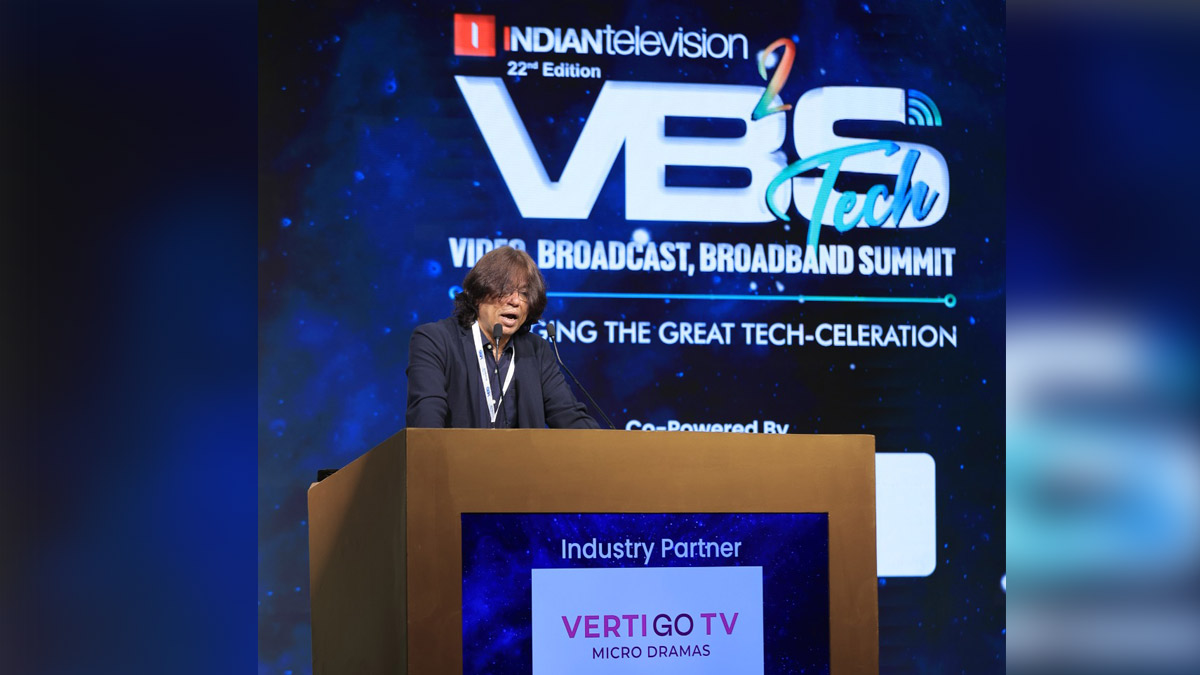
MUMBAI: While the audience settled into their seats, Anil Wanvari asked them to look up. Somewhere above the Indian Ocean, he began, a satellite the size of a dining table was racing across the sky at 28,000 kilometres per hour, completing an orbit of Earth before breakfast and another before lunch. It was not alone. There are more than 7,000 active satellites currently in low Earth orbit, up from fewer than 2,000 just five years ago. Within the next decade, that number could exceed 100,000.
With that image, Wanvari, founder and editor in chief of Indian Television Dot Com, opened the 22nd Edition of the Video Broadcast and Broadband Tech Summit 2026, framing this year’s theme Managing the Great Tech celeration as a lived disruption rather than a conference slogan.
Low Earth orbit satellites operate between 300 and 1,200 kilometres above the planet. By contrast, geostationary satellites that have carried broadcast signals for decades sit at 36,000 kilometres. The result is a stark difference in latency. Traditional GEO systems can introduce round trip delays of 600 milliseconds or more. LEO constellations can reduce that to as little as 20 milliseconds.
“That is the difference between watching a live event and being present at it,” Wanvari said.
For him, however, the LEO story is less about milliseconds and more about millions. Rural farmers in Rajasthan, fisherwomen off the Kerala coast and children in tribal schools in Chhattisgarh were invoked as examples of communities long stranded beyond the “last mile” of fibre. The sky, he argued, is now becoming their gateway.
India has the second largest internet user base in the world and has yet to cross 50 percent penetration. Every percentage point of new connectivity represents tens of millions of new users. The digital divide that once capped growth in media and entertainment is now being dismantled “batch launch by batch launch”.
The pressing question, Wanvari suggested, is not whether these audiences will come online. It is whether the industry is prepared to serve them meaningfully when they do.
If satellites are redrawing distribution maps, artificial intelligence is redrawing the production floor.
Wanvari described AI systems in Hyderabad studios that can log every shot of unedited footage, grade each frame, suggest cuts and assemble a rough edit in the time it takes a director to drink her morning coffee. Tasks that once required a team of 12 editors working for three weeks can now be executed in hours.
Production teams of 20, equipped with AI tools, can now deliver what previously demanded crews of 200. In newsrooms, AI can monitor 10,000 data sources simultaneously, identify breaking patterns in seconds and generate first drafts within minutes, localised across multiple languages.
Deepfake detection is being embedded directly into broadcast workflows, turning the same technology that threatens trust into a defensive shield for it. “Trust,” Wanvari noted, “is the most precious and fragile asset any media organisation possesses.”
Virtual production was another focal point. AI driven environments can render a 1947 Mumbai street, a Himalayan glacier at sunrise or a cricket stadium packed with 100,000 virtual fans in real time on LED volume stages, reducing dependence on physical locations, permits and weather conditions. Post production from colour grading and sound design to dubbing and accessibility features is being re engineered around automation.
The cost of high quality content creation, he argued, is “falling off a cliff” and will not return to its previous baseline.
Wanvari then shifted attention from orbit and studios to living rooms.
Next generation connected televisions, he said, are no longer passive display panels. They run AI inference locally, tracking not just what viewers choose, but whether they actually watch it, when attention drifts and what brings it back. Attention sensing technologies can detect engagement patterns and adapt recommendations accordingly.
For a generation that has never known rigid schedules, the traditional broadcast grid has dissolved into an infinite, personalised stream of content. Yet communal experiences endure.
Live sport, elections, breaking news and award nights remain gathering points. Wanvari painted a near future in which a Test match is accompanied by real time AI overlays showing ball trajectory, predicted swing and bowler fatigue indices. Viewers could switch between 17 camera angles mid over, point their phones at screens to see augmented statistics floating above players and join live watch parties across four cities, with reactions displayed as emotional heatmaps.
Every element of this ecosystem exists today in some form. The convergence, he suggested, will occur within the next three years.
Beyond satellites and AI, Wanvari highlighted a quieter shift: broadband as ambient infrastructure.
Public hotspots, community WiFi networks, 5G small cells mounted on lampposts and LEO terminals on school rooftops are weaving connectivity into everyday life. When broadband becomes as constant as air, consumption patterns change.
The Mumbai local train becomes a theatre. The auto rickshaw becomes a radio studio. The village tea stall becomes a live cricket viewing hub.
Short form and mid form content, spanning five to 25 minutes, are no longer secondary formats but primary design responses to fragmented, mobile and always connected lifestyles.
With internet penetration still below 50 percent, Wanvari described the “broadband everywhere” narrative as the single largest growth opportunity the industry has ever encountered.
For all the technological awe, the address returned repeatedly to responsibility.
Algorithms do not possess values, he argued. Humans do. Every recommendation engine reflects editorial choices. Every AI generated output is shaped by the data and priorities embedded within it.
Managing the great tech celeration, in Wanvari’s framing, is not about managing machines. It is about managing ambition, ethics and accountability.
He closed with a question that lingered long after the applause: when a child in a previously unconnected village goes online for the first time, what will they find?
The satellite may be moving at 28,000 kilometres per hour. AI may be editing in milliseconds. Connected TVs may be learning in real time. But the industry’s ultimate metric, Wanvari suggested, remains stubbornly human: whether the stories waiting on the other end of that first connection are worthy of the moment.